1. 서론: 지상 인프라의 압박과 바다로 향하는 AI 데이터센터
생성형 AI 확산으로 데이터센터 전력 확보는 글로벌 기술 기업들의 가장 중요한 인프라 과제 중 하나가 됐다. 지상 데이터센터는 토지 확보, 전력망 연결, 인허가, 냉각 전력, 지역 사회 수용성이라는 여러 제약을 동시에 안고 있다. 이런 상황에서 한국의 네이버(NAVER)가 해상 부유식 AI 데이터센터 스타트업 '판탈라사(Panthalassa)'에 투자했다는 소식은 단순한 스타트업 투자를 넘어, AI 인프라의 공간이 육지에서 바다로 확장될 수 있는지를 묻는 신호처럼 보인다.
판탈라사는 파력(Wave Energy)을 활용해 전력을 만들고, 해수 냉각을 적용하며, 저궤도 위성망을 통해 연산 결과를 육지로 전송하는 해상 노드형 AI 데이터센터를 개발 중인 기업이다. 오늘 이데아(IDEA)는 이 기술의 구조와 네이버의 전략적 의미, 그리고 상용화 단계에서 확인해야 할 리스크를 I(Issue) - D(Detail) - E(Evaluation) - A(Action) 프레임워크로 분석한다.
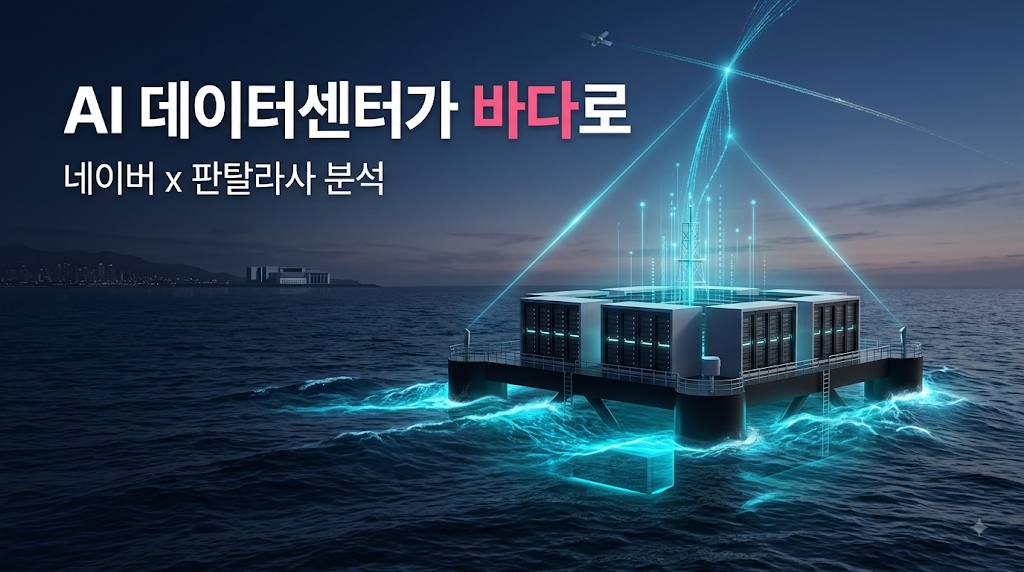
2. [ I ] Issue : 지상 데이터센터의 병목과 해상 인프라의 등장
세계 데이터센터 평균 PUE는 최근 조사에서도 1.5 안팎으로 나타나며, 최고 효율의 하이퍼스케일 데이터센터와는 격차가 남아 있다. AI 연산 수요가 커질수록 전력망 연결, 냉각, 입지 확보는 데이터센터 확장의 핵심 병목으로 부각된다.
AI 데이터센터는 대규모 전력과 안정적인 냉각 인프라가 필요하다. 그러나 육상에서는 부지 확보, 인허가, 지역 수용성, 전력망 증설 시간이 확장의 속도를 늦추는 요인이 된다.
서버 냉각은 데이터센터 전력 효율을 좌우하는 핵심 요소다. 고효율 설비를 갖춘 일부 하이퍼스케일 데이터센터는 낮은 PUE를 보이지만, 업계 평균에서는 여전히 냉각·전력 배분 오버헤드가 남아 있다.
파력 발전과 AI 연산, 해수 냉각을 하나의 부유식 노드에 결합하려는 방식은 육상 전력망과 부지 확보 부담을 줄이는 새로운 인프라 모델로 주목받고 있다.
3. [ D ] Detail : 판탈라사의 구조와 네이버의 투자 포석
1) 해양 데이터센터의 선행 실험: 나틱(Natick)에서 얻은 교훈
- 프로젝트 나틱의 의미: 마이크로소프트의 수중 데이터센터 실험은 서버 신뢰성 측면에서 의미 있는 결과를 냈다. Microsoft Research는 Natick Northern Isles 서버의 고장률이 육상 대조군의 1/8 수준이었다고 밝혔다.
- 다만 상업화는 별개의 문제: Project Natick은 연구 프로젝트로서 의미가 있었지만, 현재 Microsoft가 활성화된 수중 데이터센터를 운영하고 있는 것은 아니다. 따라서 이를 “상업적 실패”로 단정하기보다, 연구 성과가 대규모 상업 서비스로 바로 확장됐다고 보기는 어렵다고 정리하는 편이 안전하다.
2) 판탈라사의 차별점: 파력 발전과 AI 연산을 한 노드에 묶다
- 부유식 노드 구조: 판탈라사는 바다 위 부유식 노드 플랫폼 안에 파력 발전, AI 연산, 서버 냉각 기능을 통합하는 구조를 개발 중이다.
- 해수 냉각과 위성 전송: 보도에 따르면 판탈라사의 노드는 바닷물을 활용해 서버를 냉각하고, 연산 결과를 저궤도(LEO) 위성망, 예컨대 Starlink 같은 네트워크를 통해 육지로 전송하는 방식을 사용한다.
- Ocean-3 실증 계획: 판탈라사는 Ocean-1과 Ocean-2 플랫폼을 통해 해상 실증을 진행했고, Ocean-3 실증 배치를 올해 추진하며 2027년 상용화를 목표로 하고 있다.
- 세부 형상은 자료별 구분 필요: 일부 기술 분석 자료는 Ocean-3를 약 85미터 규모의 롤리팝형 부유식 구조로 설명한다. 다만 주요 국내 보도에서는 주로 “부유식 노드 플랫폼”과 “해상 AI 데이터센터”라는 구조적 특징에 초점을 맞추고 있다.
3) 네이버의 투자 전략: 차세대 AI 인프라 옵션 확보
네이버가 판탈라사에 투자한 배경은 AI 데이터센터 사업 확장과 차별화된 인프라 확보라는 관점에서 볼 수 있다. 네이버 측은 글로벌 파트너십을 통해 차별화된 데이터센터 인프라를 빠르게 확보하고 있으며, 파력 기반 재생에너지 AI 데이터센터 같은 차세대 기술에 선제적으로 투자하겠다는 취지를 밝혔다.
이데아 관점에서 보면 이 투자는 세 가지 의미를 가진다. 첫째, 지상 데이터센터 확장의 시간·공간 제약을 줄일 수 있는 대안 기술을 조기에 관찰하는 것이다. 둘째, 국가별 AI 인프라 수요에 대응할 수 있는 분산형 인프라 옵션을 확보하는 것이다. 셋째, 연료를 직접 태우지 않는 파력 기반 재생에너지를 활용해 장기적인 탄소 감축 전략과 연결할 수 있다는 점이다. 다만 이것을 곧바로 RE100 조기 달성이나 소버린 AI 수출의 확정된 수단으로 단정하기는 어렵다.
4. [ E ] Evaluation : 기술 가능성과 상용화 과제
아래 리스크는 현재 보도에서 확정된 장애물이라기보다, 해상 AI 인프라가 상용화 단계로 갈 경우 검토해야 할 이데아의 분석 과제다. 판탈라사의 모델은 흥미롭지만, 바다는 데이터센터에 우호적인 공간이면서 동시에 혹독한 환경이기도 하다.
| 평가 영역 | 핵심 리스크 및 검토 과제 |
|---|---|
| 해양 환경 내구성 | 허리케인, 염분, 파도, 장기간의 진동과 움직임을 견뎌야 한다. 일부 보도는 해양 환경이 플랫폼에 미치는 영향과 장기간 생존성이 주요 검증 과제라고 지적한다. |
| 위성 데이터 전송 한계 | 연산 결과를 위성으로 전송하는 구조는 송전 문제를 데이터 전송 문제로 바꾸는 장점이 있다. 다만 처리해야 할 데이터 양이 큰 워크로드에서는 위성 전송 용량과 지연 시간이 실질적인 제약이 될 수 있다. |
| 국제법·인허가·해양 공간 활용 | EEZ, 항행 안전, 해양 공간 계획, 연안국 인허가 같은 문제는 대규모 상용 배치 단계에서 검토해야 할 가능성이 크다. 현재 보도에서 구체적인 법적 장애물이 확정된 것은 아니지만, 해상 인프라가 커질수록 피하기 어려운 검토 영역이다. |
| 환경영향과 ESG 검증 | 대규모 노드 군집이 해양 생태계에 미칠 수 있는 누적 효과, 수중 소음, 열 방출, 장비 회수와 재활용 문제는 장기 실증과 투명한 모니터링이 필요한 영역이다. |
5. [ A ] Action : 해상 AI 인프라 시대를 위한 제언
완전 자립형 해상 인프라를 검증하기 위한 Action Plan
- 실증 데이터의 투명한 공개: Ocean-3 실증에서는 발전량, 가동률, 냉각 효율, 위성 전송 안정성, 유지보수 비용을 가능한 범위에서 투명하게 공개해야 한다. 해상 데이터센터가 육상 대안이 되려면 기술적 상상력보다 운전 데이터가 먼저 필요하다.
- 워크로드의 현실적 분류: 모든 AI 연산이 해상 노드에 적합한 것은 아니다. 대규모 학습보다 추론, 엣지성 연산, 비동기 처리, 결과 데이터가 상대적으로 작은 워크로드부터 적용 가능성을 검증하는 것이 현실적이다.
- 인허가와 환경 모니터링 프레임 구축: 연안국, 해양 규제기관, 환경 전문가와 함께 해상 데이터센터 전용 인허가·안전·환경 모니터링 기준을 조기에 설계해야 한다. 특히 대규모 배치 전에는 해양 생태계 영향 데이터를 축적하는 과정이 필요하다.
6. 최종 결론: 클라우드(Cloud)에서 오션(Ocean)으로
네이버의 판탈라사 투자는 인공지능 시대의 물리적 인프라 한계를 정면으로 바라보는 흥미로운 선택이다. 이것은 단순히 “바다 위에 데이터센터를 띄운다”는 이야기가 아니다. 전력을 육지로 가져오지 않고, 전력이 만들어지는 곳으로 연산을 보내겠다는 발상의 전환이다.
다만 이 모델이 곧바로 대형 지상 데이터센터를 대체한다고 보기는 어렵다. 파력 발전량, 위성 전송 능력, 해양 환경 내구성, 유지보수 비용, 인허가와 환경영향평가가 모두 검증되어야 한다. 특히 일부 기술 분석 자료가 설명하는 1MW급 노드 규모는 의미 있는 실험이지만, 대형 AI 학습 데이터센터와 직접 비교하기에는 아직 규모 차이가 크다.
그럼에도 판탈라사의 방향성은 분명 주목할 만하다. 과거 수중 데이터센터 실험이 서버 신뢰성과 냉각 가능성을 보여줬다면, 판탈라사는 그 질문을 한 단계 더 밀어붙여 “전력 생산, 냉각, AI 연산, 통신을 모두 해상 노드 안에 넣을 수 있는가”를 시험하고 있다. 클라우드가 더 이상 추상적인 인터넷 공간이 아니라, 전력·냉각·토지·규제의 물리적 제약 위에 놓여 있다는 사실을 생각하면, 오션 인프라는 AI 시대의 새로운 선택지 중 하나로 남을 가능성이 있다.
7. 참고 자료
- The Korea Times, Naver invests in U.S. startup developing wave-powered AI data centers: 네이버의 판탈라사 투자, 투자 목적, 투자 금액 비공개, Ocean-3 실증 및 2027년 상용화 목표 참고.
- Yonhap News Agency / Yonhap Infomax, Naver Invests in US Offshore AI Data Center Startup Panthalassa: 판탈라사 설립 연도, 파력 발전·AI 연산·해수 냉각 통합 노드, LEO 위성 전송, 1억4000만 달러 투자 유치 참고.
- Aju Press, Naver invests in wave-powered ocean data center startup Panthalassa: 네이버의 AI 인프라 확장 맥락, GAK 세종 AI 팩토리, Ocean-1·Ocean-2 실증과 Ocean-3 실증 계획 참고.
- ChosunBiz, 네이버, 바다 위 AI 데이터센터에 베팅: 네이버의 투자 배경, 파력 기반 해상 AI 데이터센터 구조, Ocean-3 실증 및 2027년 상용화 목표 참고.
- Data Center Dynamics, Panthalassa unveils wave-powered floating data center platform: Ocean-3 플랫폼, 무앵커·무케이블 구조, 위성 전송, 해양 환경 리스크와 위성 데이터 전송 제약 참고.
- Microsoft Research, Project Natick: 수중 데이터센터 실험, 서버 고장률 1/8, 해저 데이터센터 연구 결과 참고.
- Google Data Centers / Uptime Institute, Power Usage Effectiveness: 2025년 세계 데이터센터 평균 PUE 1.54 및 고효율 하이퍼스케일 데이터센터 PUE 비교 참고.
1. Introduction: AI Infrastructure Pressure and the Move Toward the Ocean
As generative AI expands, securing power for data centers has become one of the most important infrastructure challenges for global technology companies. Land-based data centers face limits around land availability, grid connection, permitting, cooling power, and local acceptance. In that context, NAVER's investment in Panthalassa, a startup developing floating offshore AI data centers, looks like more than a simple startup investment. It raises the question of whether AI infrastructure can expand from land into the ocean.
Panthalassa is developing offshore node-style AI data centers that use wave energy, seawater cooling, and low-Earth-orbit satellite links to transmit computation results back to land. Today, IDEA analyzes the structure of this technology, its strategic meaning for NAVER, and the risks that must be verified before commercialization using the I (Issue) - D (Detail) - E (Evaluation) - A (Action) framework.
2. [ I ] Issue: Land-Based Bottlenecks and the Rise of Offshore Infrastructure
The global average PUE for data centers remains around the mid-1.5 range in recent surveys, leaving a gap between the industry average and the most efficient hyperscale operators. As AI compute demand increases, grid access, cooling, and land availability become major bottlenecks for expansion.
AI data centers require large amounts of power and stable cooling infrastructure. On land, site acquisition, permitting, local acceptance, and grid expansion timelines can slow deployment.
Cooling is a key factor in data center efficiency. While some hyperscale facilities achieve very low PUE, the broader industry average still reflects cooling and power-distribution overhead.
Combining wave power, AI computing, and seawater cooling in a floating node could become a new infrastructure model that reduces dependence on land and grid expansion.
3. [ D ] Detail: Panthalassa's Structure and NAVER's Strategic Position
1) Earlier Offshore Data Center Lessons: Project Natick
- The significance of Project Natick: Microsoft's subsea data center experiment produced meaningful reliability results. Microsoft Research reported that the Natick Northern Isles servers had a failure rate one-eighth that of a land-based control group.
- Commercialization is a separate issue: Project Natick was meaningful as a research project, but Microsoft is not currently operating active underwater data centers. It is safer to say that the research results did not directly translate into broad commercial deployment, rather than calling it a commercial failure.
2) Panthalassa's Differentiation: Power and Compute in One Offshore Node
- Floating node structure: Panthalassa is developing a floating offshore node platform that integrates wave-power generation, AI computing, and server cooling.
- Seawater cooling and satellite transmission: Reports describe Panthalassa's nodes as using seawater for cooling and low-Earth-orbit satellite networks, such as Starlink, to transmit computation results back to land.
- Ocean-3 pilot plan: Panthalassa has tested Ocean-1 and Ocean-2 platforms, and plans to deploy Ocean-3 this year with a commercialization target for 2027.
- Technical-form details require source separation: Some technical-analysis sources describe Ocean-3 as an approximately 85-meter lollipop-shaped floating structure. Major Korean reports, however, focus mainly on the broader floating-node and offshore AI data center structure.
3) NAVER's Strategy: Securing Next-Generation AI Infrastructure Options
NAVER's investment can be read in the context of AI data center expansion and differentiated infrastructure. NAVER said it is rapidly securing differentiated data center infrastructure through global partnerships and will invest preemptively in next-generation technologies such as wave-powered renewable-energy AI data centers.
From IDEA's perspective, this has three meanings. First, NAVER is observing an alternative technology that could reduce the time and space constraints of land-based data center expansion. Second, it is securing a distributed infrastructure option that could respond to country-level AI infrastructure demand. Third, wave-based renewable energy that does not directly burn fuel could connect with longer-term carbon-reduction strategies. However, it is too early to treat this as a confirmed path to early RE100 achievement or direct sovereign-AI export.
4. [ E ] Evaluation: Technical Potential and Commercialization Tasks
The risks below are IDEA's analytical checklist for possible commercialization, not confirmed barriers stated in current reports. Panthalassa's model is compelling, but the ocean is both an attractive and harsh environment for infrastructure.
| Evaluation Area | Key Risks and Review Tasks |
|---|---|
| Marine Durability | The platform must withstand hurricanes, salt spray, waves, and long-term vibration and motion. Some reports point to long-term survival in harsh ocean environments as a major verification task. |
| Satellite Data Transfer Limits | Using satellites turns a power-transmission problem into a data-transmission problem. That can be elegant, but workloads with large data-transfer needs may face bandwidth and latency limits. |
| Law, Permitting, and Maritime Space | Issues such as EEZ rules, navigation safety, maritime spatial planning, and coastal-state permitting may need review at large-scale deployment. Current reports do not confirm specific legal barriers, but these are likely review areas as offshore infrastructure scales. |
| Environmental Impact and ESG Verification | Large fleets of nodes may require long-term monitoring of cumulative ecological effects, underwater noise, heat release, equipment recovery, and recycling. |
5. [ A ] Action: Recommendations for an Offshore AI Infrastructure Era
Action Plan for Verifying Autonomous Offshore AI Infrastructure
- Transparent pilot data: Ocean-3 pilots should disclose power output, uptime, cooling efficiency, satellite-link stability, and maintenance costs where possible. Offshore data centers need operational data before they can be treated as a serious land-based alternative.
- Realistic workload classification: Not every AI workload will fit offshore nodes. Inference, edge-like computing, asynchronous processing, and workloads with smaller result-data volumes may be more realistic starting points than massive training workloads.
- Permitting and environmental monitoring framework: Coastal states, maritime regulators, and environmental experts should help design permitting, safety, and ecological monitoring standards early. Before large-scale deployment, marine-impact data needs to accumulate.
6. Final Conclusion: From Cloud to Ocean
NAVER's investment in Panthalassa is an interesting move that directly addresses the physical infrastructure limits of the AI era. This is not simply about placing data centers at sea. It is about changing the direction of infrastructure design: instead of bringing offshore energy back to land, send compute to where the energy is produced.
Still, this model should not be seen as an immediate replacement for large land-based data centers. Wave-power output, satellite transmission capacity, marine durability, maintenance costs, permitting, and environmental impact all need verification. In particular, some technical analyses describe a 1MW-class node as meaningful, but still much smaller than large AI training data centers.
Even so, Panthalassa's direction is worth watching. If earlier subsea data center experiments showed server reliability and cooling possibilities, Panthalassa pushes the question further: can power generation, cooling, AI compute, and communication all be integrated into a single offshore node? If cloud infrastructure is ultimately built on physical constraints such as power, cooling, land, and regulation, ocean infrastructure may remain one of the more intriguing options for the AI era.
7. Sources and References
- The Korea Times, Naver invests in U.S. startup developing wave-powered AI data centers: NAVER's investment, undisclosed investment amount, Ocean-3 pilot and 2027 commercialization target.
- Yonhap News Agency / Yonhap Infomax, Naver Invests in US Offshore AI Data Center Startup Panthalassa: Panthalassa's founding year, wave power, AI compute, seawater cooling, LEO satellite transmission, and $140 million funding round.
- Aju Press, Naver invests in wave-powered ocean data center startup Panthalassa: NAVER's AI infrastructure context, GAK Sejong AI factory, Ocean-1 and Ocean-2 trials, and Ocean-3 plan.
- ChosunBiz, NAVER backs U.S. Panthalassa to build wave-powered offshore AI data centers: investment background, offshore AI data center structure, Ocean-3 plan and 2027 commercialization target.
- Data Center Dynamics, Panthalassa unveils wave-powered floating data center platform: Ocean-3 platform, no-anchor and no-cable structure, satellite transmission, ocean-environment risks and satellite-transfer constraints.
- Microsoft Research, Project Natick: subsea data center experiment, one-eighth server failure rate, and subsea data center research results.
- Google Data Centers / Uptime Institute, Power Usage Effectiveness: 2025 global data center average PUE of 1.54 and hyperscale efficiency comparison.
[이데아 심층 분석] 무대 중앙으로 향하는 팬덤: K컬처 메가 프로젝트 '패노메논(FANOMENON)' 해부 / [
1. 서론: 조력자에서 주인공으로, K컬처의 새 실험 '패노메논'그동안 팬덤은 음원 스트리밍, 앨범 구매, 굿즈 소비를 통해 K팝 산업을 움직이는 거대한 심장이었으나, 정작 공식적인 무대의 주인
www.ideas6926.cloud
[이데아 심층 분석] 사드(THAAD)를 넘어서는 파괴력: 美 타이폰 미사일 역내 전개와 한국의 지정학
1. 서론: 제1도련선의 창(槍), 그리고 한반도의 위기바야흐로 동북아시아 신냉전의 거대한 체스판이 흔들리고 있다.미국이 중단거리미사일폐기조약(INF) 파기 이후 신속하게 개발한 지상 발사형
www.ideas6926.cloud


