1. 서론: 무디스의 3.5%, 반가웠지만 마음이 마냥 가볍지는 않았다
8월 18일, 무디스(Moody's)가 한국의 2026년 경제성장률 전망치를 2.5%에서 3.5%로 올렸다는 소식을 봤다. 처음 숫자를 봤을 때는 꽤 강한 인상을 받았다. 올해 초만 해도 1.8%를 이야기하던 기관이 2.5%를 거쳐 3.5%까지 올렸다면, 적어도 한국 반도체가 지금 글로벌 AI 투자 흐름에서 얼마나 중요한 위치에 있는지는 분명해진 셈이다.
그런데 이 숫자를 보고 바로 안심이 되지는 않았다. 반도체 수출과 대기업 실적은 뜨겁지만, 시장과 생활에서 느끼는 온도는 그만큼 고르지 않다. 원/달러 환율은 여전히 1,400원대 초중반에 머물고 있고, 내수 회복은 수출 숫자만큼 시원하게 체감되지 않는다. 오늘 이데아(IDEA)는 무디스가 왜 이렇게 강하게 한국을 봤는지, 그리고 그 좋은 숫자 뒤에 남아 있는 수출 호황과 내수 체감의 간격을 차분하게 짚어보려 한다.
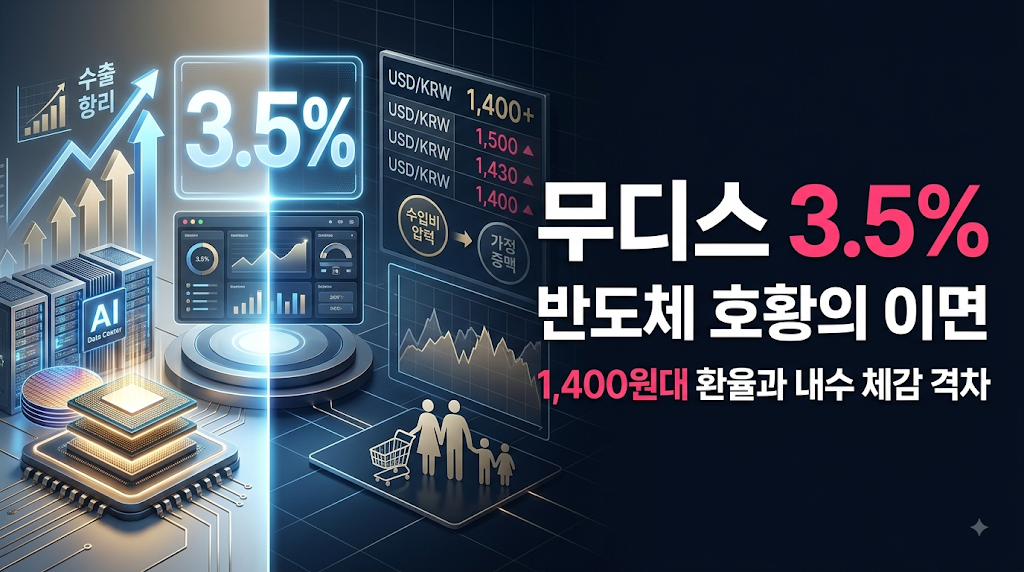
2. [ I ] Issue : 3.5%라는 숫자가 던진 진짜 질문
무디스의 3.5% 전망은 한국은행, IMF, KDI의 전망보다 높다. 그래서 이 숫자는 단순한 전망치 하나가 아니라, 지금 한국 경제를 어떤 눈으로 볼 것인지에 대한 질문처럼 느껴진다. 한국 경제가 좋아졌다는 말만으로는 부족하다. 무엇이 좋아졌고, 그 좋아진 흐름이 어디까지 퍼지고 있는지를 따로 봐야 한다.
무디스는 고성능 메모리 수요가 계속되고, 한국의 선도 메모리 업체를 대신할 현실적인 공급자가 많지 않다는 점을 봤다. 이 때문에 반도체 업황이 2027년 중반까지 강할 수 있다고 판단했다.
반도체, AI 데이터센터, Physical AI를 중심으로 한 정부의 대형 프로젝트는 단순한 산업 지원책이 아니다. 무디스는 이 흐름이 제대로 실행된다면 생산성과 잠재성장률을 높일 수 있다고 봤다.
수출이 강하고 성장률이 올라가면 세수 여건도 나아질 수 있다. 무디스는 2026년 GDP 대비 재정적자 비율을 기존 목표보다 0.1%포인트 낮은 3.8%로 전망했다.
3. [ D ] Detail : 좋은 숫자 안에 들어 있는 서로 다른 온도
1) 수출은 분명히 강하다
무디스의 낙관론은 그냥 나온 말이 아니다. 관련 보도에 따르면 한국의 2026년 1~7월 상품 수출은 전년 동기 대비 51% 늘었고, 그 중심에는 반도체가 있었다. KDI도 반도체 가격 상승과 수출 물량 증가가 교역조건을 개선시키면서 경상수지 흑자가 이례적으로 커질 수 있다고 봤다. 관련 보도에서는 KDI의 2026년 경상수지 흑자 전망이 기존 1,488억 달러에서 2,390억 달러로 올라갔다고 전했다. 1분기 GDP가 전년 동기 대비 3.6%, 전기 대비 1.7% 성장한 것도 결국 이 수출 힘을 보여주는 대목이다.
2) 기관마다 보는 눈은 여전히 다르다
- 무디스 3.5%: 2월 1.8%, 5월 2.5%를 거쳐 3.5%까지 올라왔다. 핵심은 반도체 슈퍼사이클과 AI 인프라 투자, 그리고 한국 고성능 메모리의 대체 어려움이다.
- 주요 글로벌 IB 평균 3.2%: 관련 보도는 8개 주요 투자은행 평균 전망치를 3.2%로 전했다. 일부 민간기관은 4%대 전망도 냈지만, 각 기관의 전제는 조금씩 다르다.
- 한국은행과 IMF 2.6%: 한국은행은 2026년 성장률 전망을 2.6%로 높였고, 소비자물가 상승률 전망도 2.7%로 올렸다. IMF 역시 2026년 한국 성장률을 2.6%로 제시했다.
- KDI 2.5%: KDI는 반도체 수출 호조와 내수 개선을 인정하면서도, 중동 전쟁과 유가 상승, 건설투자 회복 지연 같은 하방 위험을 함께 봤다. 나는 이 지점이 꽤 중요하다고 본다. 수출은 뜨겁지만, 모든 부문이 같은 속도로 회복되는 것은 아니기 때문이다.
3) 무디스의 경고도 그냥 지나치기 어렵다
무디스는 성장률을 올려 잡으면서도 장기 재정 부담을 함께 언급했다. 고령화로 늘어나는 의무지출, 국방·안보 비용, 수출 경쟁력을 유지하기 위한 투자 비용은 성장률이 높아졌다고 사라지는 문제가 아니다. 오히려 지금처럼 반도체 호황이 왔을 때 재정과 산업 구조를 손봐야 한다는 뜻으로 읽힌다. 좋은 때일수록 해야 할 일을 미루면, 다음 둔화 국면에서 선택지가 줄어든다.
4. [ E ] Evaluation : 코스피는 웃다가 멈췄고, 환율은 쉽게 내려오지 않았다
무디스의 성장률 상향이 확인된 8월 18일, 한국 금융시장은 꽤 솔직한 반응을 보였다. 반도체 기대감은 분명 강했지만, 시장은 그 기대만 보고 끝까지 달리지는 않았다. 단기 급등 이후의 차익실현, 미국 국채금리 상승, 중동 리스크가 한꺼번에 들어오면서 분위기가 달라졌다.
| 시장 반응 (8/18 기준) | 현상 및 지표 흐름 | 이데아(IDEA)의 실질 평가 |
|---|---|---|
| 주식 시장 (코스피) | AI 반도체 기대감에 7,127.77로 출발했고 장중 7,216.62까지 올랐다. 하지만 오후로 갈수록 힘이 빠졌고, 결국 6,869.83으로 1.55% 하락 마감했다. | 처음에는 반도체 기대가 시장을 끌어올렸지만, 끝까지 버티지는 못했다. 장 초반 외국인 매수세가 있었음에도 기관 매도와 차익실현이 더 크게 작용했다. |
| 수급 구조 | 외국인은 장 초반 5,000억 원 이상 순매수했지만 최종 순매수는 555억 원 수준으로 줄었다. 기관은 약 1조1,928억 원 순매도했고, 개인은 약 1조1,978억 원 순매수했다. | 이날 시장은 외국인과 기관이 함께 환호한 장이라기보다는, 기관이 이익을 챙기고 개인이 그 물량을 받아낸 장에 가까웠다. 숫자는 좋아졌지만, 수급은 아직 조심스럽다. |
| 외환 시장 (원/달러) | 일부 실시간 환율 제공처는 8월 18일 원/달러 환율을 1,414~1,415원대로 표시했다. 다만 Yahoo Finance 일별 데이터는 8월 18일 종가를 1,411.87원으로 표시해 제공처별 차이가 있다. | 경상수지 흑자가 커질 수 있다는 전망만으로 환율이 바로 내려오지는 않았다. 미국 금리, 달러 흐름, 지정학적 위험, 해외투자 관련 달러 수요가 함께 얽혀 있기 때문이다. |
교과서처럼만 보면 경상수지 흑자가 커질수록 원화 강세 압력이 커지는 것이 자연스럽다. 하지만 실제 시장은 그렇게 단순하게 움직이지 않는다. 금리 차, 달러 선호, 지정학적 위험, 해외투자 수요, 주식시장 수급이 동시에 작동한다. 그래서 지금 한국 경제를 볼 때 중요한 문장은 이것에 가깝다. 수출은 뜨겁지만, 그 온기가 내수와 가계까지 고르게 내려오지는 않았다.
5. [ A ] Action : 수출 호황을 내수 체력으로 바꾸려면
수출 호황을 오래 가는 체력으로 바꾸기 위한 Action Plan
- 수출 호황의 연결 통로를 다시 만들어야 한다: 3.5% 성장 전망은 반도체가 강하게 끌어올린 숫자다. 이 숫자가 진짜 경제 체력으로 남으려면 수출 대기업의 호황이 협력업체 투자, 국내 고용, 임금, 기술 인력 양성으로 이어져야 한다. 정부는 투자세액공제, 공급망 지원, 하도급 보호 장치를 숫자보다 실제 현장 흐름에 맞게 설계해야 한다.
- 1,400원대 환율이 주는 생활 부담을 봐야 한다: 높은 환율은 수출기업에는 도움이 될 수 있지만, 에너지와 원자재를 들여오는 기업과 가계에는 부담이 된다. 성장률 전망이 좋아졌다고 해서 자영업자와 중소기업의 체감이 바로 좋아지는 것은 아니다. 정부와 한국은행은 거시건전성을 지키는 선에서 비용 부담이 큰 업종에 대한 선별적 지원을 고민해야 한다.
- 호황기일수록 구조개혁을 미루면 안 된다: 고령화, 국방·안보 비용, 첨단산업 투자 부담은 계속 남아 있다. 세수가 좋아질 수 있는 시기라면 연금 개혁, 재정 준칙, 지역 균형형 첨단산업 투자, 인력 재교육을 같이 추진해야 한다. 3.5% 전망은 축배를 들라는 신호라기보다, 어려운 개혁을 시작할 시간을 벌었다는 신호에 가깝다.
6. 최종 결론: 3.5%는 승리 선언이 아니라, 아직 써야 할 시간이다
무디스의 3.5% 전망은 한국 반도체 산업의 힘을 다시 확인시켜 준다. AI 인프라 투자가 커질수록 고성능 메모리의 중요성은 더 커지고, 그 안에서 한국 기업의 자리는 쉽게 대체되기 어렵다. 반도체, AI 데이터센터, Physical AI를 중심으로 한 정책 방향이 잠재성장률을 높일 수 있다는 평가도 분명 긍정적이다.
하지만 숫자가 좋아졌다고 해서 경제 전체가 편해졌다고 말하기는 어렵다. 8월 18일 코스피가 장 초반 강세를 보이다가 하락 마감한 것처럼, 시장은 호재와 부담을 동시에 본다. 환율도 마찬가지다. 1,400원대 초중반의 원/달러 환율은 수출기업의 원화 환산 실적에는 도움이 될 수 있지만, 에너지와 원자재를 수입해 쓰는 기업과 가계에는 비용 부담으로 돌아온다.
그래서 오늘의 결론은 조금 조심스럽다. 한국 경제는 반도체라는 강한 엔진을 얻었지만, 그 엔진의 열이 내수와 중소기업, 가계의 체감 회복으로 충분히 전달되는지는 아직 더 확인해야 한다. 정부와 통화 당국은 반도체 호황이라는 순풍을 놓치지 않되, 수출과 내수를 잇는 통로를 다시 만들고 장기 재정 부담을 줄이는 개혁에 속도를 내야 한다. 3.5%라는 숫자는 한국 경제의 최종 승리 선언이 아니라, 구조개혁을 실행할 수 있는 드문 시간표에 가깝다.
출처 및 참고자료
- Moody’s 3.5% 성장률 상향, 반도체 사이클, 2027년 중반까지의 업황 전망, 재정적자 3.8% 전망, 장기 재정 부담 경고 관련 보도: Korea Herald, Pulse, Seoul Economic Daily, SBS, ChosunBiz 등.
- KDI 2026년 성장률 2.5%, 1분기 GDP 전년 대비 3.6%, 전기 대비 1.7%, 내수 회복과 하방 위험 관련 자료: KDI Economic Outlook 2026 1st Half.
- KDI 2026년 경상수지 전망 관련 보도: ChosunBiz English, KDI lifts South Korea growth outlook as chip exports surge.
- 한국은행 2026년 성장률 2.6%, 소비자물가 상승률 2.7% 전망: Bank of Korea Economic Outlook May 2026.
- IMF 2026년 한국 성장률 2.6% 전망: IMF Country Data 및 2026년 7월 세계경제전망 관련 보도.
- 8월 18일 코스피 장중 흐름, 7,127.77 출발, 7,216.62 고점, 6,869.83 하락 마감, 기관 매도, 차익실현, 미국 국채금리와 중동 리스크 관련 보도: ChosunBiz English 및 시장 데이터 제공처.
- USD/KRW 1,414~1,415원대 환율 흐름과 제공처별 차이: KRED, FXKRW, Wise, Yahoo Finance 등 환율 데이터 제공처.
- 본문의 문화산업·거시경제 해석과 시나리오는 공개 보도와 공식 자료를 바탕으로 정리한 IDEA의 분석적 관점이며, 특정 기관 전망에 대한 확정적 판단이 아니다.
1. Introduction: Moody's 3.5% Felt Encouraging, But Not Entirely Comfortable
On August 18, Moody's raised South Korea's 2026 growth forecast from 2.5% to 3.5%. The number stood out. An agency that had talked about 1.8% earlier this year moved to 2.5%, and then to 3.5%. That tells me one thing clearly: Korean semiconductors are sitting very close to the center of the global AI investment cycle.
Still, the number did not make me feel completely relaxed. Semiconductor exports and large-company earnings are strong, but the domestic economy does not feel equally warm. USD/KRW is still in the low-to-mid 1,400 won range, and the domestic recovery does not feel as clean as the export numbers suggest. Today, IDEA looks at why Moody's turned so positive, and what remains behind the headline number: the gap between export strength and domestic economic feel.
2. [ I ] Issue: The Real Question Behind the 3.5% Number
Moody's 3.5% forecast is higher than the forecasts from the Bank of Korea, the IMF and the KDI. So this is not just another forecast number. It asks a bigger question: what exactly has improved in Korea, and how far does that improvement spread?
Moody's focused on continued demand for high-performance memory and the limited number of realistic alternatives to Korean suppliers. That is why Moody's expects the semiconductor cycle to remain strong at least into mid-2027.
Government projects around semiconductors, AI data centers and Physical AI are not just industry slogans. Moody's viewed these efforts as a possible path toward higher productivity and stronger potential growth if they are executed well.
When exports are strong and growth improves, revenue conditions can also improve. Moody's projected Korea’s 2026 fiscal deficit at 3.8% of GDP, 0.1 percentage point better than the original target.
3. [ D ] Detail: Different Temperatures Inside the Good Numbers
1) Exports Are Clearly Strong
Moody's optimism did not come from nowhere. Related reports said Korea’s merchandise exports from January to July 2026 rose 51% from a year earlier, led by semiconductors. KDI also expected Korea to maintain an unusually large current account surplus as semiconductor prices and export volumes improved the terms of trade. A related report said KDI raised its 2026 current account surplus forecast from $148.8 billion to $239.0 billion. Q1 GDP growth of 3.6% year over year and 1.7% quarter over quarter also points to the strength of exports.
2) Institutions Still See Korea Differently
- Moody's 3.5%: The forecast moved from 1.8% in February to 2.5% in May and then to 3.5%. The main reasons are the semiconductor supercycle, AI infrastructure investment and Korea’s hard-to-replace position in high-performance memory.
- Major Global IB Average 3.2%: Reports said the average forecast from eight major investment banks stood at 3.2%. Some private institutions reportedly offered forecasts in the 4% range, but each forecast uses different assumptions.
- Bank of Korea and IMF 2.6%: The Bank of Korea projected 2026 growth at 2.6% and CPI inflation at 2.7%. The IMF also listed Korea’s 2026 growth forecast at 2.6%.
- KDI 2.5%: KDI recognized strong semiconductor exports and improving domestic demand, but also pointed to downside risks from the Middle East war, higher oil prices and delayed construction recovery. I think this point matters. Exports are hot, but not every part of the economy is recovering at the same speed.
3) Moody's Warning Is Worth Reading Twice
Moody's raised the growth forecast, but it also warned about longer-term fiscal pressure. Aging-related mandatory spending, defense and security costs, and investment needed to maintain export competitiveness will not disappear just because this year's growth looks better. If anything, a boom like this is the time to repair the structure before the next slowdown arrives.
4. [ E ] Evaluation: The KOSPI Smiled Early, Then Pulled Back
On August 18, when Moody's upgrade was reported, the Korean market reacted in a very honest way. Semiconductor optimism was clearly there. But the market did not run on that optimism alone. Profit-taking after a sharp rally, higher U.S. government bond yields and renewed Middle East risk all came into the picture.
| Market Reaction (Aug. 18) | Market Flow | IDEA's Practical Assessment |
|---|---|---|
| Stock Market (KOSPI) | The KOSPI opened at 7,127.77 on AI semiconductor optimism and rose as high as 7,216.62 intraday. But it lost strength later in the session and closed down 1.55% at 6,869.83. | Semiconductor optimism lifted the market early, but it was not enough to hold the gains. Early foreign buying was visible, but institutional selling and profit-taking mattered more by the close. |
| Investor Flow | Foreign investors bought more than 500 billion won early in the session, but final net buying narrowed to about 55.5 billion won. Institutions net sold about 1.1928 trillion won, while retail investors net bought about 1.1978 trillion won. | This was not a simple day of foreigners and institutions celebrating together. It looked closer to a session where institutions took profit and retail investors absorbed the supply. The numbers improved, but the flow still looked cautious. |
| FX Market (USD/KRW) | Some real-time providers showed USD/KRW in the 1,414 to 1,415 won range on August 18. Yahoo Finance daily data, however, showed the August 18 close at 1,411.87, so provider differences matter. | A larger current account surplus outlook did not immediately pull the exchange rate lower. U.S. rates, dollar trends, geopolitical risk and overseas-investment-related dollar demand are all part of the same equation. |
Textbook logic says a larger current account surplus should create pressure for won appreciation. Real markets are rarely that clean. Rate differentials, dollar preference, geopolitical risk, overseas investment demand and equity-market flows all matter. The sentence I keep coming back to is this: exports are hot, but that heat has not yet spread evenly into domestic demand and household income.
5. [ A ] Action: Turning Export Strength Into Domestic Strength
Action Plan to Turn the Export Boom Into Lasting Economic Strength
- Rebuild the channels from exports to the domestic economy: The 3.5% forecast is heavily lifted by semiconductors. For that number to become real economic strength, large exporters’ gains need to flow into supplier investment, domestic jobs, wages and technical workforce training. The government should design investment tax incentives, supply-chain support and subcontractor protections around actual field-level transmission, not just headline optimism.
- Watch the daily burden of the 1,400-won exchange rate: A high exchange rate can help exporters, but it also raises pressure on companies and households that import energy and raw materials. A better growth forecast does not automatically improve the daily reality for small businesses and the self-employed. The government and the Bank of Korea should consider selective support for sectors most exposed to cost pressure while keeping macroprudential stability intact.
- Do not postpone reform during a boom: Aging, defense and security costs, and advanced-industry investment needs are still there. If tax conditions improve, Korea should move faster on pension reform, fiscal rules, regionally balanced advanced-industry investment and workforce reskilling. The 3.5% forecast feels less like a victory lap and more like time gained for difficult reform.
6. Final Conclusion: 3.5% Is Not a Victory Declaration, It Is Time That Must Be Used
Moody's 3.5% forecast confirms the strength of Korea’s semiconductor industry. As AI infrastructure investment expands, high-performance memory becomes more important, and Korean suppliers are not easy to replace. The idea that policy efforts around semiconductors, AI data centers and Physical AI could lift potential growth is also clearly positive.
But a better number does not mean the whole economy has become comfortable. Just as the KOSPI rose sharply early on August 18 and then closed lower, markets look at both good news and burdens at the same time. The exchange rate tells a similar story. A low-to-mid 1,400 won USD/KRW rate can support exporters’ won-translated earnings, but it can also raise cost pressure for companies and households that import energy and raw materials.
So my conclusion is cautious. Korea now has a powerful semiconductor engine, but it still has to prove that this engine can transmit heat into domestic demand, small and midsize businesses and household income. The government and monetary authorities should not waste the semiconductor tailwind. They should rebuild the link between exports and domestic recovery and move faster on reforms that reduce long-term fiscal pressure. The 3.5% number is not the final victory declaration of the Korean economy. It is closer to a rare timetable for structural reform.
Sources and References
- Reports from Korea Herald, Pulse, Seoul Economic Daily, SBS and ChosunBiz on Moody's 3.5% growth upgrade, semiconductor cycle outlook through mid-2027, the 3.8% fiscal-deficit forecast and long-term fiscal warnings.
- KDI Economic Outlook 2026 1st Half for the 2.5% 2026 growth forecast, Q1 GDP growth of 3.6% year over year and 1.7% quarter over quarter, domestic-demand recovery and downside risks.
- ChosunBiz English report on KDI’s current account outlook, including the $239.0 billion 2026 surplus forecast.
- Bank of Korea Economic Outlook May 2026 for the 2.6% growth forecast and 2.7% CPI inflation forecast.
- IMF Country Data and reports on the July 2026 World Economic Outlook update for the IMF’s 2.6% Korea growth forecast.
- ChosunBiz English and market-data providers for the August 18 KOSPI flow: 7,127.77 open, 7,216.62 intraday high, 6,869.83 close, institutional selling, profit-taking, U.S. yield pressure and Middle East risk.
- KRED, FXKRW, Wise and Yahoo Finance for USD/KRW movement around the 1,414 to 1,415 won range and provider differences.
- The cultural-industry and macroeconomic interpretations in this article reflect IDEA’s analytical perspective based on public reports and official data, not a definitive judgment on any institution’s forecast.
[이데아 심층 분석] 유리천장을 깨는 거부: 그래미 '아시안 팝' 신설과 방탄소년단(BTS)의 권력 이
1. 서론: 대중음악 권력의 이동과 제도적 한계 노출지금 우리는 2026년 8월 17일 오전을 지나고 있다.서구 대중음악 산업의 가장 보수적인 상징 중 하나인 그래미 어워드(Grammy Awards)가 새로운 논쟁
www.ideas6926.cloud
[이데아 심층 분석] 러시아의 흑조, 나탈리야 구세바의 메이저 정복을 위한 3개년 최적화 로드맵
1. 서론: 골프 변방에서 온 흑조, 차세대 슈퍼스타의 등장지금 우리는 2026년 8월 16일의 아침을 맞이하고 있다.현대 여자 프로 골프는 생체역학, 통계, 심리학이 융합된 첨단 과학의 전쟁터다. 코
www.ideas6926.cloud


