1. 서론: 지구 온난화를 넘어선 ‘열대화’의 감각과 IDEA 프레임워크
2026년 여름의 폭염은 더 이상 “덥다”는 말로만 설명하기 어렵다. Copernicus는 2026년 5월 전 지구 평균 표면기온이 15.81℃였고, 1850~1900년 산업화 이전 평균보다 1.42℃ 높았다고 밝혔다. 파리협정의 1.5℃ 목표는 장기 평균 기준이기 때문에 한 달 수치만으로 목표가 붕괴됐다고 말할 수는 없지만, 월별 지표가 그 경계선 가까이 다가섰다는 사실만으로도 충분히 무겁다.
대한민국도 예외가 아니었다. 8월 1일 경남 양산은 41.6℃를 기록하며 1904년 이후 국내 근대 기상관측 사상 최고기온 기록을 하루 만에 다시 썼다. 국가 전력망은 최대전력수요 98.8GW 가능성에 대비해 107GW의 공급능력과 8.2GW의 예비력을 관리하겠다고 밝혔지만, 생활 현장에서는 노후 공동주택의 변압기와 수배전 설비가 더 큰 부담을 받고 있다. 오늘 이데아(IDEA)는 이 여름을 I(Issue) - D(Detail) - E(Evaluation) - A(Action) 프레임워크로 점검한다.
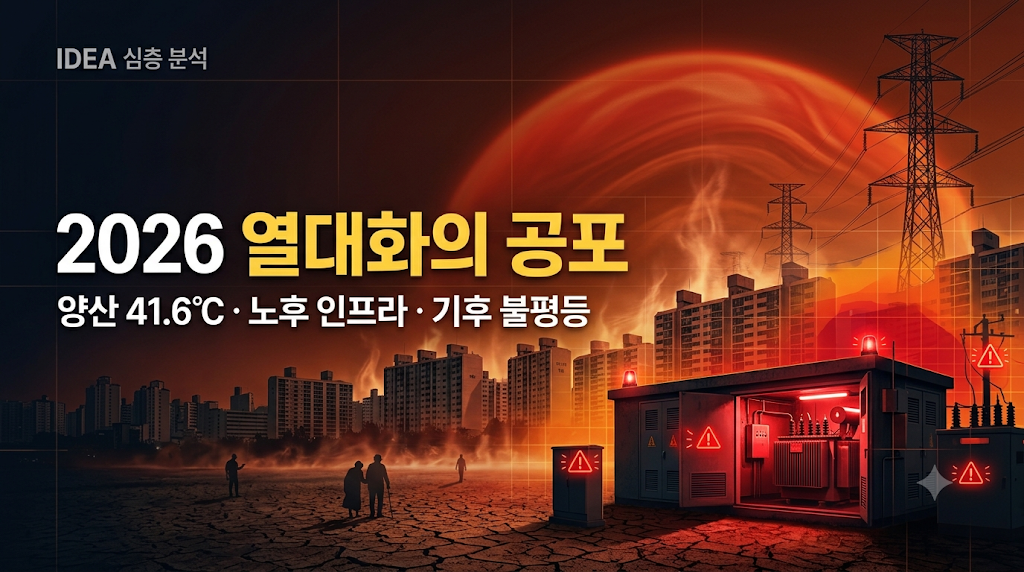
2. [ I ] Issue : 유럽의 1만 명대 초과 사망과 대한민국의 41.6℃
2026년 여름, 폭염은 여러 지역에서 동시에 사회 시스템의 약한 고리를 건드렸다. Reuters는 6월 22~28일 유럽 27개국 통계에서 초과 사망자가 10,650명으로 집계됐다고 보도했다. 이 수치는 열 관련 사망만 따로 뽑은 것이 아니라 모든 원인의 초과 사망을 합산한 것이지만, 보도는 해당 주간의 극심한 폭염이 사망 증가의 핵심 배경으로 지목됐다고 전했다.
한국에서는 남부지방을 중심으로 기온 기록이 빠르게 바뀌었다. 8월 1일 오후 2시 8분 경남 양산은 41.6℃까지 올랐고, 전날 같은 지역에서 기록된 41.4℃를 하루 만에 넘어섰다. 같은 날 부산 금정구 40.5℃, 경남 창원 40.4℃, 김해 40.2℃ 등 경남권 곳곳에서도 40℃대 기온이 확인됐다. 폭염은 일상뿐 아니라 야외 산업과 스포츠 일정까지 직접 흔들었다. KBO는 8월 1일 부산과 창원 경기를 폭염으로 취소했고, 창원 경기는 8월 2일에도 이틀 연속 취소됐다.
- 글로벌 기온 지표: Copernicus 기준 2026년 5월 전 지구 평균기온은 산업화 이전 대비 +1.42℃였다.
- 파리협정 관련 해석: WMO는 개별 연도의 1.5℃ 초과가 곧바로 파리협정 장기 목표 실패를 뜻하지는 않는다고 설명한다. 다만 2026~2030년 중 최소 1년이 1.5℃를 일시 초과할 가능성은 매우 높게 제시됐다.
- 유럽 폭염 피해: Reuters는 6월 22~28일 유럽 27개국에서 10,650명의 초과 사망자가 집계됐다고 보도했다.
- 대한민국 최고기온: 2026년 8월 1일 경남 양산 41.6℃. 1904년 이후 국내 근대 기상관측 사상 최고기온 기록을 하루 만에 경신했다.
- 농축수산 피해: 행정안전부 기준 5월 15일부터 7월 30일까지 폭염으로 폐사한 가축은 41만 9,014마리, 양식 어류 피해는 13만 1,295마리로 보도됐다.
3. [ D ] Detail : 1차 산업과 생활 전력 인프라가 동시에 받는 압박
기후 위기가 촉발한 체제적 스트레스 지수
폭염은 단순한 불쾌지수를 넘어 식량 공급망, 전력 수급, 주거 인프라, 보건 안전망을 동시에 압박한다. 문제는 국가 단위의 전력 공급만이 아니라, 각 가정으로 전기를 보내는 단지 내부 설비와 취약계층의 냉방 접근성까지 이어진다.
이 지수는 공식 통계가 아니라, 확인된 보도와 공개 자료를 바탕으로 IDEA가 사회적 압박의 방향을 시각화한 것이다.
3.1. 농축수산업의 피해와 물가 압력: 폭염은 축산과 양식 현장을 먼저 흔든다. 행정안전부 기준으로 5월 15일부터 7월 30일까지 폭염으로 폐사한 가축은 돼지 2만 5,299마리와 가금류 39만 3,715마리를 합쳐 41만 9,014마리로 보도됐다. 양식 어류 피해도 13만 1,295마리로, 지난해 같은 기간 1만 4,030마리보다 9배 이상 많았다. 이런 피해가 길어지면 축산물과 수산물 가격에는 시간차를 두고 부담이 생길 수밖에 없다.
3.2. 전력수요 98.8GW 가능성과 공급능력 107GW: 기후에너지환경부는 폭염 지속과 흐린 날씨가 겹칠 경우 최대전력수요가 98.8GW까지 늘 수 있다고 전망했다. 동시에 공급능력 107GW, 예비력 8.2GW를 확보해 관리 가능한 수준으로 대응하겠다고 밝혔다. 이 수치만 보면 국가 전력망 전체가 즉시 붕괴되는 상황은 아니다. 그러나 전력망의 끝단, 즉 오래된 공동주택 내부 설비에서는 다른 문제가 생긴다.
3.3. 노후 공동주택의 전기설비 병목: 아파트관리신문은 1991년 이전에 지어진 공동주택의 경우 세대당 약 1kW 수준을 기준으로 전기설비가 설계된 사례가 많다고 설명했다. 반면 최근에는 시스템에어컨, 인덕션, 건조기, 전기차 충전설비 등으로 가구당 평균 전력 사용량이 3~5kW 수준으로 늘었다. 이 차이가 바로 폭염기에 노후 공동주택 변압기와 수배전반에 부담을 주는 구조적 원인이다.
3.4. 가뭄과 저수율의 지역 격차: 대구·경북의 최근 한 달 강수량은 평년의 70.3% 수준으로 보도됐다. 일부 지역에서는 농업용 저수지가 한 자릿수 저수율까지 떨어졌다는 보도도 나왔다. 전국 다목적댐 전체 저수량이 예년 수준을 유지하더라도, 영남권처럼 강수 부족이 집중되는 지역에서는 농업용수와 생활용수 부담이 체감상 훨씬 크게 나타날 수 있다.
| 체크 항목 | 확인된 수치 / 내용 | IDEA 해석 |
|---|---|---|
| 전 지구 평균기온 | 2026년 5월 산업화 이전 대비 +1.42℃ | 장기 목표 붕괴로 단정할 수는 없지만, 1.5℃ 경계에 매우 가까운 월별 지표다. |
| 유럽 초과 사망 | 6월 22~28일, 유럽 27개국 10,650명 | 폭염이 보건 시스템과 고령층 취약성을 동시에 압박했음을 보여준다. |
| 한국 최고기온 | 양산 41.6℃ | 국내 폭염 기준 자체가 바뀌고 있다. |
| 전력수요 | 최대 98.8GW 가능성, 공급능력 107GW | 거시 전력망보다 생활권 말단 설비 병목이 더 현실적인 위험이 될 수 있다. |
| 가축 폐사 | 41만 9,014마리 | 농가 피해가 누적되면 식품 가격과 지역경제 부담으로 이어질 수 있다. |
| 양식 어류 피해 | 13만 1,295마리 | 고수온 피해가 남해안 양식업의 취약성을 드러낸다. |
| 온열질환 | 7월 30일 기준 1,701명, 사망 13명 | 실외 노동자와 고령층 보호가 보건 정책의 핵심이 된다. |
4. [ E ] Evaluation : 기후 불평등과 냉방비 딜레마
폭염은 모든 사람에게 같은 온도로 오지만, 같은 위험으로 오지는 않는다. 냉방이 되는 실내에서 일하는 사람과 논밭·건설현장·도로 위에서 일하는 사람의 체감 위험은 완전히 다르다. 질병관리청 응급실 감시체계 기준 5월 15일부터 7월 30일까지 누적 온열질환자는 1,701명, 사망자는 13명으로 보도됐다. 이후 7월 31일까지 누적 환자는 1,781명으로 늘었다는 보도도 있었다. 집계 시점에 따라 수치는 달라지지만, 폭염이 보건 위기로 번지고 있다는 방향은 분명하다.
- 기후 불평등: 온열질환자의 상당수는 실외에서 발생했다. 보도에 따르면 발생 장소는 작업장, 논밭, 길가 등 실외 비중이 높았다. 이는 폭염이 단순한 날씨 문제가 아니라 노동 조건과 소득 조건의 문제라는 점을 보여준다.
- 냉방권의 현실화: 냉방은 더 이상 사치재가 아니라 생존재에 가깝다. 특히 고령자, 기저질환자, 영유아, 옥외 노동자에게 냉방 접근성은 건강과 직결된다.
- 전기요금 부담: 정부는 2026년 7~8월 주택용 전기요금 누진제 구간을 한시적으로 완화해 1구간을 300kWh까지, 2구간을 450kWh까지 넓히겠다고 밝혔다. 그럼에도 사용량이 많은 가구와 취약계층은 냉방비 부담을 크게 느낄 수 있다.
따라서 핵심은 단순히 “에어컨을 아껴 쓰자”가 아니다. 폭염 특보가 이어지는 기간에는 냉방이 생존 조건이 된다. 문제는 이 생존 조건에 접근할 수 있는 사람이 누구이고, 비용 부담을 감당하지 못해 냉방을 줄이는 사람이 누구인지다.
5. [ A ] Action : 체제적 복원력 강화를 위한 IDEA의 3대 제언
국가 재난 인프라 재구축을 위한 정책 제언
- 노후 공동주택 전기설비 교체 지원: 폭염기 정전은 단지 내부 설비 문제로만 방치하기 어렵다. 20년 이상 된 공동주택, 세대당 전력용량이 낮은 단지, 고령층 비중이 높은 단지를 우선 대상으로 변압기와 수배전반 교체 지원을 확대할 필요가 있다.
- 옥외 노동자 보호의 강제력 강화: 폭염 특보 발효 시 단순 휴식 권고를 넘어, 실제 작업 중지와 임금 손실 보전이 함께 작동해야 한다. 그렇지 않으면 노동자는 생계와 건강 사이에서 선택을 강요받는다.
- 냉방권과 에너지 바우처 현실화: 여름철 누진제 완화는 중요한 출발점이지만, 폭염이 장기화되면 취약계층 에너지 바우처와 냉방 지원을 더 현실적으로 조정해야 한다. 냉방 접근성은 앞으로 재난 복지의 핵심 지표가 될 가능성이 크다.
6. 최종 결론: 재난이 된 여름, 인프라가 답해야 한다
2026년 여름은 기후위기가 더 이상 먼 미래의 추상적 문제가 아니라는 점을 보여준다. 전 지구 평균기온은 산업화 이전 대비 1.42℃ 높은 월별 지표를 보였고, 유럽에서는 폭염 주간에 1만 명이 넘는 초과 사망이 집계됐다. 한국에서는 양산 41.6℃라는 기록이 나왔고, 가축과 양식 어류 피해, 온열질환자 증가, 노후 공동주택 전기설비 부담이 동시에 드러났다.
이제 핵심 질문은 “얼마나 더 더워질 것인가”만이 아니다. 더 중요한 질문은 “우리 사회의 인프라가 그 더위를 견딜 수 있는가”다. 국가 전력망, 공동주택 변압기, 농업용수, 양식장, 응급의료, 노동 안전, 냉방비 지원은 서로 따로 떨어진 문제가 아니다. 모두 폭염이라는 하나의 스트레스 테스트 안에서 연결돼 있다.
IDEA의 결론은 단순하다. 기후는 이미 새로운 위험 기준을 만들고 있고, 이제 인프라와 제도가 그 기준에 맞게 다시 설계돼야 한다.
7. 출처 및 참고자료
- Copernicus Climate Change Service, Surface air temperature for May 2026: 2026년 5월 전 지구 평균기온 15.81℃, 산업화 이전 대비 +1.42℃ 관련 자료 참고. Copernicus May 2026 Temperature Report
- World Meteorological Organization, New report suggests more global temperature records ahead: 2026~2030년 1.5℃ 일시 초과 가능성과 파리협정 장기 목표 해석 참고. WMO Global Temperature Outlook
- Reuters, Europe recorded 10,000 excess deaths during late-June heatwave: 2026년 6월 22~28일 유럽 27개국 초과 사망자 10,650명 관련 보도 참고. Reuters Europe Heatwave Excess Deaths
- 연합뉴스, 양산 41.6도 국내 관측 이래 최고기온 하루 만에 경신: 2026년 8월 1일 경남 양산 41.6℃, 부산 금정구 40.5℃, 창원 40.4℃, 김해 40.2℃ 관련 보도 참고. 연합뉴스 양산 41.6℃ 보도
- 연합뉴스, 프로야구 부산·창원 경기 폭염으로 취소: 2026년 8월 1일 KBO 부산·창원 경기 폭염 취소 관련 보도 참고. 연합뉴스 KBO 폭염 취소 보도
- 기후에너지환경부 보도자료, 올여름 역대 최대전력수요 전망에도 안정적인 전력수급에 총력: 최대전력수요 98.8GW 가능성, 공급능력 107GW, 예비력 8.2GW, 7~8월 주택용 누진제 구간 완화 관련 자료 참고. https://www.mcee.go.kr/home/web/board/read.do?pagerOffset=0&maxPageItems=10&maxIndexPages=10&menuId=10598&boardId=1873140&boardMasterId=939기후에너지환경부 전력수급 보도자료
- MBN, 극한 폭염 동물도 예외 아니다: 2026년 5월 15일부터 7월 30일까지 가축 41만 9,014마리, 양식 어류 13만 1,295마리 폐사 관련 보도 참고. MBN 폭염 가축·어류 피해 보도
- 아파트관리신문, 폭염 앞둔 아파트 정전 막으려면 변압기부터 살펴야: 1991년 이전 공동주택 세대당 약 1kW 설계 사례, 최근 가구당 3~5kW 전력 사용량, 여름철 공동주택 전기설비 과부하 관련 자료 참고. 아파트관리신문 노후 아파트 전기설비 보도
- 연합뉴스, 극한 폭염에 메마른 영남권: 대구·경북 최근 1개월 강수량 평년 70.3%, 보현산댐 저수율 16.4% 등 가뭄 관련 보도 참고. 연합뉴스 영남권 가뭄 보도
- 서울신문, 20대마저 더위로 사망: 2026년 7월 31일까지 온열질환자 1,781명, 사망 13명 및 실외 발생 비중 관련 보도 참고. 서울신문 온열질환 보도
- 뉴시스, 폭염 속 사망자 13명: 2026년 5월 15일부터 7월 30일까지 누적 온열질환자 1,701명, 사망 13명 관련 보도 참고. 뉴시스 온열질환 통계 보도
8. 면책조항
1. Introduction: The Feel of ‘Global Boiling’ and the IDEA Framework
The summer of 2026 is difficult to explain with the word “hot” alone. Copernicus reported that the global average surface air temperature for May 2026 was 15.81°C, which was 1.42°C above the estimated 1850–1900 pre-industrial average. This does not mean the Paris Agreement’s 1.5°C long-term goal has already collapsed, because that target is assessed over a long-term average. Still, the monthly indicator itself is close enough to the boundary to feel serious.
South Korea was not an exception. On August 1, Yangsan in South Gyeongsang Province recorded 41.6°C, breaking Korea’s modern meteorological observation record since 1904 just one day after the previous record. While the national power system prepared for possible peak demand of 98.8GW with 107GW of supply capacity and 8.2GW of reserve margin, older apartment complexes faced a different pressure at the end of the power distribution chain. Today, IDEA reviews this summer through the I (Issue) - D (Detail) - E (Evaluation) - A (Action) framework.
2. [ I ] Issue: Europe’s 10,000-plus Excess Deaths and Korea’s 41.6°C
In the summer of 2026, heatwaves touched weak points across social systems. Reuters reported that 10,650 excess deaths were recorded across 27 European countries during the week of June 22 to 28. The figure represented excess deaths from all causes, not only direct heat deaths, but the report identified the extreme heatwave as a key background factor.
In Korea, temperature records changed quickly across the south. At 2:08 p.m. on August 1, Yangsan reached 41.6°C, surpassing the 41.4°C record set in the same city the previous day. On the same day, temperatures above 40°C were also reported in parts of Busan, Changwon and Gimhae. The heatwave disrupted daily life, outdoor work and sports. KBO canceled games in Busan and Changwon on August 1 due to heat, and the Changwon game was canceled again on August 2.
- Global temperature indicator: May 2026 global average temperature was 1.42°C above the pre-industrial average, according to Copernicus.
- Paris Agreement context: WMO explains that individual years above 1.5°C do not mean the long-term Paris Agreement target has failed, but temporary exceedance risks are rising.
- Europe heatwave toll: Reuters reported 10,650 excess deaths across 27 European countries during June 22–28.
- Korea heat record: Yangsan reached 41.6°C on August 1, 2026, breaking Korea’s modern observation record.
- Livestock and fish damage: From May 15 to July 30, reported heat-related losses included 419,014 livestock and 131,295 farmed fish.
3. [ D ] Detail: Pressure on Primary Industries and Household-Level Power Infrastructure
Systemic Stress Index Triggered by Climate Risk
Heatwaves pressure food supply, electricity demand, housing infrastructure and public health at the same time. The issue is not only national power supply, but also apartment-level electrical equipment and access to cooling among vulnerable groups.
This index is not an official statistic. It is IDEA’s visualization of social stress based on confirmed public data and reports.
3.1. Damage to farms and fisheries: Heatwaves hit livestock and aquaculture first. Reported losses from May 15 to July 30 included 419,014 livestock and 131,295 farmed fish. Farmed fish losses were more than nine times higher than the same period a year earlier. If these losses continue, they can eventually pressure food prices and local economies.
3.2. Possible peak demand of 98.8GW and supply capacity of 107GW: Korea’s energy authorities said peak power demand could reach 98.8GW if prolonged heat coincides with cloudy weather. They also said supply capacity of 107GW and reserve margin of 8.2GW would be managed. That does not point to immediate national grid collapse. The more tangible problem can appear at the local distribution and building-equipment level.
3.3. Electrical bottlenecks in aging apartments: Apartment Management Newspaper explained that many apartment complexes built before 1991 were designed around roughly 1kW per household. Today, household power usage has risen toward 3–5kW with air conditioners, induction stoves, dryers and EV chargers. That gap is a structural reason older transformers and switchboards are stressed during heatwaves.
3.4. Regional drought gaps: Recent one-month rainfall in Daegu and North Gyeongsang was reported at 70.3% of normal. Some agricultural reservoirs were also reported to have fallen to single-digit storage rates. Even if national multipurpose dam storage remains broadly stable, the drought burden can feel much heavier in regions where rainfall shortage is concentrated.
4. [ E ] Evaluation: Climate Inequality and the Cooling-Cost Dilemma
Heat reaches everyone, but risk is not distributed equally. A person working inside an air-conditioned office and a person working in a field, on a road or at a construction site do not face the same danger. Korea’s heat illness emergency-room surveillance system recorded 1,701 cumulative heat-related illness patients and 13 deaths from May 15 to July 30. Another report said the cumulative patient count rose to 1,781 by July 31. The exact number changes by reporting date, but the direction is clear: heat is becoming a public-health crisis.
- Climate inequality: Many heat-related illness cases occurred outdoors, including workplaces, fields and roads. This shows that heat is also a labor and income issue.
- Cooling as a survival need: Cooling is no longer a luxury in extreme heat. For older adults, infants, people with underlying conditions and outdoor workers, access to cooling is directly linked to health.
- Electricity-cost pressure: The government said it would temporarily ease residential progressive electricity-rate brackets for July and August 2026 by widening the first tier to 300kWh and the second tier to 450kWh. Even so, cooling bills can still weigh heavily on high-use households and vulnerable groups.
5. [ A ] Action: IDEA’s Three Proposals for Systemic Resilience
Policy Proposals for Disaster-Ready Infrastructure
- Support electrical upgrades in aging apartment complexes: Heatwave-related outages should not be dismissed only as private building management failures. Older complexes, low-capacity buildings and communities with many vulnerable residents should be prioritized for transformer and switchboard upgrades.
- Strengthen protections for outdoor workers: Heatwave warnings should trigger more than recommendations. Work stoppage rules and wage-loss compensation need to operate together.
- Make cooling support more realistic: Temporary easing of electricity brackets is a starting point. If heatwaves become longer and more frequent, energy vouchers and cooling assistance for vulnerable groups need to become more practical.
6. Final Conclusion: Summer Has Become a Disaster Test
The summer of 2026 shows that climate risk is no longer a distant abstraction. Global temperatures approached the 1.5°C boundary in monthly data, Europe recorded more than 10,000 excess deaths during a heatwave week, and Korea saw a 41.6°C national record in Yangsan. Livestock and aquaculture losses, heat-related illnesses and aging apartment electrical stress all appeared at the same time.
The central question is no longer only “how hot will it get?” The more practical question is “can our infrastructure withstand that heat?” National power supply, apartment transformers, agricultural water, fisheries, emergency medicine, labor safety and cooling-cost support are not separate issues. They are all connected inside the same heatwave stress test.
IDEA’s conclusion is simple: climate is already creating a new risk standard, and infrastructure and institutions must now be redesigned to match it.
7. Sources and References
- Copernicus Climate Change Service, Surface air temperature for May 2026. Copernicus May 2026 Temperature Report
- World Meteorological Organization, New report suggests more global temperature records ahead. WMO Global Temperature Outlook
- Reuters, Europe recorded 10,000 excess deaths during late-June heatwave. Reuters Europe Heatwave Excess Deaths
- Yonhap News Agency, Yangsan 41.6°C heat record report. Yonhap Yangsan Heat Record Report
- Yonhap News Agency, KBO heatwave cancellation report. Yonhap KBO Heat Cancellation Report
- Ministry of Climate, Energy and Environment, summer power supply report. https://www.mcee.go.kr/home/web/board/read.do?pagerOffset=0&maxPageItems=10&maxIndexPages=10&menuId=10598&boardId=1873140&boardMasterId=939MCEE Power Supply Press Release
- MBN, heat-related livestock and aquaculture losses. MBN Livestock and Fish Loss Report
- Apartment Management Newspaper, transformer and apartment power-infrastructure report. Apartment Management Newspaper Electrical Infrastructure Report
- Yonhap News Agency, Yeongnam drought and reservoir report. Yonhap Yeongnam Drought Report
- Seoul Shinmun, heat-related illness report. Seoul Shinmun Heat Illness Report
- Newsis, heat-related illness statistics report. Newsis Heat Illness Statistics Report
8. Disclaimer
2026.08.02-[이데아 심층 분석] BTS의 그래미 보이콧과 영상 삭제 논란: 낡은 문화 권력의 민낯과 흔들리는 권위
[이데아 심층 분석] BTS의 그래미 보이콧과 영상 삭제 논란: 낡은 문화 권력의 민낯과 흔들리는 권
1. 서론: 글로벌 대중음악의 지각 변동과 낡은 권위의 균열최근 글로벌 음악 산업의 헤게모니를 뒤흔드는 중대한 문화 권력의 충돌이 발생했다. 한국의 그룹 방탄소년단(BTS)이 2027년 열릴 제69회
www.ideas6926.cloud
2026.07.31-[이데아 심층 분석] 1954년 형사소송법 제정 이후 72년 형사사법체계의 전환과 2026 형소법 개정안: 과연 누구를 위한 법인가 (IDEA 분석)
[이데아 심층 분석] 1954년 형사소송법 제정 이후 72년 형사사법체계의 전환과 2026 형소법 개정안:
1. 서론: 1954년 형사소송법 제정 이후 72년 형사사법체계의 중대한 전환오늘은 2026년 7월 31일 금요일이다.대한민국 국회 본회의에서 검사의 직접수사 기능과 보완수사권을 폐지하고, 공소기각 사
www.ideas6926.cloud


