1. 서론: 쪼개지는 인터넷 세상, 애플의 고육지책
반도체 설계부터 운영체제, 앱 생태계까지 자체 통제를 고집하던 애플(Apple)이, 자사의 '애플 인텔리전스(AI 기능)'를 중국에 출시하기 위해 중국 당국의 심사를 거치고 알리바바, 바이두 같은 현지 빅테크 기업들과 파트너십을 맺은 것입니다. 챗GPT나 구글 제미나이를 쓸 수 없는 규제 환경을 넘기 위해 선택한 이 고육지책. 오늘 이데아(IDEA)는 애플이 왜 이런 타협을 선택할 수밖에 없었는지, 그리고 이 결정이 미국과 전 세계에 어떤 지정학적 딜레마를 안겨주는지 I(Issue) - D(Detail) - E(Evaluation) - A(Action) 프레임워크로 객관적으로 짚어봅니다.
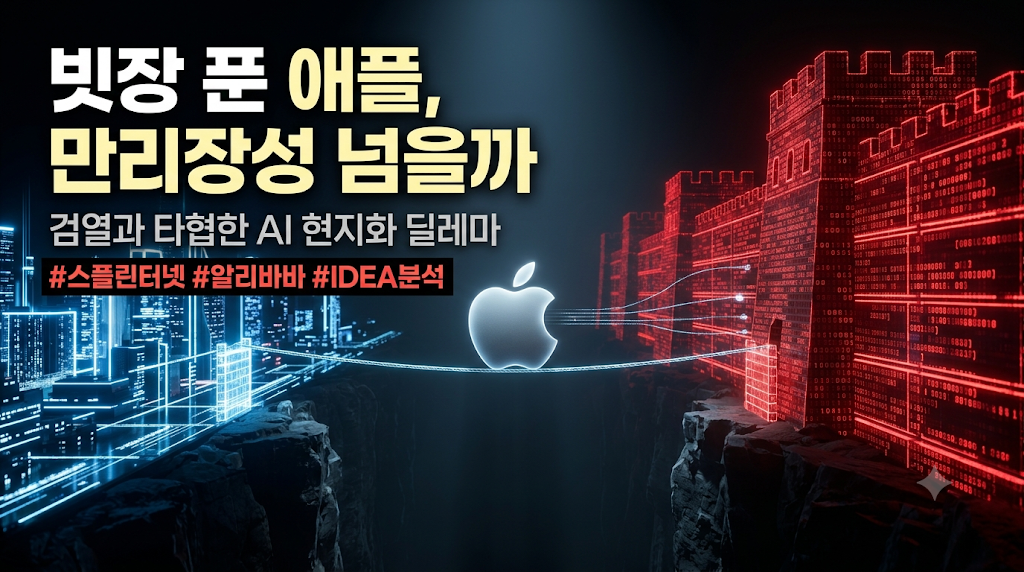
2. [ I ] Issue : 애플이 중국 토종 AI와 손잡은 3가지 배경
애플의 이번 행보는 단순한 현지 마케팅이 아닙니다. 중국의 강력한 인터넷 규제, 무섭게 치고 올라오는 현지 경쟁사들, 그리고 위협받는 시장 점유율이라는 삼중고에 대응하기 위한 궤도 수정입니다.
중국에서 대중에게 생성형 AI 서비스를 하려면 당국의 엄격한 보안 평가를 통과하고 알고리즘을 등록해야 합니다. 이러한 만리방화벽을 넘기 위해 현지 기업과의 파트너십이 대안으로 떠올랐습니다.
미국의 제재를 뚫고 부활한 화웨이나 샤오미 등 중국 기업들은 자체 AI를 발 빠르게 탑재해 시장을 선점하고 있습니다. 애플 역시 중국 시장 점유율 방어를 위해 AI 도입을 서둘러야 했습니다.
애플은 기본 연산은 자사 생태계를 활용하되, 복잡한 기능이나 검색 등 특정 영역에서는 '알리바바'와 '바이두'의 모델을 활용하는 낯선 하이브리드 타협안을 선택했습니다.
3. [ D ] Detail : 규제, 프라이버시, 그리고 현지화 파트너십
1) 현지 규제 통과를 위한 알리바바와의 협력
중국 정부는 생성형 AI가 내놓는 답변이 체제 안보 등 현지 규정에 부합하는지 철저히 검증합니다. 글로벌 AI 모델의 진입이 제한된 상황에서, 애플은 2026년 7월 중국 당국(CAC)의 승인을 획득했으며 이 과정에서 중국 규제를 이미 내재화한 알리바바의 '큐원(Qwen)' 모델을 중국 버전에 통합하기로 결정했습니다.
2) 바이두와의 검색 연동 및 프라이버시 과제
애플은 검색 및 시각 지능 기능 강화를 위해 바이두가 중국용 애플 인텔리전스 개발에 참여한다고 확인했습니다. 이 과정에서 애플은 현지 기업의 기술을 도입하면서도 온디바이스 연산 비중을 높이는 등 자사의 핵심인 '프라이버시 보호' 원칙을 최대한 지키기 위해 고심한 것으로 알려졌습니다.
3) 철통 규제로 인한 출시 지연과 험난한 현지화
애플 인텔리전스는 미국 등 타 국가에서는 먼저 출시되었으나, 중국의 고유한 생성형 AI 규제 환경으로 인해 현지 출시는 수년간 지연되었습니다. 글로벌 표준 소프트웨어를 단일 국가의 규제 및 서버 인프라에 맞춰 재설계하는 과정은 다국적 기술 기업이 마주한 물리적, 시간적 비용의 한계를 보여줍니다.
4. [ E ] Evaluation : 우려하는 미국, 딜레마에 빠진 빅테크
중국 시장 점유율 방어를 위한 애플의 선택은, 역설적으로 자국인 미국 정치권 및 전문가들 사이에서 복잡한 논쟁을 불러일으키고 있습니다.
| 평가 및 우려 지점 | 미국 내 여론과 파장 | 이데아(IDEA)의 시선 |
|---|---|---|
| 기술 및 안보 리스크 우려 | 일부 미국 정치권과 기술 전문가들은 미국 기업과 중국 AI 기업의 파트너십이 장기적으로 기술 스필오버(Spillover)를 유발할 수 있다고 주장합니다. | 결과적으로 국가 안보와 글로벌 기업의 상업적 이익이 정면으로 충돌하는 전형적인 딜레마 상황이 연출되고 있습니다. |
| 검열 타협 논란 | 애플이 중국의 철저한 콘텐츠 필터링 규제를 수용한 것을 두고, 서구 매체 일각에서는 이념적 타협이라는 비판적 시각을 제기합니다. | 비판론자들은 현지 AI 모델 사용이 사실상 중국 검열 체제와의 타협이라 주장하며, 기업 이미지 타격을 우려하고 있습니다. |
| 스플린터넷(Splinternet) 고착화 | 중국 진출을 위해선 '현지 규제 맞춤형 AI'를 별도 도입해야 한다는 산업적 선례가 남게 되었습니다. | 글로벌 기업들이 단일 표준을 포기하고 세계용과 중국용을 별도로 운영해야 하는 '파편화 비용(Fragmentation cost)'이 고착화될 위험이 있습니다. |
미국 정부가 대중국 기술 통제를 강화하는 가운데, 이러한 파트너십이 향후 양국 정부의 새로운 규제 제동에 걸릴 가능성도 배제할 수 없습니다. 애플은 미중 지정학의 가장 예민한 경계선 위에서 전략적 줄타기를 하고 있습니다.
5. [ A ] Action : 어떻게 지켜볼 것인가? 향후 관전 포인트
미중 AI 패권 전쟁의 향방을 읽는 모니터링 플랜
- 데이터 보호 기술의 검증: 아이폰에서 알리바바나 바이두 모델로 데이터가 처리될 때, 애플이 약속한 프라이버시 암호화 및 비식별화 기술이 실제로 완벽하게 작동하는지에 대한 업계 및 기술 전문가들의 객관적인 검증 결과에 주목해야 합니다.
- 미국 정치권 및 규제 당국의 동향: 미국의 대중국 강경파 의원들이나 상무부가 애플과 현지 기업 간의 파트너십에 대해 실질적인 제재나 규제를 가할 것인지 예의 주시해야 합니다. 이는 중국에 진출한 다른 글로벌 빅테크 기업들의 사업 방식에도 엄청난 영향을 미칠 수 있습니다.
- 실질적 점유율 회복 여부 (시장 반응): 현지 모델과 결합된 애플 인텔리전스가 중국 소비자들에게 긍정적인 경험을 제공하여 화웨이 등으로 향하던 수요를 돌려세울 수 있을지가 관건입니다. 애플의 현지화 타협이 실제 매출 방어로 이어질지 시장 지표를 꼼꼼히 확인해야 합니다.
6. 최종 결론: 쪼개지는 세계, 기업들의 불가피한 생존 궤적
애플이 알리바바, 바이두와 협력하여 중국 내 AI 서비스를 구축한 것은 단순한 비즈니스 선택의 문제를 넘어섭니다. 이는 글로벌 기술 제국조차도 각국의 억압적이거나 이질적인 데이터 규제 앞에서는 현지화라는 타협안을 수용할 수밖에 없음을 보여주는 '스플린터넷 시대의 불가피한 생존 전략'을 상징합니다.
애플은 이 파트너십을 통해 중국 시장에서의 경쟁력 저하를 방어할 귀중한 교두보를 마련했습니다. 그러나 동시에 '글로벌 단일 생태계 유지'와 '프라이버시 수호'라는 자사의 굳건한 브랜드 가치를 일정 부분 양보해야 했으며, 일부 미국 내에서는 장기적인 안보 우려 섞인 시선을 받고 있습니다. 기술 패권을 둘러싼 강대국들의 갈등 한가운데서 사업을 영위해야 하는 다국적 기업들. 이들의 아슬아슬한 현지화 줄타기가 미·중 첨단 기술 경쟁의 향방과 글로벌 산업 생태계를 어떻게 바꾸어 놓을지 깊은 관심이 집중되고 있습니다.
1. Introduction: A Splintering Internet and Apple's Desperate Measure
Apple, a company that has insisted on absolute control from semiconductor design to operating systems and app ecosystems, went through Chinese authorities' reviews and formed partnerships with local Big Tech companies like Alibaba and Baidu to launch its 'Apple Intelligence' in China. A desperate measure chosen to overcome a regulatory environment where ChatGPT or Google Gemini cannot be used. Today, IDEA looks objectively at why Apple had to choose this compromise and what geopolitical dilemmas this decision poses for the US and the world, using the I (Issue) - D (Detail) - E (Evaluation) - A (Action) framework.
2. [ I ] Issue: 3 Backgrounds for Apple Partnering with Homegrown Chinese AI
Apple's move is not mere localized marketing. It is a course correction to respond to the triple threat of China's strong internet regulations, fiercely advancing local competitors, and threatened market share.
To provide generative AI services to the public in China, one must pass the authorities' strict security evaluations and register algorithms. To cross this Great Firewall, partnerships with local companies emerged as the alternative.
Chinese companies like Huawei and Xiaomi, which resurrected through US sanctions, are preempting the market by rapidly equipping their own AI. Apple also had to rush its AI introduction to defend its market share in China.
Apple chose an unfamiliar hybrid compromise: utilizing its own ecosystem for basic computations, but leveraging models from 'Alibaba' and 'Baidu' for specific areas like complex functions or search.
3. [ D ] Detail: Regulation, Privacy, and Localization Partnerships
1) Cooperation with Alibaba to Pass Local Regulations
The Chinese government thoroughly verifies whether generative AI answers comply with local regulations, including regime security. With entry restricted for global AI models, Apple secured approval from the Cyberspace Administration of China (CAC) in July 2026, and in the process, decided to integrate Alibaba's 'Qwen' model, which already internalizes Chinese regulations, into the Chinese version.
2) Search Integration with Baidu and Privacy Challenges
Apple confirmed that Baidu is participating in the development of Apple Intelligence for China to enhance search and visual intelligence functions. During this process, it is known that Apple agonized to maximally protect its core principle of 'privacy'—such as increasing the proportion of on-device computation—even while introducing local corporate technology.
3) Launch Delays and Arduous Localization Due to Ironclad Regulations
While Apple Intelligence was launched earlier in the US and other countries, local launch in China was delayed for years due to its unique generative AI regulatory environment. The process of redesigning globally standardized software to fit a single country's regulations and server infrastructure shows the limits of physical and time costs faced by multinational tech companies.
4. [ E ] Evaluation: A Concerned US and Big Tech in a Dilemma
Apple's choice to defend its Chinese market share is, paradoxically, sparking complex debates among politicians and experts back in the United States.
| Evaluation & Concern Points | US Public Opinion & Repercussions | IDEA's Perspective |
|---|---|---|
| Tech & Security Risk Concerns | Some US politicians and tech experts argue that partnerships between US and Chinese AI companies could cause long-term tech spillovers. | Consequently, a typical dilemma is unfolding where national security and the commercial interests of global companies directly collide. |
| Censorship Compromise Controversy | Regarding Apple's acceptance of China's strict content filtering regulations, some Western media raise critical views of an ideological compromise. | Critics argue that using local AI models is effectively a compromise with the Chinese censorship system, raising concerns about corporate image damage. |
| Solidification of the Splinternet | An industrial precedent has been set that to enter China, one must separately introduce 'AI tailored to local regulations.' | There is a risk that the 'Fragmentation cost'—where global companies abandon a single standard and operate separate versions for the world and China—will become entrenched. |
As the US government tightens tech controls on China, the possibility that these partnerships might face new regulatory brakes from both governments cannot be ruled out. Apple is performing a strategic tightrope walk on the most sensitive boundary of US-China geopolitics.
5. [ A ] Action: How to Watch? Future Points to Observe
Monitoring Plan to Read the Direction of the US-China AI Hegemony War
- Verification of Data Protection Technology: We must pay attention to objective verification results from industry and tech experts on whether Apple's promised privacy encryption and de-identification technologies actually work perfectly when data is processed by Alibaba or Baidu models on iPhones.
- Trends of US Politicians and Regulatory Authorities: We must closely watch whether hardline US lawmakers regarding China or the Department of Commerce will impose actual sanctions or regulations on partnerships between Apple and local companies. This could have a massive impact on how other global Big Tech companies operating in China do business.
- Actual Market Share Recovery (Market Reaction): The key is whether Apple Intelligence, combined with local models, can provide a positive experience for Chinese consumers and turn around demand heading towards Huawei. We must meticulously check market indicators to see if Apple's localization compromise leads to actual revenue defense.
6. Final Conclusion: A Splintering World and the Inevitable Survival Trajectories of Companies
Apple partnering with Alibaba and Baidu to build AI services in China goes beyond a simple business choice. It symbolizes the 'inevitable survival strategy in the Splinternet era,' proving that even global tech empires have no choice but to accept the compromise of localization before the oppressive or heterogeneous data regulations of individual countries.
Through this partnership, Apple established a valuable beachhead to defend against declining competitiveness in the Chinese market. However, at the same time, it had to somewhat concede its firm brand values of 'maintaining a single global ecosystem' and 'guarding privacy,' and is receiving glances mixed with long-term security concerns from some within the US. Multinational companies forced to do business amidst conflicts between great powers vying for tech hegemony. Deep attention is focused on how their precarious localization tightrope walks will change the direction of US-China advanced tech competition and the global industrial ecosystem.
[이데아 심층 분석] 청구서가 된 동맹: 미·이란 전쟁 속 트럼프의 압박과 한미 연합훈련 축소의
1. 서론: 흔들리는 동맹, 냉정한 손익계산서의 시대지금 우리는 2026년 8월 20일을 지나고 있습니다.미국과 이란의 군사적 대치가 반년을 넘기며 장기화되자, 트럼프 행정부 특유의 '거래적 외교관
www.ideas6926.cloud
[이데아 심층 분석] 무디스(Moody's)의 3.5% 서프라이즈: 반도체 호황 이면의 1,400원대 환율 딜레마 /
1. 서론: 무디스의 3.5%, 반가웠지만 마음이 마냥 가볍지는 않았다지금 우리는 2026년 8월 19일 오전 8시를 지나고 있다.8월 18일, 무디스(Moody's)가 한국의 2026년 경제성장률 전망치를 2.5%에서 3.5%로 올
www.ideas6926.cloud


