1. 서론: 지정학적 단층선의 붕괴와 '에너지-식량' 무기화
2026년 2월 28일 촉발된 미·이란 전쟁은 단순한 군사적 충돌을 넘어, 현대 문명을 지탱하는 가장 치명적인 동맥인 호르무즈 해협(Strait of Hormuz)을 마비시켰다. 이 지정학적 폭발은 에너지 안보를 넘어 식량 안보라는 인류의 생존 영역으로 파괴적인 연쇄 반응을 일으키고 있다.
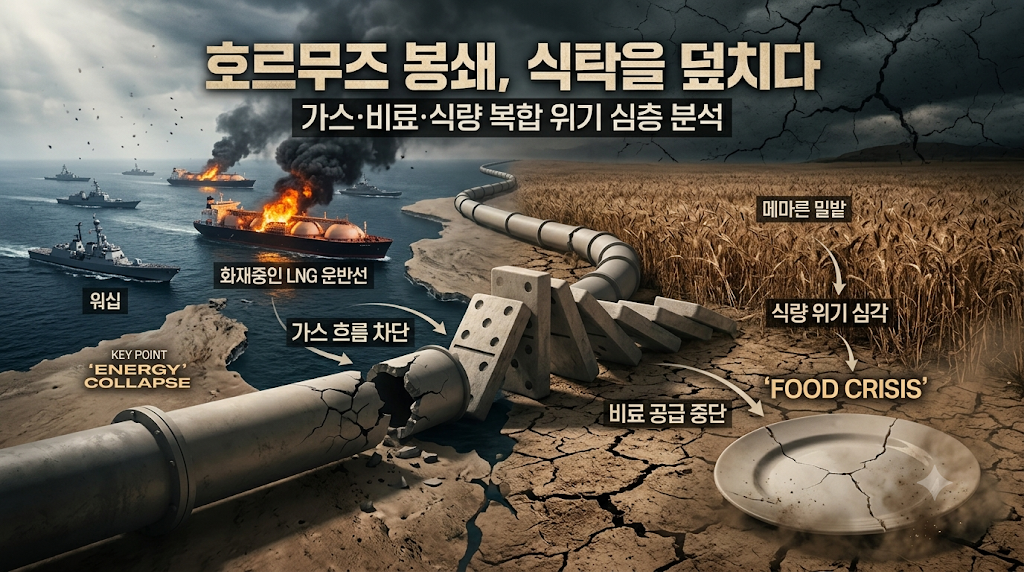
현대 농업은 에너지 집약 산업이다. 특히 작물 성장의 핵심인 질소 비료는 원가의 최대 80%를 천연가스에 의존한다. 중동 걸프 지역은 이 천연가스와 비료 자원의 세계 최대 공급처다. 이란의 해협 봉쇄와 카타르 LNG 시설 타격은 글로벌 LNG 시장 마비 → 비료 생산 중단 및 가격 폭등 → 재앙적인 식량 수확량 급감이라는 '복합 시스템 위기'를 촉발했다. 오늘 이데아(IDEA)는 이 거대한 붕괴 메커니즘을 I(Issue) - D(Detail) - E(Evaluation) - A(Action) 프레임워크로 완벽히 해부한다.
2. [ I ] Issue : '초크포인트' 마비가 불러온 글로벌 공급망의 뇌사
호르무즈 해협은 대체 불가능한 절대 요충지다. 이란의 통행 제한과 주요 시설 타격은 글로벌 실물 경제에 1970년대 오일쇼크에 버금가는 충격을 가했다.
해상 원유 거래량의 최대 27%, LNG 수출 물량의 20%가 통과하는 해협이 닫혔다. 휴전 이후에도 보험료 폭등과 안전 우려로 물류는 회복되지 못하고 있다.
3월 18일 이란의 타격으로 카타르 전체 LNG 생산 능력의 17%가 영구 손상되었다. 복구에 3~5년이 소요되어 글로벌 가스 시장의 구조적 결핍이 고착화되었다.
2025년 4월 대비 2026년 4월, 해협 통과 물량은 궤멸적이다. LNG -95%, 요소 비료 -83%, 암모니아 -75%. 비료 산업의 1차 원료가 시장에서 사라졌다.
3. [ D ] Detail : 천연가스 대란과 식량 생산 생태계의 붕괴 메커니즘 해부
1) 하버-보슈 공정의 종속성: 천연가스는 곧 비료다
질소 비료 합성을 위한 '하버-보슈 공정'은 필수 수소를 추출하고 고온·고압을 발생시키기 위해 절대적으로 천연가스(메탄)에 의존한다. 천연가스는 단순한 연료가 아니라 화학적 원료(Feedstock) 그 자체다. 아시아 LNG 현물 가격의 140% 폭등은 글로벌 비료 생산업체들에게 조업할수록 적자가 발생하는 '경제성 상실'을 강제했다.
2) 중동 걸프의 지배력과 '요소(Urea)' 쇼크
- 비료 수출 과점: 걸프 연안국은 글로벌 비료 교역량의 30%를 책임진다. 특히 DAP/MAP 비료의 세계 2위 수출 거점이다.
- 요소 공급망 마비: 가장 보편적인 질소 비료인 '요소'는 글로벌 교역량의 최대 50%가 이 지역에서 나온다. 호르무즈 봉쇄로 글로벌 요소 공급량의 36%가 즉각 증발했다. 가격은 순식간에 톤당 800달러를 돌파하며 49% 폭등했다.
3) 인구 대국의 비료 공장 연쇄 셧다운 (2차 파급 효과)
더 심각한 것은 중동발 LNG를 수입해 비료를 만들던 인도, 방글라데시, 파키스탄 등 거대 농업 국가들의 상황이다. 카타르 가스 공급 단절로 자국 내 비료 공장이 가동 중단되었다. 이는 수억 명의 인구를 부양하는 국내 식량 안보에 직결되는 치명타다. G7조차 '전략적 비료 비축량'이 없어 속수무책으로 당했다.
4. [ E ] Evaluation : 파종 실패에서 기아 위기까지, 복합 위기의 평가
에너지에서 시작된 나비효과는 농업 현장을 강타하며 시간차를 두고 절대적인 식량 물량 부족(Shortfall in crops)으로 발현되고 있다.
| 위기 전개 단계 | 핵심 현상 및 정량 지표 | 이데아(IDEA)의 실질 평가 |
|---|---|---|
| 1단계: 봄 파종기 직격탄 | 미농업국연맹(AFBF)의 국가 안보 위협 경고. 비료 조달 비용 40% 이상 상승. | 농부들에게 옥수수·밀(비료 대량소모) 대신 대두·콩과 식물로의 '강제적 작물 전환(Crop Shift)' 요구. 3대 칼로리원(쌀·밀·옥수수) 수확량 급감 예고. |
| 2단계: 축산업 도미노 붕괴 | 사료용 대두 부족 및 가격 급등. 브라질·중국 등 거대 축산국 사료 부족. | 사육 두수 감축으로 이어져 2026년 하반기 이후 전 세계적 육류 및 유제품 가격의 구조적 폭등 촉발. |
| 3단계: 글로벌 사우스 기아 현실화 | 에티오피아 필수품 가격 40% 폭등. 카타르 등 걸프국조차 식량 90% 수입 의존으로 자승자박. | 구매력 취약 신흥국에서 기근(Famine) 발생 위험 위험 고조. 식품 가격 인상이 장기적 구조적 상승 사이클에 진입. |
또한, 가스 부족은 중국 등에서 온실가스 배출이 극심한 '석탄(Coal)' 기반 비료 생산의 귀환을 초래했다. 이는 식량 안보를 위해 기후 안보를 희생하는 퇴행적 결과를 낳으며, 미국 트럼프 행정부의 '재정 지원' 정책이 물리적 결핍을 해결하지 못하는 근본적 한계를 드러냈다.
5. [ A ] Action : 인류의 식탁을 지키기 위한 중장기 전략 제언
패러다임 전환: 에너지를 볼모로 잡은 농업을 구하라
- '전략적 비료 비축(Strategic Fertilizer Reserves)' 제도 신설: 주요 선진국은 원유와 동등한 수준으로 암모니아, 요소, 인산염 등 핵심 비료를 국가 핵심 안보 자산으로 재분류해야 한다. 수개월 분량의 상시 비축을 법적·제도적으로 의무화하는 프레임워크를 즉각 신설하라.
- '그린 암모니아(Green Ammonia)'로의 산업 패러다임 전환: 천연가스 조달에 목을 매는 현행 비료 생산 시스템은 지속 가능하지 않다. 재생에너지를 활용해 물을 전기 분해하여 수소를 얻는 그린 암모니아 기술에 국가적 투자를 집중하여 지정학적 리스크로부터 식량 안보를 분리(Decoupling)하라.
- 화학 물류망의 인프라 재설계: 단일 해협에 의존하는 물류망의 취약성이 입증되었다. 사우디아라비아 등 인접국은 원유뿐만 아니라 암모니아 등 액상 비료 자원을 우회 항구나 내륙 파이프라인으로 안전하게 운송할 수 있는 복합 화학 물류망을 신규 건설해야 한다.
6. 최종 결론: 지정학적 인질극의 희생양이 된 인류의 식탁
2026년 미·이란 전쟁은 단순한 지역 분쟁이 아니라, 글로벌 경제의 가장 취약한 연결 고리를 정밀 타격한 치명적인 복합 시스템 붕괴 사례다. 단일 초크포인트(호르무즈 해협)의 마비가 천연가스 가격 폭등을 낳고, 이것이 하버-보슈 공정에 종속된 글로벌 질소 비료 산업의 셧다운을 야기하며, 최종적으로 농작물 작황 부진과 인플레이션, 극빈국의 기아로 이어지는 명백한 인과 구조를 입증했다.
세계는 이미 2026년 파종 실패의 청구서를 가을 수확기의 식량 부족과 2027년 살인적인 마트 진열대 물가로 돌려받을 준비를 하고 있다. 에너지 생산국들이 에너지와 비료를 무기화하여 글로벌 사우스를 기아로 몰아넣는 비극을 차단하기 위해서는 국제 사회의 공조가 그 어느 때보다 절실하다. 역설적으로 미국과 호주는 카타르의 빈자리를 메우며 에너지-비료 공급망의 새로운 헤게모니를 쥘 기회를 맞았다. 에너지가 농업을 볼모로 잡는 시대를 끝내지 못한다면, 인류의 식탁은 영원히 지정학적 인질극의 희생양이 될 것이다.
1. Introduction: Collapse of Geopolitical Fault Lines and the Weaponization of Energy-Food
The US-Iran war, triggered on February 28, 2026, went beyond a simple military conflict to paralyze the Hormuz Strait, the most critical artery sustaining modern civilization. This geopolitical explosion is causing destructive chain reactions that extend beyond energy security into the realm of human survival: food security.
Modern agriculture is an energy-intensive industry. Specifically, nitrogen fertilizer, essential for crop growth, relies on natural gas for up to 80% of its production cost. The Gulf region is the world's largest supplier of this natural gas and processed fertilizer resources. Iran's blockade of the strait and attacks on Qatar's LNG facilities have triggered a 'Complex System Crisis': Paralysis of the global LNG market → Shutdown of fertilizer production and price spikes → Catastrophic plunges in global crop yields. Today, IDEA perfectly dissects this massive collapse mechanism using the I (Issue) - D (Detail) - E (Evaluation) - A (Action) framework.
2. [ I ] Issue : Paralysis of a 'Chokepoint' Leading to Brain Death of the Global Supply Chain
The Hormuz Strait is an irreplaceable pivotal point. Iran's restriction of passage and attacks on key infrastructure inflicted a shock on the global real economy comparable to the 1970s Oil Shock.
A strait through which up to 27% of maritime crude oil trade and 20% of LNG export volume passed has been closed. Even after the ceasefire, logistics have not recovered due to exploding insurance premiums and safety concerns.
Iran's attack on March 18 permanently damaged 17% of Qatar's overall LNG production capacity. Recovery will take 3 to 5 years, formalizing a structural deficiency in the global gas market.
Compared to April 2025, the volume passing through the strait in April 2026 is catastrophic. LNG -95%, Urea Fertilizer -83%, Ammonia -75%. The primary raw materials for the fertilizer industry have disappeared from the market.
3. [ D ] Detail : Dissecting the Collapse Mechanism of Natural Gas Chaos and the Food Production Ecosystem
1) Haber-Bosch Dependency: Natural Gas is Fertilizer
The 'Haber-Bosch process' for nitrogen fertilizer synthesis relies absolutely on natural gas (methane) to extract essential hydrogen and generate high heat and pressure. Natural gas is not merely a fuel but a chemical feedstock itself. The 140% spike in LNG prices in the Asian spot market forced global fertilizer producers into a state of 'economic non-viability' where continuing operations only meant incurring losses.
2) Gulf Region Dominance and the 'Urea' Shock
- Fertilizer Export Oligopoly: Gulf coastal states are responsible for 30% of global fertilizer trade volume. They are specifically the world's second-largest export hub for DAP/MAP fertilizers.
- Urea Supply Chain Paralysis: Up to 50% of the global trade volume for 'Urea,' the most common nitrogen fertilizer, comes from this region. Due to the Hormuz blockade, 36% of the global Urea supply immediately evaporated. Prices spiked by 49% in just a few weeks, exceeding $800 per ton.
3) Chain Shutdown of Fertilizer Factories in Populous Nations (Secondary Effects)
More severe is the situation in populous agricultural nations that imported LNG from the Middle East to produce fertilizer domestically, such as India, Bangladesh, and Pakistan. Following the cutoff of Qatari gas supply, domestic fertilizer factories shut down. This is a fatal blow directly linked to domestic food security supporting hundreds of millions. Even G7 nations were helpless, as they possessed zero 'strategic fertilizer reserves.'
4. [ E ] Evaluation : Assessment of the Complex Crisis, from Planting Failure to Famine
The butterfly effect that began with energy has struck agricultural fields with a time lag, manifesting as a physical limitation of absolute food volume (Shortfall in crops).
| Crisis Development Stage | Key Phenomena and Quantitative Indicators | Practical Assessment by IDEA |
|---|---|---|
| Phase 1: Direct Hit to Spring Planting | Warning of national security threat from AFBF. Fertilizer procurement costs rose over 40%. | Farmers forced into severe 'Forced Crop Shift' from corn/wheat (high fertilizer consumption) to soy/legumes. Sharp plunge in yields of three major calorie sources (rice, wheat, corn) predicted. |
| Phase 2: Livestock Value Chain Collapse | Shortage of feed-grade soybeans and price spikes. Feed shortage in large livestock nations like Brazil/China. | Leads to a reduction in livestock numbers, which structurally triggers an exploding price increase in meat and dairy globally after the second half of 2026. |
| Phase 3: Famine Risk Realized in Global South | Price of essentials in Ethiopia spiked over 40%. Even Gulf nations like Qatar face 파괴of food security due to 90% import reliance. | High elevation of famine occurrence risk in emerging and poor nations. Food price increases entered a long-term structural upward cycle. |
Furthermore, the gas shortage prompted a return of 'Coal'-based fertilizer production in nations like China. This created a climate-retrogressive result where food security sacrificed climate security, and it exposed the fundamental limits of the Trump administration's 'financial aid' policies in the US, which cannot fill the physical void of chemical raw materials (ammonia, urea).
5. [ A ] Action : Strategic Proposals to Protect Humanity's Dining Table
Paradigm Shift: Rescue Agriculture Taken Hostage by Energy
- Establishment and Mandating of 'Strategic Fertilizer Reserves': Major developed nations must reclassify core fertilizers such as ammonia, urea, and phosphates as core national security assets equivalent to crude oil. Immediately create a legal and institutional framework that mandates a constant strategic reserve of several months' worth of supply.
- Industrial Paradigm Shift to 'Green Ammonia': The current fertilizer production system, which relies on natural gas supply, is not sustainable. Concentrate national investment on 'Green Ammonia' technology, which uses renewable energy to electrolyze water for hydrogen to synthesize nitrogen. This is the only solution that decouples food security from geopolitical risk and prevents climate retrogression.
- Redesigning Infrastructure for Liquid Chemical Logistics: As the vulnerability of the maritime logistics network relying on a single strait has been proven, neighboring countries like Saudi Arabia must build new complex chemical logistics networks capable of safely transporting liquid fertilizer resources like ammonia through inland pipelines or alternative ports.
6. Final Conclusion: Involuntary Hostages of Geopolitics, Humanity's Plates
The US-Iran war triggered in 2026 is absolutely not just a regional conflict, but a case of a fatal complex system collapse that precisely targeted the most vulnerable link sustaining the global economy. It has proven a clear causal structure where the paralysis of a single chokepoint (Hormuz Strait) causes a natural gas price explosion, which triggers a shutdown of the global nitrogen fertilizer industry dependent on the Haber-Bosch process, ultimately leading to poor crop yields, inflation, and starvation in극빈nations.
The world is already preparing to receive the invoice for the 2026 planting failure in the form of food shortages during the autumn harvest and murderous prices on grocery shelves in 2027. International cooperation for emergency fertilizer swaps and food aid is more desperate than ever to stop the dominos of famine and riots predicted in the Global South. Paradoxically, the US and Australia are positioned to enjoy strategic opportunities by filling the void left by Qatar and seizing hegemony in energy-fertilizer supply chains. Unless we end the era where energy takes agriculture taken hostage, humanity's plates will forever remain victims of geopolitical involuntary hostage situations.
[이데아 심층 분석] '규제 선도국' 일본의 대전환: 안심 설계로 무장한 웹3.0 국가 전략 / [IDEA Deep D
1. 서론: 글로벌 규제 패러다임의 전환과 'IDEA' 프레임워크지금 우리는 2026년 8월 9일 오전 8시를 지나고 있다.글로벌 금융 시장에서 웹3.0(Web3)의 비중이 커지는 가운데, 가상자산 규제의 방향도 빠
www.ideas6926.cloud
[이데아 심층 분석] 굴욕당한 애플과 부메랑이 된 쥐어짜기: CXMT 거래 거절로 본 공급망 패권 이
1. 서론: 수요자 우위 시대의 종언과 'IDEA' 프레임워크수십 년간 글로벌 IT 산업은 막강한 구매력을 쥔 '수요자(Buyer)'를 중심으로 굴러갔다. 그 정점에는 시가총액 3조 달러를 호령하며 하청업체를
www.ideas6926.cloud


