1,479원 돌파한 원/달러 환율: 트럼프 2.0과 한국 경제의 구조적 위기 (2025년 11월 분석)
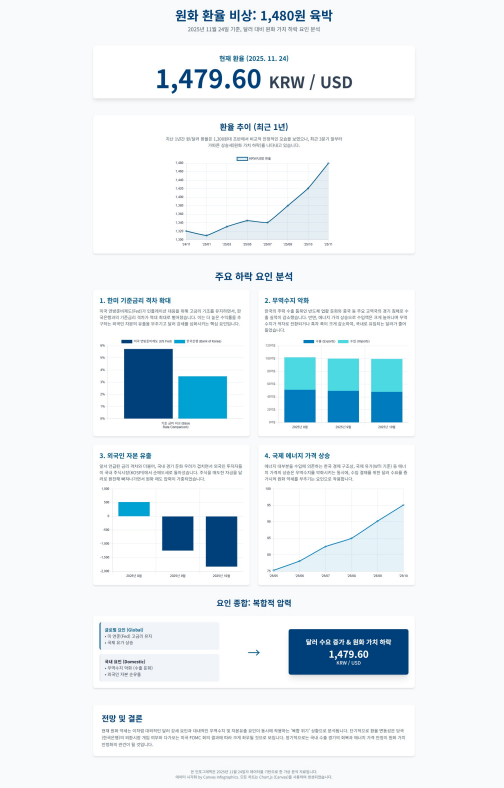
요약: 2025년 11월 24일, 서울 외환시장에서 원/달러 환율이 장중 1,479.60원까지 치솟으며 글로벌 금융위기 수준으로 통화 가치가 하락했습니다. 이는 '트럼프 2.0'의 무역 압박, 한미 금리차의 비대칭성, 그리고 '서학개미'로 대변되는 구조적 자본 유출이 복합적으로 작용한 결과입니다. 본 보고서는 한국 경제가 직면한 '퍼펙트 스톰'을 분석하고 향후 전망을 제시합니다.
1. 개요: 퍼펙트 스톰의 도래
2025년 11월 24일, 서울 외환시장에서 원/달러 환율은 장중 한때 1,479.60원까지 치솟으며 심리적 저지선인 1,475원을 돌파했고, 종가는 전일 대비 0.43% 상승한 1,476.07원을 기록했습니다. 이는 단순한 일일 변동성을 넘어선 수치로, 원화의 실질실효환율(REER) 기준으로 볼 때 2009년 글로벌 금융위기 당시 수준인 89.09 포인트까지 하락한 심각한 통화 가치 훼손을 의미합니다.
금번 환율 급등 사태는 표면적으로는 11월 미 연방공개시장위원회(FOMC)의 12월 금리 인하 기대감 후퇴와 국내 증시에서의 외국인 매도세에 기인한 것으로 보이나, 본질적으로는 도널드 트럼프 대통령의 재집권 이후 구체화된 "트럼프 2.0 (Trump 2.0)" 통상 정책의 충격이 실물 경제에 반영되기 시작했음을 시사합니다.
2. 시장 동향 분석: 유동성 진공과 외국인의 이탈
11월 24일, 원/달러 환율은 개장 초부터 외국인의 코스피 매도세가 집중되면서 급격히 상승폭을 확대했습니다. 장중 한때 외환 당국의 구두 개입성 발언으로 1,450원대 후반까지 일시적 되돌림이 있었으나, 오후 들어 결제 수요(Importers' Demand)와 역외 매수세가 결합하며 다시 1,475원을 상향 돌파했습니다.
이날의 가격 움직임은 전형적인 "유동성 진공(Liquidity Vacuum)" 상태를 보여주었습니다. 수출업체들은 환율의 추가 상승을 기대하며 달러 매도를 미루는 '래깅(Lagging)' 전략을 취했고, 수입업체들은 공포감에 달러를 미리 확보하려는 '리딩(Leading)' 전략으로 대응하며 수급 불균형을 심화시켰습니다.
외국인 투자자들은 코스피 시장에서 약 2억 9,100만 달러(약 4,000억 원) 규모의 순매도를 기록했으며, 이는 즉각적인 환전 수요로 이어져 환율 상승의 트리거가 되었습니다.
3. 지정학적 충격: 트럼프 2.0과 구조적 디커플링
원화 가치의 약세 고착화는 미국의 급진적 통상 정책 변화에 따른 구조적 결과물입니다. 시장은 트럼프 1기보다 훨씬 강력한 정책 충격을 가격에 반영하고 있습니다.
3.1 보편적 관세와 3,500억 달러의 청구서
트럼프 행정부는 2025년 4월부터 모든 수입품에 대해 10%의 보편적 기본 관세를 부과하기 시작했습니다. 한국은 자동차 관세 면제를 위해 향후 수년간 미국 내에 3,500억 달러(약 480조 원) 규모의 투자를 집행하겠다는 약속을 해야 했습니다. 이는 막대한 자본 유출 요인으로 작용하여 원화의 하단을 높이는 지지선 역할을 하고 있습니다.
3.2 IRA 폐지와 반도체 규제
일명 "크고 아름다운 법안(OBBBA)" 서명으로 인해 2차전지 산업의 보조금 기대가 붕괴되었으며, 삼성전자와 SK하이닉스에 대한 '검증된 최종 사용자(VEU)' 지위 박탈은 반도체 산업의 불확실성을 극대화했습니다. 이는 한국 기업들의 미래 이익 송금 규모 감소와 자산 가치 하락으로 이어져 원화 약세의 근본 원인이 되고 있습니다.
4. 거시경제적 비대칭성: 연준과 한은의 엇박자
미국 경제는 견조함을 유지하며 연준의 금리 인하 기대감을 낮추고 있는 반면, 한국은행은 가계부채와 경기 침체 우려로 인해 금리 동결을 이어가고 있습니다.
- 미 연준: 트럼프 행정부의 관세 정책에 따른 인플레이션 재점화 우려로 12월 금리 인하 가능성이 낮아짐. 미 10년물 국채 금리는 4.06%~4.17% 레인지 유지.
- 한국은행: 가계부채와 부동산 문제로 금리 인하가 어렵고, 성장률 둔화로 인상도 불가능한 진퇴양난. 현재 한미 금리 역전폭은 1.25%p 이상 유지 중.
5. 자본수지의 붕괴: 서학개미와 WGBI의 배신
과거 "무역 흑자"가 환율을 방어했다면, 현재는 "자본 수지 적자"가 환율 상승을 주도하고 있습니다.
5.1 The Great Exodus of 'Seohak Ants'
국내 거주자의 해외 증권 투자는 역대 최고치를 경신하고 있습니다. 국내 증시의 부진과 미국 증시(AI 테마)의 고성장은 가계 저축을 원화 자산에서 달러 자산으로 이동시키고 있습니다. 개인의 해외 투자는 대부분 환노출 상태로 이루어져 환율 상승의 직접적인 원인이 됩니다.
5.2 WGBI 편입 지연
환율 안정의 구원투수로 기대되었던 세계국채지수(WGBI) 편입 시점이 2026년 4월로 연기되면서, 기대감으로 유입되었던 외국인 채권 자금이 이탈하고 있습니다. 이는 채권 금리 상승과 원화 약세를 동시에 유발했습니다.
6. 섹터별 영향 및 정책 대응의 한계
SK하이닉스 등 반도체 주는 미국 규제 강화 우려로 급락했고, 2차전지 섹터 역시 보조금 폐지 공포로 약세를 보였습니다. 정부는 구두 개입과 국민연금과의 외환 스왑 확대(500억 달러 → 650억 달러) 카드를 꺼내 들었으나, 펀더멘털 개선 없는 조치는 시장의 추세를 돌리기에 역부족이었습니다.
7. 결론 및 2026년 전망: 뉴노멀 1,500원 시대
11월 24일의 1,479.60원 기록은 단순한 오버슈팅이 아닙니다. 이는 한국 경제가 "고환율 구조"로 이행하는 과정의 진통입니다.
- 단기 전망: 12월 연준의 금리 결정에 따라 1,500원 일시 돌파 가능성이 높습니다.
- 중장기 전망: 2026년 4월 WGBI 자금 유입 이후 1,400원대 초반으로 안정될 수 있으나, 과거와 같은 1,100~1,200원대 환율 복귀는 당분간 어려울 것으로 보입니다.
기업과 투자자들은 "환율 1,400원대 상시화"를 기본 시나리오로 설정하고 리스크 관리에 임해야 할 것입니다.
함께 보면 좋은 글
미국의 우크라이나 종전 전략 분석: 28개 조항 평화안과 지정학적 함의 / US Ukraine Strategy Shift: 28-Po
View English Version 한국어 버전 보기 미국의 우크라이나 종전 전략 분석: 28개 조항 평화안과 지정학적 함의#우크라이나전쟁 #러시아우크라이나 #미국대외정책 #28개조항평화안 #트럼프행정부 #바이
www.ideas6926.cloud
참고 소스 (Reference Sources)
- Trading Economics - South Korean Won Extends Losses
- Korea JoongAng Daily - Won sinks to lowest real value
- Chosun Ilbo - Foreign Exchange Authorities' Intervention
- KED Global - Korean retail rush to US stocks
- EY - Tariff troubles: Could protectionism revive stagflation?
- Congress.gov - U.S. Export Controls and China
- FTSE Russell - March 2025 semi-annual country classification
USD/KRW Surpasses 1,479: Trump 2.0 and the Structural Crisis of the Korean Economy (Nov 2025 Analysis)
Summary: On November 24, 2025, the USD/KRW exchange rate surged to 1,479.60 won in the Seoul foreign exchange market, with the currency's value falling to levels seen during the Global Financial Crisis. This is a result of a combination of factors: 'Trump 2.0' trade pressure, interest rate asymmetry between the US and Korea, and structural capital outflows driven by 'Seohak Ants' (retail investors). This report analyzes the 'Perfect Storm' facing the Korean economy and provides a future outlook.
1. Overview: The Arrival of the Perfect Storm
On November 24, 2025, the USD/KRW exchange rate soared to a high of 1,479.60 won in the Seoul foreign exchange market, breaching the psychological resistance line of 1,475 won, and closed at 1,476.07 won, up 0.43% from the previous day. This figure goes beyond simple daily volatility; in terms of the Real Effective Exchange Rate (REER), it signifies a severe erosion of currency value, falling to 89.09 points, a level seen during the 2009 Global Financial Crisis.
While this surge appears superficially due to receding expectations of a rate cut by the FOMC in December and foreign selling in the domestic stock market, it fundamentally suggests that the shock of "Trump 2.0" trade policies, concretized after Donald Trump's return to power, is beginning to be reflected in the real economy.
2. Market Trend Analysis: Liquidity Vacuum and Foreign Exit
On November 24, the won/dollar exchange rate faced strong upward pressure from the opening as foreign selling in the KOSPI intensified. Although there was a temporary pullback to the upper 1,450s due to verbal intervention by foreign exchange authorities, it broke through 1,475 won again in the afternoon as settlement demand (Importers' Demand) combined with offshore buying.
The price movement on this day demonstrated a typical "Liquidity Vacuum". Exporters adopted a 'Lagging' strategy, delaying dollar selling in anticipation of further rate hikes, while importers responded with a 'Leading' strategy to secure dollars in advance out of fear, deepening the supply-demand imbalance.
Foreign investors recorded a net selling of about $291 million (approx. 400 billion won) in the KOSPI market, which led to immediate currency conversion demand, acting as a trigger for the exchange rate hike.
3. Geopolitical Shock: Trump 2.0 and Structural Decoupling
The fixation of the won's weakness is a structural result of radical changes in US trade policy. The market is pricing in policy shocks much stronger than Trump 1.0.
3.1 Universal Tariffs and a $350 Billion Bill
The Trump administration began imposing a 10% universal baseline tariff on all imports starting April 2025. To secure an exemption for automobile tariffs, Korea had to promise to execute investments worth $350 billion (approx. 480 trillion won) in the US over the coming years. This acts as a massive capital outflow factor, serving as a support line raising the floor of the won exchange rate.
3.2 Abolition of IRA and Semiconductor Regulations
The signing of the so-called "One Big Beautiful Bill Act (OBBBA)" collapsed subsidy expectations for the battery industry, and the revocation of 'Validated End-User (VEU)' status for Samsung Electronics and SK Hynix maximized uncertainty in the semiconductor industry. This leads to a decrease in future profit repatriation and asset value decline for Korean companies, becoming a root cause of the won's weakness.
4. Macroeconomic Asymmetry: Fed vs. BOK Mismatch
While the US economy remains robust, lowering expectations for a Fed rate cut, the Bank of Korea continues to freeze rates due to household debt and recession concerns.
- US Fed: The possibility of a December rate cut has decreased due to concerns about reflation from Trump's tariff policies. The US 10-year Treasury yield remains in the 4.06%~4.17% range.
- Bank of Korea (BOK): Caught in a dilemma where cutting rates is difficult due to household debt and real estate, while raising them is impossible due to slowing growth. The current interest rate inversion gap remains over 1.25%p.
5. Collapse of Capital Balance: Betrayal of Seohak Ants & WGBI
If "trade surplus" defended the exchange rate in the past, "capital account deficit" is now leading the rate hike.
5.1 The Great Exodus of 'Seohak Ants'
Overseas securities investment by domestic residents is hitting record highs. The stagnation of the domestic stock market and the high growth of the US market (AI theme) are shifting household savings from KRW assets to USD assets. Retail investments are mostly unhedged, becoming a direct cause of the exchange rate rise.
5.2 Delay in WGBI Inclusion
As the inclusion in the World Government Bond Index (WGBI), expected to be a savior for exchange rate stability, was postponed to April 2026, foreign bond funds that had entered on expectations are exiting. This caused both bond yields to rise and the won to weaken simultaneously.
6. Sector Impact and Limits of Policy Response
Semiconductor stocks like SK Hynix plunged due to fears of tighter US regulations, and the battery sector also weakened due to subsidy abolition fears. The government utilized verbal intervention and expanded the FX swap with the National Pension Service ($50 billion → $65 billion), but measures without fundamental improvements were insufficient to turn the market trend.
7. Conclusion & 2026 Outlook: The New Normal of 1,500 Won
The record of 1,479.60 won on November 24 is not a simple overshooting. It is the growing pain of the Korean economy transitioning to a "high exchange rate structure".
- Short-term Outlook: High possibility of temporarily breaching 1,500 won depending on the Fed's rate decision in December.
- Mid-to-Long-term Outlook: It may stabilize to the low 1,400 won range after WGBI inflows in April 2026, but a return to the past 1,100~1,200 won range seems unlikely for the time being.
Companies and investors should set "constant 1,400 won exchange rate" as a base case and engage in risk management.
Further Reading
Reference Sources
- Trading Economics - South Korean Won Extends Losses
- Korea JoongAng Daily - Won sinks to lowest real value
- Chosun Ilbo - Foreign Exchange Authorities' Intervention
- KED Global - Korean retail rush to US stocks
- EY - Tariff troubles: Could protectionism revive stagflation?
- Congress.gov - U.S. Export Controls and China
- FTSE Russell - March 2025 semi-annual country classification
미국의 우크라이나 종전 전략 분석: 28개 조항 평화안과 지정학적 함의 / US Ukraine Strategy Shift: 28-Po
View English Version 한국어 버전 보기 미국의 우크라이나 종전 전략 분석: 28개 조항 평화안과 지정학적 함의#우크라이나전쟁 #러시아우크라이나 #미국대외정책 #28개조항평화안 #트럼프행정부 #바이
www.ideas6926.cloud


