고환율 이후 변동성 장세에서 무엇을 점검할까
환율이 급등했던 시기에는 달러 자산의 원화 평가액이 빠르게 커졌고, 이후 원화가 강해지는 과정에서는 그 효과가 반대로 작용했다. 같은 해외자산을 보유해도 매수 시점과 환율 처리 방식에 따라 원화 기준 수익률이 달라질 수 있다는 점이 계좌에서 선명하게 드러났다.
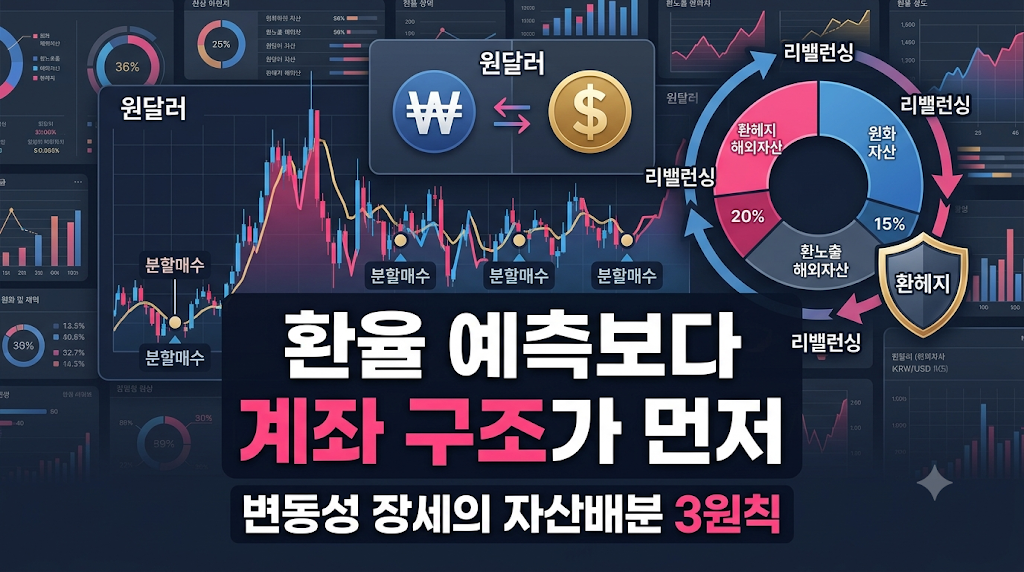
나는 단기 환율의 고점과 저점을 맞히기보다 환노출 자산, 환헤지 자산과 원화 자산이 한쪽으로 과도하게 기울지 않았는지 먼저 살펴본다. 이번 IDEA 분석은 특정 비중을 정답처럼 제시하지 않고, 변동성이 큰 환경에서 확인할 세 가지 원칙을 정리하는 데 목적을 둔다.
[ I ] Issue: 환율보다 먼저 확인할 세 가지 변수
상반기의 급격한 원화 약세와 8월 하순의 원화 강세가 이어지면서 단일 방향 전망보다 환율이 계좌 평가액에 주는 충격을 점검할 필요가 커졌다.
국민연금은 해외투자 전략적 환헤지 비율을 10%에서 15%로 높였다. 환헤지 확대는 선물환 거래를 통해 달러 공급 요인이 될 수 있지만, 실제 집행 규모와 시점에 따라 시장 영향은 달라질 수 있다.
환헤지 비용은 단순 수수료가 아니라 양국 금리차, 선물환 가격, 통화 베이시스, 계약 갱신과 운용비용 등에 따라 달라진다. 상품명에 붙은 H 표시만 보고 실제 비용을 단정하기 어렵다.
[ D ] Detail: 변동성 장세에서 점검할 세 가지 원칙
원칙 1: 환노출을 수익 도구가 아니라 위험 요인으로 본다
환노출 해외자산은 원달러 환율이 상승할 때 원화 평가액이 커질 수 있고, 환율이 하락하면 반대 효과가 나타난다. 글로벌 위험회피 국면에서 달러가 강해질 경우 주가 하락분을 일부 완충할 가능성도 있지만, 달러와 주식이 언제나 반대 방향으로 움직이는 것은 아니다.
수출기업 역시 원화 약세의 수혜를 일률적으로 받지 않는다. 달러 매출 비중뿐 아니라 원재료 수입, 해외 생산비용, 외화부채와 기업의 자체 환헤지 여부가 실적을 함께 결정한다. 디지털 콘텐츠 기업도 해외 서버비와 마케팅비 등 외화비용이 발생할 수 있다.
따라서 나는 환노출을 무조건 유리한 구조로 보지 않고, 원화 약세와 강세에서 계좌가 각각 얼마나 움직이는지를 확인하는 변수로 취급한다.
원칙 2: DCA는 평균단가 인하가 아니라 매수시점 분산이다
정액 분할매수는 일정한 금액을 여러 시점에 나누어 투자하는 방식이다. 가격이 하락하는 과정에서는 평균 매입단가를 낮출 수 있지만, 가격이 계속 오르면 이전보다 높은 가격에 추가 매수하게 된다. 따라서 DCA가 평균단가를 반드시 낮추거나 손실을 막는다고 말할 수는 없다.
그럼에도 분할매수는 한 번의 환전이나 매수 시점에 전체 자금이 노출되는 위험을 줄이는 데 활용할 수 있다. 환율 예측이 어려운 상황에서 매수 시점을 여러 구간으로 나눈다는 점에 의미가 있다.
리밸런싱도 수익을 보장하는 전략은 아니다. 다만 미리 정한 자산배분 범위에서 크게 벗어난 자산을 조정함으로써 특정 통화나 자산에 위험이 집중되는 것을 관리할 수 있다.
원칙 3: 자산 성격과 투자 목적에 맞춰 환헤지를 선택한다
환헤지는 환율 변동을 줄이는 대신 별도의 비용과 추적오차가 발생할 수 있다. 미국 금리가 한국보다 높은 환경에서는 원화 투자자가 달러 노출을 헤지할 때 비용이 발생할 가능성이 있지만, 실제 비용은 정책금리 차이와 정확히 일치하지 않는다.
주식은 환노출, 채권은 환헤지라는 단순 공식도 모든 투자자에게 적용되지 않는다. 투자기간, 향후 원화 사용 계획, 환율 변동 감내 수준, 상품별 헤지 방식과 실부담비용을 함께 확인해야 한다.
본문에서는 이를 IDEA 통화 바구니 프레임워크라고 부른다. 이는 표준 금융용어가 아니라 원화 자산, 환노출 해외자산, 환헤지 해외자산과 대체자산을 각각 다른 역할로 구분해 점검하기 위한 자체 분석 틀이다.
내 판단이 달라지는 경계선
IF / THEN 점검 기준
IF 환율 상승으로 달러 자산의 원화 평가 비중이 목표 범위를 크게 넘어선다면
THEN 환율이 더 오를지 예측하기보다 계좌의 통화 집중도가 과도해졌는지 먼저 확인한다.
IF 일정 기간 안에 원화로 사용할 자금이 해외자산에 묶여 있다면
THEN 환율 변동을 감수할 수 있는지, 환헤지나 현금 확보가 필요한지 따로 검토한다.
IF 환헤지형 상품을 보유하고 있다면
THEN 상품명에 표시된 H뿐 아니라 투자설명서의 헤지 방식, 목표 비율, 총보수, 기타비용과 추적오차를 함께 확인한다.
[ E ] Evaluation: 전략별 장점과 한계를 함께 본다
| 점검 방식 | 기대 역할 | 반드시 함께 볼 한계 |
|---|---|---|
| 환노출 해외주식 | 원화 약세 시 원화 평가액 상승 가능성과 통화 분산 효과 | 원화 강세 시 환차손이 발생할 수 있고 달러가 항상 주가 하락을 상쇄하지는 않는다. |
| 정액 분할매수 | 환전과 매수 시점을 분산해 한 번의 진입 위험을 완화 | 평균단가 하락이나 수익을 보장하지 않으며 상승장에서는 높은 가격에 계속 매수할 수 있다. |
| 정기 리밸런싱 | 특정 통화와 자산으로 위험이 과도하게 집중되는 것을 관리 | 거래비용과 세금이 발생할 수 있으며 강세 자산을 일찍 줄이는 결과가 나타날 수 있다. |
| 환헤지 해외자산 | 원화 기준 환율 변동을 줄이고 기초자산 흐름에 집중 | 헤지 비용, 추적오차와 환율 상승에 따른 이익 포기가 발생할 수 있다. |
| 원화 현금성 자산 | 생활비와 예정된 지출을 위한 유동성 확보 | 물가상승과 기회비용 때문에 장기 실질가치가 낮아질 수 있다. |
반대편에서 보면 환헤지 확대가 항상 정답은 아니다
환율이 높은 수준에서 내려올 것으로 예상하면 환헤지 자산이 편안해 보일 수 있다. 하지만 환율 전망은 자주 달라지고, 원화 약세가 다시 나타나면 환헤지형은 달러 상승에 따른 원화 평가 이익을 얻지 못한다.
반대로 환노출 자산을 오래 보유한다고 해서 항상 유리한 것도 아니다. 투자 종료 시점의 환율이 매수 시점보다 낮다면 기초자산 수익의 일부가 환차손으로 줄어들 수 있다.
결국 환헤지 여부는 환율 전망 하나보다 자금의 사용 통화와 시점, 투자기간, 변동성 감내 수준을 중심으로 판단해야 한다.
핵심 3줄 요약
- 첫째. 2026년 환율은 큰 폭으로 오르내렸으므로 특정 전망 구간보다 계좌의 통화 집중도를 먼저 확인한다.
- 둘째. DCA는 평균단가 인하나 수익 보장 전략이 아니라 환전과 매수 시점을 분산하는 방법이다.
- 셋째. 환헤지 여부는 금리차뿐 아니라 목적, 기간, 비용, 추적오차와 원화 사용 계획까지 함께 판단해야 한다.
[ A ] Action: 오늘 확인할 세 가지
환율 변동성 개인 점검 메모
- 통화별 비중 확인: 원화 자산, 환노출 달러 자산과 환헤지 해외자산이 각각 계좌에서 차지하는 비중을 적어본다.
- 현금 사용 시점 분리: 생활비나 가까운 시일의 원화 지출에 필요한 자금과 장기 투자자금을 같은 방식으로 운용하고 있지 않은지 확인한다.
- 상품의 실제 비용 확인: ETF와 펀드의 투자설명서에서 환헤지 목표 비율, 총보수, 기타비용, 추적오차와 환헤지 방식을 확인한다.
세 가지 시나리오로 다시 보는 계좌
시나리오 A: 원화 강세가 이어지는 경우
환노출 해외자산의 원화 평가액이 기초자산 수익보다 약하게 나타날 수 있다. 이때는 환차손만 보고 성급히 움직이기보다 당초 보유 목적과 투자기간이 달라졌는지 확인한다.
시나리오 B: 환율이 넓은 범위에서 오르내리는 경우
분할매수와 정기적인 비중 점검의 의미가 커질 수 있다. 다만 잦은 거래가 비용을 늘리지 않는지 함께 살펴본다.
시나리오 C: 원화 약세가 다시 강해지는 경우
달러 자산의 원화 평가 비중이 빠르게 커질 수 있다. 환차익을 수익 신호로만 보기보다 전체 계좌가 한 통화에 지나치게 의존하고 있는지 점검한다.
최종 결론: 예측보다 계좌 구조가 먼저다
환율이 급등한 뒤 빠르게 내려온 흐름은 단일 방향 전망에 모든 판단을 맡기는 일이 얼마나 불편한지 보여주었다. 국민연금의 환헤지 확대처럼 외환시장 수급에 영향을 줄 수 있는 재료도 발표 내용과 실제 집행 과정, 현물환시장에 전달되는 경로를 구분해서 봐야 한다.
나는 환노출, 분할매수와 환헤지를 시장을 이기는 공식으로 보지 않는다. 서로 다른 위험을 다루는 도구로 보고, 내 자금의 사용 목적과 기간에 맞는지 점검한다.
결론은 단순하다. 환율의 다음 숫자를 맞히기보다 원화 강세와 약세가 모두 찾아왔을 때 계좌가 감당할 수 있는 구조인지 확인하는 일이 먼저다.
What Should I Review After a Period of Extreme Currency Volatility?
When the won weakened sharply, the won value of dollar assets increased. As the won later strengthened, the same currency effect worked in reverse. Even when the underlying overseas asset did not change, entry timing and currency treatment affected won-based portfolio values.
Instead of predicting the next currency peak or trough, I first check whether unhedged foreign assets, hedged assets and won assets have become excessively concentrated. This IDEA review does not present one allocation as universally correct. It organizes three principles for evaluating currency risk.
[ I ] Issue: Three Variables to Check Before Predicting USD/KRW
Sharp won weakness in the first half and subsequent strengthening in late August increased the importance of understanding portfolio sensitivity rather than relying on a single-direction forecast.
Korea’s National Pension Service increased its strategic foreign-exchange hedge ratio from 10% to 15%. Expanded hedging can create dollar-supply effects through forward transactions, but the market impact depends on the timing and scale of execution.
Currency-hedging costs can reflect interest-rate differences, forward pricing, cross-currency basis, rollover conditions and operating expenses. The H label alone does not reveal the full cost.
[ D ] Detail: Three Principles for a Volatile Currency Market
Principle 1: Treat Currency Exposure as a Risk Factor
Unhedged foreign assets may gain in won terms when USD/KRW rises and lose value when the won strengthens. A stronger dollar can sometimes cushion equity losses during risk-off periods, but currencies and equities do not always move in opposite directions.
Exporters do not benefit equally from won weakness. Foreign-currency revenue, imported materials, overseas operating costs, foreign debt and corporate hedging policies all affect earnings. Digital-content companies can also face dollar-denominated server and marketing costs.
I therefore treat currency exposure as a variable to measure under both won-strength and won-weakness scenarios, not as an automatic source of return.
Principle 2: DCA Diversifies Timing but Does Not Guarantee a Lower Cost
Dollar-cost averaging invests a fixed amount across multiple dates. It can lower the average purchase price during a declining market, but it may also add investments at increasingly higher prices during a sustained rise.
Its practical role is to reduce dependence on one conversion or purchase date. This can be useful when exchange-rate forecasting is unreliable, but it does not guarantee returns or prevent losses.
Rebalancing also does not guarantee excess returns. It can, however, help manage concentration when currency movements cause one asset group to become much larger than intended.
Principle 3: Match Currency Hedging to the Asset and Purpose
Currency hedging reduces exchange-rate exposure but may introduce hedge costs and tracking differences. When U.S. rates exceed Korean rates, hedging dollar exposure into won may involve a cost, although that cost does not necessarily equal the policy-rate gap.
The simple rule that equities should always remain unhedged and bonds should always be hedged does not fit every investor. Investment horizon, future won liabilities, risk tolerance and each product’s hedge methodology should be reviewed together.
This article calls the framework the IDEA Currency Basket. It is an IDEA review framework rather than a standard financial term. It separates won assets, unhedged foreign assets, hedged foreign assets and alternatives by their intended portfolio roles.
Where My View Would Change
IF / THEN Review Rules
IF currency gains push dollar assets far beyond their intended portfolio range,
THEN I first review currency concentration instead of predicting another rise in USD/KRW.
IF money needed in won within a defined period remains invested in foreign assets,
THEN I review whether currency volatility is acceptable or whether liquidity and hedging need attention.
IF I own a currency-hedged product,
THEN I review the hedge target, methodology, total expense, additional costs and tracking difference rather than relying only on the H label.
[ E ] Evaluation: Benefits and Limits
| Approach | Potential Role | Important Limitation |
|---|---|---|
| Unhedged Foreign Equities | Currency diversification and potential won gains during won weakness | Won strengthening can produce currency losses, and dollar gains do not always offset equity declines. |
| Dollar-Cost Averaging | Diversifies conversion and purchase timing | Does not guarantee a lower average cost, downside protection or profit. |
| Periodic Rebalancing | Manages concentration across currencies and asset classes | Can create trading costs, taxes and premature sales of strongly performing assets. |
| Currency-Hedged Assets | Reduces exchange-rate influence on won-based returns | May involve hedge costs, tracking differences and the loss of gains from dollar appreciation. |
| Won Cash-Like Assets | Provides liquidity for living expenses and planned liabilities | Inflation and opportunity costs can reduce long-term real value. |
The Other Side: More Hedging Is Not Always Better
Currency-hedged assets may appear attractive when the won is expected to strengthen. However, currency forecasts frequently change. If won weakness returns, hedged products will not receive the won-based benefit of dollar appreciation.
Unhedged assets are not always superior over long periods either. If USD/KRW is lower at the end of an investment than at purchase, currency losses can reduce the underlying asset return.
The choice should therefore focus on spending currency, investment horizon, liquidity needs and risk tolerance rather than one exchange-rate forecast.
Three-Line Summary
- First. Large currency swings in 2026 make portfolio concentration more important than one forecast range.
- Second. DCA diversifies timing but does not guarantee a lower average cost or a profit.
- Third. Hedging decisions should consider purpose, horizon, cost, tracking difference and future won needs.
[ A ] Action: Three Things I Check Today
Personal Currency-Risk Review
- List currency exposure: Record the proportions of won assets, unhedged dollar assets and currency-hedged foreign assets.
- Separate spending from investing: Check whether money needed for near-term won expenses is being managed like long-term investment capital.
- Review actual product costs: Read the product documents for hedge targets, methodology, total expenses, additional costs and tracking differences.
Three Portfolio Scenarios
Scenario A: Continued Won Strength
Unhedged foreign assets may deliver weaker won-based returns than their underlying assets. I review the original holding purpose and investment horizon before reacting to currency losses.
Scenario B: Continued Two-Way Volatility
Staggered purchases and periodic allocation reviews may become more useful, but excessive transactions can also increase costs.
Scenario C: Renewed Won Weakness
The won value of dollar assets may rise quickly. I treat currency gains as a reason to review concentration rather than as an automatic buy signal.
Final Conclusion: Portfolio Structure Comes Before Prediction
The sharp rise and subsequent decline in USD/KRW demonstrate the limitations of relying on a single currency direction. Market factors such as expanded NPS hedging should also be assessed by separating the policy announcement, actual implementation and transmission channel into the foreign-exchange market.
I do not treat unhedged exposure, DCA or currency hedging as formulas for beating the market. They are different tools for managing different risks.
The conclusion is simple. Before predicting the next exchange-rate number, I first check whether my portfolio can withstand both won strength and won weakness.
출처 및 참고자료 / Sources and References
- 한국은행 경제통계시스템 ECOS: 원달러 환율과 국내 금융시장 지표 확인. Bank of Korea ECOS
- 국민연금 해외투자 환헤지 개선 관련 보도: 전략적 환헤지 비율을 10%에서 15%로 높이고 전술적 환헤지 허용 범위를 포함해 최대 20%까지 환위험을 관리할 수 있다는 내용 참고. 국민연금 전략적 환헤지 확대
- Federal Reserve H.15 Selected Interest Rates: 미국 연방기금금리와 국채금리 등 공식 금리 환경 확인. Federal Reserve H.15
- U.S. Department of the Treasury, Daily Treasury Par Yield Curve Rates: 미국 국채 만기별 공식 금리 참고. https://home.treasury.gov/resource-center/data-chart-center/interest-rates/TextView?field_tdr_date_value=2026&type=daily_treasury_yield_curveU.S. Treasury Daily Rates
- 환헤지 비용은 양국 금리차뿐 아니라 선물환 가격, 통화 베이시스, 계약 기간, 운용비용과 상품 구조의 영향을 받을 수 있다. 실제 비용과 헤지 비율은 각 상품의 투자설명서와 운용보고서에서 확인해야 한다.
- IDEA 통화 바구니는 표준 금융용어가 아니라 통화별 자산 역할을 구분하기 위해 본문에서 정의한 개인적인 점검 프레임워크다.
면책조항 / Disclaimer
This article is a personal market-review note based on publicly available information. Exchange rates, interest rates, currency-hedging costs and investment performance can vary according to market conditions, product structure, contract terms, implementation and timing. References to unhedged exposure, dollar-cost averaging, rebalancing, currency hedging and scenarios are not investment advice, buy or sell recommendations, portfolio-weight recommendations, return guarantees or financial-product recommendations. Investors should review the relevant product documents and make decisions according to their own financial circumstances, investment horizon, liquidity needs and risk tolerance.
[이데아 칼럼] 백악관 옥타곤과 워싱턴 그랑프리: 정치가 쇼가 되는 순간 / [IDEA Column] The White House
백악관 옥타곤과 워싱턴 그랑프리: 정치가 쇼가 되는 순간정치가 늘 진지한 언어로만 움직이는 것은 아니다. 때로 정치는 무대, 조명, 음악, 속도, 격투기, 군용기 비행, 대형 스크린을 통해 더
www.ideas6926.cloud
[이데아 심층 분석] 샤인머스캣의 추락과 다품종 프리미엄의 반격: 한국 포도 산업 생존 로드맵 /
1. 서론: 달콤했던 붐, 그리고 쓰디쓴 조정한때 대한민국 과일 시장에서 고급 포도의 상징처럼 불리던 샤인머스캣. 그러나 최근의 시장 흐름을 보면 그 위상은 예전 같지 않습니다. 재배면적은
www.ideas6926.cloud


