1. 서론: 다가오는 두 개의 거대한 파도와 'IDEA' 프레임워크
오늘은 한국시간 기준 2026년 7월 31일 금요일이다.
최근 코스피 장중 5,262선 붕괴와 양대 시장 서킷브레이커 발동 등 국내 자본시장의 극심한 발작이 이어지는 가운데, 투자자들의 셈법은 더욱 복잡해지고 있다. 2026년 하반기 국내 가상자산 시장은 2027년 1월 1일로 확정된 가상자산 소득 과세와 스테이블코인 규제라는 미완의 뇌관을 동시에 마주하고 있다.
단순히 "세금을 낸다" 혹은 "코인이 퇴출된다"는 1차원적 공포에 휩쓸려서는 안 된다. 확정된 세법이 투자자의 거래 습관을 어떻게 바꿀지, 그리고 아직 열려 있는 스테이블코인 입법 논의가 비트코인 수급과 김치 프리미엄에 어떤 구조적 압력을 가할지가 핵심이다. 오늘 이데아(IDEA)는 I(Issue) - D(Detail) - E(Evaluation) - A(Action) 프레임워크를 통해 정책 설계가 낳을 시장 변동성을 완벽하게 해부한다.
2. [ I ] Issue : 자본시장 불안과 2027 가상자산 규제의 서막
2026년 7월 국내 증시는 반도체 밸류에이션 부담과 레버리지 ETF 쏠림 현상으로 인해 거대한 변동성을 겪었다. 그러나 "증시에서 빠져나온 자금이 무조건 가상자산으로 간다"고 단정할 수는 없다. 과세와 규제 불확실성이 커지는 구간에서 자금은 예금, 달러, 금 등 다양한 피난처로 분산되기 마련이다.
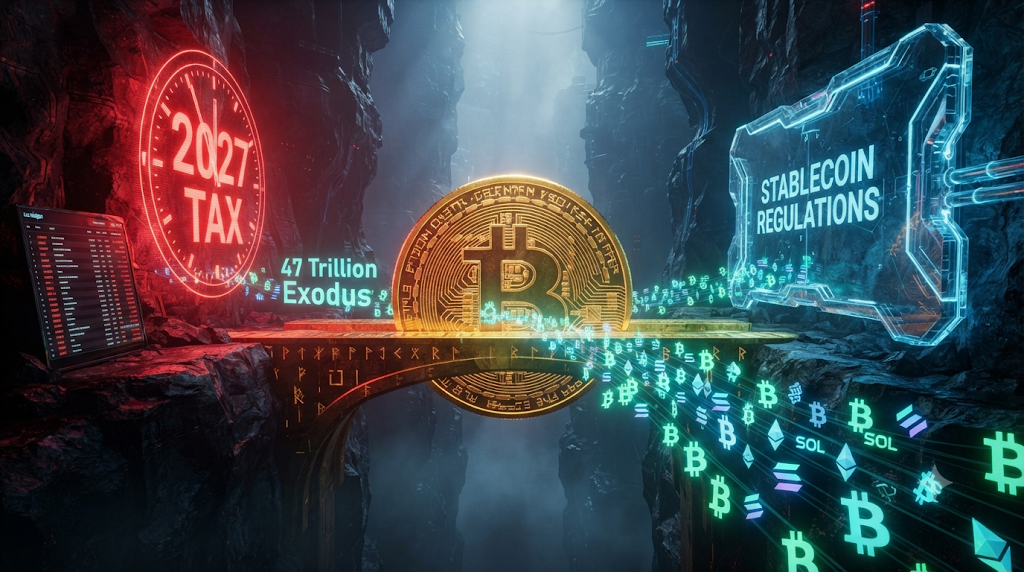
이러한 거시적 불안 속에서, 가상자산 시장 자체는 두 가지 핵심 변수를 맞이하고 있다. 첫째는 2024년 세법 개정 이후 2년 유예되어 2027년 1월 1일 시행이 확정된 기타소득 분리과세이고, 둘째는 47조 원 규모의 해외 자본 이전을 촉발한 스테이블코인 제도화 및 해외 코인 규율 논의다.
- 2027년 가상자산 과세: 1월 1일 이후 양도·대여분부터 연 250만 원 기본공제 후 20%(지방세 포함 22%) 기타소득 분리과세.
- 스테이블코인 법안 논의: 자본금 50억 원 이상, 준비자산 100% 의무화 등 원화 연동 코인 제도화 및 해외 코인 규제 검토 진행 중.
- 온체인 자본 엑소더스: 2026년 상반기 국내 투자자가 해외 거래소 및 개인 지갑으로 이전한 가상자산 규모 약 47조 원 돌파 (단순 탈출이 아닌 규제 밖 수요 이동).
3. [ D ] Detail : 과세 구조의 맹점과 스테이블코인의 입법 현주소
가상자산 시장을 뒤흔들 3대 정책 압력 지수
규제는 단순히 세금을 걷는 것을 넘어 투자자의 행동(Behavior)과 수급 생태계를 완전히 재편한다.
3.1. 과세의 핵심: '의제취득가액'과 '손실 이월공제 불가'
국세청 안내에 따르면 2027년 1월 1일 이전 보유 가상자산의 취득가액은 실제 취득가액과 2026년 12월 31일 시가 중 큰 금액으로 인정된다. 예컨대 4,000만 원에 산 비트코인이 2026년 말 1억 5,000만 원이 된다면, 향후 과세 출발점은 1억 5,000만 원이 된다. 이는 장기 보유자들의 매도 시점을 늦추는 강력한 완충 장치로 작용한다. 또한 현행법상 손실 이월공제가 불가능하므로, 투자자들은 세 부담을 줄이기 위해 단기 트레이딩을 멈추고 장기 보유 및 연말 포지션 정리를 우선시할 것이다.
3.2. 자본 이동의 진실: 47조 원은 왜 해외로 향했는가?
2026년 상반기 해외로 빠져나간 47조 원은 단순한 '세금 탈출'이 아니다. 레버리지 파생상품, RWA(실물자산 토큰화), 스테이블코인 기반 이자 수익 등 국내 제도권에서 차단된 다양한 투자 상품에 대한 수요가 규제 밖 시장으로 이동한 것이다.
3.3. 스테이블코인 규제: '전면 금지'가 아닌 '요건 강화'
원화 스테이블코인은 자본금 50억 원, 100% 준비자산, 백서 제출, 이자 지급 제한 등을 중심으로 깐깐하게 제도화될 전망이다. 반면 해외 발행 스테이블코인(USDT, USDC 등)에 대해서는 국내 유통 요건, 역외 이전 보고 연계 등 규율이 강화될 가능성이 크다. 아직 USDT의 국내 전면 퇴출이 확정된 것은 아니지만, 국가 간 자금 이동의 허들이 높아지는 것은 기정사실화되고 있다.
4. [ E ] Evaluation : 비트코인 수급을 옥죄는 세 가지 시나리오
이러한 규제들이 맞물릴 때, 비트코인 수급과 국내 시장(김치 프리미엄)에는 다음과 같은 연쇄 작용이 일어날 수 있다.
- 공급 축소 압력 (매도 지연): 의제취득가액 조항으로 인해 2026년 말 기준 시가가 높을수록 과세에 유리해지므로, 국내 거래소 내 대규모 매도 유인이 줄어들어 유통 물량 감소가 발생할 수 있다.
- 비트코인의 브릿지(Bridge) 수요 부각: 해외 스테이블코인 전송 규제가 심화되어 이동 비용이 증가하면, 글로벌 유동성이 가장 풍부한 비트코인이 해외 거래소로 자금을 넘기는 대체 전송 수단으로 더 많이 활용될 수 있다.
- 김치 프리미엄 변동성 확대: 자금 이동의 마찰력이 커지면 차익거래가 원활히 작동하지 않아 김치 프리미엄이 쉽게 해소되지 않거나 비정상적으로 확대되는 구간이 발생할 위험이 커진다.
이데아(IDEA)가 전망하는 시장 시나리오
시나리오 A (완만한 정착): 과세 시행 및 스테이블코인 이용자 보호 중심의 규제 안착. 수급 충격은 제한적이며 투자자는 세무 증빙 확보에 주력함.
시나리오 B (해외 코인 통제 강화 - 핵심 경계): 해외 스테이블코인 유통 요건 대폭 강화. 거래소 간 가격 차이(김프)가 확대되고 비트코인이 대체 전송 자산으로 흡수되며 일시적 수급 왜곡 발생.
시나리오 C (규제 불확실성 지속): 입법 지연 및 과세 재논의 발생. 정책 불확실성으로 자금 이동 방향을 잡지 못하는 피로도 누적 구간.
5. [ A ] Action : 2026년 하반기, 투자자가 취해야 할 생존 지침
"비트코인 가격이 확정적으로 폭등할 것인가?"라는 질문은 틀렸다. 지금은 정책 설계에 따라 커질 수 있는 '구조적 변동성'에 대비해야 할 때다.
투자자 핵심 체크포인트 4계명
- 2026년 연말 시가 및 취득가액 정리 완비: 2027년 세금 계산의 출발점이 될 2026년 12월 31일 시가와 본인의 실제 취득가액 데이터를 철저히 확보하고 비교해야 한다.
- 지갑 간 이동 및 거래 내역 증빙: 잦은 단기 매매를 지양하고, 거래소·개인 지갑·해외 플랫폼 간의 자금 이동 시 꼬리표(증빙)를 명확히 남겨 과세 투명성을 입증할 준비를 마쳐야 한다.
- 스테이블코인 입법 과정 모니터링: 자본금 50억, 100% 준비자산 등 원화 코인 규제뿐만 아니라, 해외 발행 코인에 대한 국내 유통·전송 규제 법안 확정 여부를 실시간으로 추적하라.
- 김치 프리미엄 맹신 금지: 김프 확대 구간을 단순한 무위험 차익 기회로 착각해서는 안 된다. 입출금 제한, 세무 부담, 외환 규정 리스크가 얽힌 위험 구간일 가능성이 높다.
6. 최종 결론: 진짜 리스크는 가격이 아니라 '유동성의 고립'이다
2027년 가상자산 과세는 확정된 미래이며, 스테이블코인 규제는 여전히 그 형태가 다듬어지고 있는 현재 진행형이다. 과세는 의제취득가액과 손실 이월 불가라는 제도를 통해 투자자들의 매도 시점을 늦출 것이고, 스테이블코인 규제는 글로벌 자본의 이동 비용(Friction)을 높일 것이다.
이 두 가지가 맞물릴 때 일어나는 현상은 '공급 고갈에 따른 무조건적 비트코인 폭등'이 아니다. 이데아(IDEA)가 보는 가장 큰 리스크는 제도 변화에 따라 국내 유동성이 어디에 갇히고, 어디로 새며, 어떤 자산이 그 좁은 통로를 연결하는 브릿지 역할을 하게 될 것인가 하는 '유동성의 왜곡과 고립'이다. 지금은 막연한 장밋빛 전망 대신, 엄격한 세무 데이터 관리와 입법 모니터링이라는 가장 차갑고 이성적인 방어막을 세워야 할 시점이다.
7. 출처 및 면책조항
- 국세청, 거주자의 가상자산소득 과세 개요: 2027년 양도분 과세, 분리과세, 기본공제, 의제취득가액 등.
- 한국경제, 원화 스테이블코인 및 여야 법안 비교: 자본금 50억 원, 100% 준비자산, 백서 신고, 상환 기한 등.
- 서울경제 영문판: 2026년 상반기 47조 원 규모 해외 가상자산 이전.
- CNBC: 단일종목 레버리지 ETF 개인 순매수 규모 및 변동성 쏠림 분석.
- 국세청 등 세무 자료: 손익통산 구조 및 손실 이월공제 제한 요건.
1. Introduction: Two Approaching Massive Waves and the 'IDEA' Framework
Today is Friday, July 31, 2026 KST.
Amidst extreme seizures in the domestic capital market, including the recent intraday KOSPI breakdown below 5,262 and the activation of circuit breakers in both major markets, investors' calculations are becoming more complex. In the second half of 2026, the domestic virtual asset market faces two simultaneous variables: the confirmed virtual asset income taxation starting January 1, 2027, and the unfinished detonator of stablecoin regulation.
One must not be swept away by one-dimensional fears like "paying taxes" or "coins being expelled." The core issues are how the confirmed tax laws will change investors' trading habits, and what structural pressures the ongoing stablecoin legislative discussions will impose on Bitcoin supply/demand and the Kimchi premium. Today, IDEA perfectly dissects the market volatility born from policy design using the I (Issue) - D (Detail) - E (Evaluation) - A (Action) framework.
2. [ I ] Issue: Capital Market Instability and the Prelude to 2027 Crypto Regulations
In July 2026, the domestic stock market experienced massive volatility due to valuation burdens on semiconductors and herding in leverage ETFs. However, we cannot conclude that "all funds leaving the stock market will unconditionally go into virtual assets." In phases of heightened taxation and regulatory uncertainty, funds naturally diversify into safe havens like deposits, dollars, and gold.
Amidst this macroeconomic instability, the virtual asset market itself is facing two core variables. First is the separate taxation on miscellaneous income, delayed since 2024 and confirmed to be implemented on January 1, 2027. Second is the discussion on institutionalizing stablecoins and regulating foreign coins, which has triggered a massive 47 trillion KRW offshore capital transfer.
- 2027 Virtual Asset Taxation: Separate miscellaneous income tax of 20% (22% with local tax) after an annual basic deduction of 2.5 million KRW on capital gains/lending from Jan 1, 2027.
- Stablecoin Legislation Discussions: Discussions ongoing regarding institutionalizing KRW-pegged coins (mandating 5B KRW capital, 100% reserves) and regulating foreign coins.
- On-chain Capital Exodus: The volume of virtual assets transferred by domestic investors to foreign exchanges and private wallets in H1 2026 exceeded approximately 47 trillion KRW (a movement of demand outside regulations rather than a simple escape).
3. [ D ] Detail: Blind Spots in Tax Structure and the Current State of Stablecoin Legislation
Top 3 Policy Pressure Indices Shaking the Crypto Market
Regulations go beyond simply collecting taxes; they entirely reshape investor behavior and the supply-demand ecosystem.
3.1. The Core of Taxation: 'Deemed Acquisition Cost' and 'No Loss Carryforward'
According to the NTS, the acquisition cost for virtual assets held prior to Jan 1, 2027, will be recognized as the larger of the actual acquisition cost or the market price on Dec 31, 2026. For example, if Bitcoin bought at 40M KRW becomes 150M KRW by the end of 2026, the starting point for future taxation becomes 150M KRW. This acts as a powerful buffer delaying the selling point for long-term holders. Furthermore, since current laws do not allow loss carryforwards, investors will likely halt short-term trading and prioritize long-term holding and year-end position clearing to minimize tax burdens.
3.2. The Truth Behind Capital Movement: Why Did 47 Trillion KRW Go Offshore?
The 47 trillion KRW that flowed overseas in H1 2026 was not a simple 'tax escape'. It represents a movement to unregulated markets due to demand for diverse investment products blocked in the domestic institutional system, such as leveraged derivatives, RWA (Real World Asset) tokenization, and stablecoin-based interest yields.
3.3. Stablecoin Regulation: 'Stricter Requirements', Not a 'Total Ban'
KRW stablecoins are expected to be strictly institutionalized, focusing on 5B KRW capital, 100% reserve assets, whitepaper submissions, and restrictions on interest payments. On the other hand, regulations regarding domestic circulation conditions and offshore transfer reporting for foreign-issued stablecoins (USDT, USDC, etc.) are highly likely to be strengthened. While a total domestic ban on USDT is not yet confirmed, it is a foregone conclusion that hurdles for cross-border capital movement will increase.
4. [ E ] Evaluation: Three Scenarios Squeezing Bitcoin Supply & Demand
When these regulations intertwine, the following chain reactions may occur regarding Bitcoin supply and demand and the domestic market (Kimchi Premium).
- Supply Contraction Pressure (Selling Delay): Due to the deemed acquisition cost clause, a higher market price at the end of 2026 becomes more advantageous for taxes. Thus, the incentive for massive sell-offs within domestic exchanges decreases, which may lead to a reduction in circulating supply.
- Highlighting Bitcoin's Bridge Demand: If foreign stablecoin transfer regulations intensify and transfer costs increase, Bitcoin—with the deepest global liquidity—may be utilized more as an alternative transfer asset to move funds to foreign exchanges.
- Expansion of Kimchi Premium Volatility: As friction in capital movement increases, arbitrage trading will not operate smoothly, raising the risk of phases where the Kimchi premium does not easily dissolve or expands abnormally.
Market Scenarios Forecasted by IDEA
Scenario A (Gradual Settlement): Tax implementation and stablecoin regulations centered on user protection settle down smoothly. Supply/demand shocks are limited, and investors focus on securing tax proofs.
Scenario B (Strict Foreign Coin Control - Core Alert): Drastic strengthening of foreign stablecoin circulation requirements. The price gap between exchanges (Kimchi Premium) widens, Bitcoin is absorbed as an alternative transfer asset, and temporary supply/demand distortions occur.
Scenario C (Persistent Regulatory Uncertainty): Legislative delays and renewed tax debates. A fatigue-accumulating phase where capital cannot set a direction due to policy uncertainty.
5. [ A ] Action: Survival Guidelines for Investors in H2 2026
The question, "Will Bitcoin prices skyrocket definitively?" is flawed. Now is the time to prepare for 'structural volatility' that will amplify depending on policy design.
4 Core Checkpoints for Investors
- Complete Organization of End-of-2026 Market & Acquisition Prices: You must thoroughly secure and compare your actual acquisition cost data with the market price on Dec 31, 2026, which will be the starting point for tax calculations in 2027.
- Proofs for Inter-Wallet Transfers and Trading Histories: Avoid frequent short-term trading, and prepare to prove tax transparency by clearly leaving 'tags' (proofs) when moving funds between exchanges, private wallets, and foreign platforms.
- Monitor the Stablecoin Legislative Process: Track in real-time not only the KRW coin regulations (5B capital, 100% reserves) but also whether regulatory bills on the domestic circulation and transfer of foreign-issued coins are confirmed.
- Do Not Blindly Trust the Kimchi Premium: Do not mistake a phase of premium expansion as a simple risk-free arbitrage opportunity. It is highly likely a danger zone entangled with deposit/withdrawal limits, tax burdens, and FX regulation risks.
6. Final Conclusion: The Real Risk is 'Isolation of Liquidity', Not Price
The 2027 virtual asset taxation is a confirmed future, and stablecoin regulation remains a work in progress. Taxation will delay investors' selling points through the deemed acquisition cost and no loss carryforward systems, while stablecoin regulations will increase the friction cost of global capital movement.
When these two interlock, the resulting phenomenon is not an 'unconditional Bitcoin explosion due to supply exhaustion.' The biggest risk seen by IDEA is 'liquidity distortion and isolation'—where domestic liquidity gets trapped, where it leaks, and what asset serves as the bridge connecting that narrow passage due to institutional changes. Now is the time to build the coldest, most rational defense mechanisms of strict tax data management and legislative monitoring, rather than relying on vague rosy outlooks.
7. Sources and Disclaimer
- National Tax Service, Crypto Income Tax Overview: 2027 capital gains tax, separate taxation, basic deduction, deemed acquisition cost, etc.
- Korea Economic Daily, KRW Stablecoin & Bipartisan Bill Comparison: 5B KRW capital, 100% reserves, whitepaper reporting, redemption deadlines, etc.
- Seoul Economic Daily (English): 47 trillion KRW in offshore crypto transfers in H1 2026.
- CNBC: Single-stock leverage ETF retail net buying volume and volatility herding analysis.
- NTS and Tax Data: P/L netting structure and restrictions on loss carryforward requirements.
[이데아 심층 분석] 2026년 7월 한국 증시 대폭락의 복합 원인과 하반기 자본시장 생존 전략 (IDEA
1. 서론: 숫자로 확인되는 2026년 7월의 충격과 'IDEA' 프레임워크2026년 7월, 한국 증시는 단순한 조정을 넘어 시장 구조의 취약성이 한꺼번에 드러난 기록적인 대폭락 국면을 겪었다. 7월 1일 시가 8,
www.ideas6926.cloud
2026.07.29-[이데아 심층 분석] 시총 711조 괴물의 등장, 중국 CXMT 상장 쇼크와 한국 반도체의 '진짜 위기' (IDEA 분석)
[이데아 심층 분석] 시총 711조 괴물의 등장, 중국 CXMT 상장 쇼크와 한국 반도체의 '진짜 위기' (IDEA
1. 서론: 글로벌 반도체 지형의 지각변동과 생존을 위한 'IDEA' 프레임워크글로벌 반도체 지형을 뒤흔들 거대한 지각변동이 시작되었다. 지난 27일 중국 최대 D램 제조사 창신메모리(CXMT)가 상하이
www.ideas6926.cloud


