1. 서론: 예견되지 않은 위기, 다카이치 내각의 붕괴 시그널과 'IDEA' 프레임워크
지금 우리는 2026년 8월 5일 수요일 아침을 맞이하고 있다.
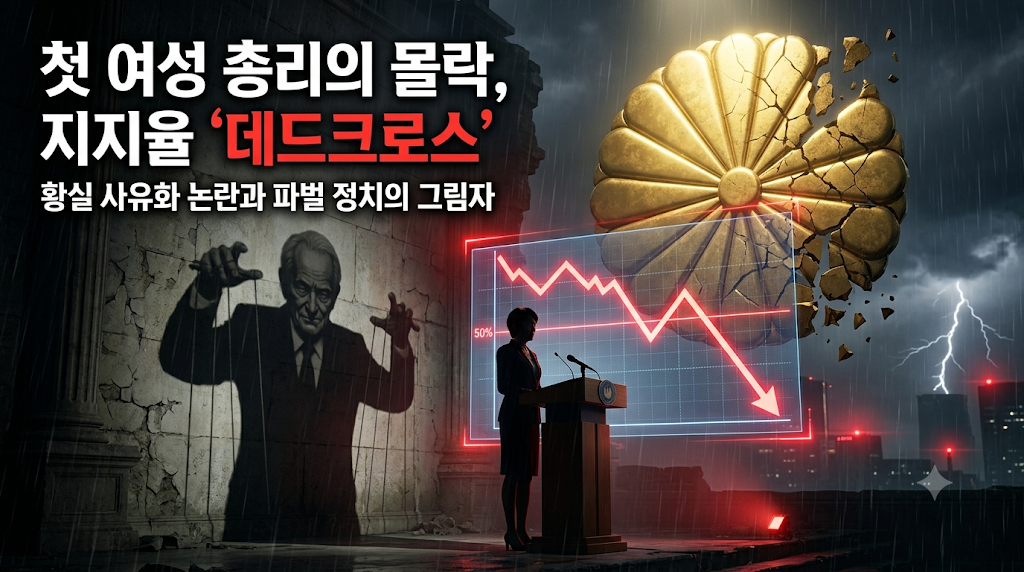
일본 헌정사상 140년 만에 탄생한 첫 여성 총리이자 71%라는 압도적 지지율로 화려하게 출범했던 다카이치 사나에(高市早苗) 내각이 정권 출범 9개월 만에 파멸적인 민심 이반에 직면했다. 한 달 만에 지지율이 최대 12%포인트(p) 폭락하며 50% 선이 붕괴되었고, 비지지율이 지지율을 역전하는 '데드크로스(Dead Cross)'까지 발생했다.
이 전례 없는 폭락의 방아쇠는 1947년 제정 이래 상징천황제의 근간을 처음으로 건드린 '황실전범(皇室典範) 개정안' 강행 처리였다. 그러나 이는 단순한 통계적 하락이 아니다. 일본 사회의 고질적인 파벌 정치, 시대착오적 혈통주의, 그리고 장기화된 고물가로 인한 거시경제적 피로도가 임계점에서 폭발한 체제적 위기다. 오늘 이데아(IDEA)는 다카이치 내각을 뒤흔든 일본 정치 지형의 충돌을 I(Issue) - D(Detail) - E(Evaluation) - A(Action) 프레임워크로 완벽히 해부한다.
2. [ I ] Issue : 6시간 만의 졸속 개정과 데드크로스의 발생
현재 일본 황실은 왕위 계승 자격을 갖춘 남성이 3명, 그중 실질적 후계자는 히사히토 친왕 단 한 명뿐인 심각한 단절 위기에 처해 있다. 이를 해결하기 위해 다카이치 내각은 2026년 7월 17일, 황실전범 개정안을 단 6시간의 질의 및 심의만 거친 채 압도적 의석수로 강행 통과시켰다.
하지만 이 법안은 대다수 국민이 열망하던 '아이코 천황(여성 천황)'의 가능성을 법적으로 완전 차단하고, 일왕과 36촌 밖인 '생판 남(구 황족 남성)'을 양자로 입적시켜 기필코 부계 남자 왕을 세우겠다는 극단적 보수 우익의 아집이었다. 이 독선적 행보 직후 발표된 7월 하순 여론조사에서 다카이치 내각은 철퇴를 맞았다.
- 황실전범 개정 핵심: 여성 천황 배제. '구(舊) 황족 남성'의 양자 입적 허용을 통한 부계 혈통주의 고수.
- 요미우리신문 (7/25~26): 지지율 57% (-12%p 폭락), 비지지 34% (+13%p 폭등).
- 마이니치신문 (7/18~19): 지지율 41% (-10%p), 비지지 44%. 정권 출범 최초 데드크로스 발생.
- 아사히신문 (7/20): 여성 천황 불가(현행 제도 유지)에 대해 "납득할 수 없다" 응답 62%. 황실전범 개정 강행에 "이해 못 함" 60%.
3. [ D ] Detail : 붕괴를 견인한 세 가지 권력의 그림자
다카이치 내각 지지율 폭락의 3대 압력 지수
단순한 정책 실패가 아닌, 막후 실세의 권력욕과 민생 외면이 빚어낸 촌극이다.
3.1. 파벌의 이익과 아소 다로 가문의 황실 사유화 의혹: 황실전범 개정의 흑막에는 다카이치 총리의 킹메이커이자 거대 파벌의 수장인 '아소 다로' 전 총리가 있다. 아소의 여동생인 노부코 왕비가 이번 법안을 통해 구 황족 남성을 양자로 들일 확률이 가장 높으며, 이 양자가 낳은 아들이 천황이 될 수 있다. 대중은 이를 나루히토 직계의 대를 끊고 막후 실세인 아소 가문이 미래 천황을 배출하려는 노골적인 '외척 정치'이자 황실 사유화 시도로 받아들였으며, 이것이 배신감과 뇌관으로 작용했다.
3.2. 살인적 고물가와 4년 연속 실질임금 하락 방관: 4년 연속 실질임금이 줄어들며 국민의 체감 민생은 최악에 달했다. 그러나 다카이치는 식료품 소비세율 인하 등 서민 대책에 소극적이었고, 요미우리 조사에서 고물가 대응 부정 평가는 무려 71%로 치솟았다. 민생이 파탄 난 상황에서 36촌 밖의 양자 입적이나 논하는 중앙 정치는 극도의 절망감을 안겼다.
3.3. 여성 총리가 '여왕'을 막아선 젠더 정치의 아이러니: 헌정 최초의 여성 총리가 여성 천황 등극을 원천 봉쇄했다. 스스로는 권력의 정점에 오르고도 "여성 천황은 전통에 어긋난다"는 그녀의 행보는, 진보 및 여성 유권자들에게 그녀를 그저 가부장적 자민당 파벌 논리를 대변하는 '명예 남성'이자 '기득권 수호자'로 각인시켰다. 이와 대조적으로 같은 시기 4개월 출산휴가를 헌정 최초로 단행한 33세 가와타 교토부 야와타 시장의 행보는 중앙정부의 시대착오성을 더욱 부각시켰다.
4. [ E ] Evaluation : 무당파와 장노년층의 동반 이탈, 그리고 오만의 대가
이번 지지율 폭락의 가장 뼈아픈 대목은 전통적 지지 기반의 붕괴다.
- 무당파층의 완벽한 이탈: 중도 확장을 포기한 결과, 유권자의 39%를 차지하는 무당파층에서 데드크로스가 발생했다 (아사히 조사 기준 지지 36% vs 비지지 42%).
- 장노년층의 실망감: 지지통신 조사에 따르면 자민당의 강력한 기반이던 60대 지지율이 63.7%에서 39.9%로 반토막 났다. 보수층조차 80% 이상이 '아이코 천황'을 지지했으나, 국민적 상식을 배신하고 상징천황제를 파벌의 전리품으로 전락시킨 행태에 분노한 것이다.
- 불통의 오만함: 다카이치 총리는 야당의 재논의 요구를 단칼에 거절하고, 지지율 폭락에 "원인을 모르겠다", "숫자에 일희일비하지 않겠다"며 유권자의 경고를 철저히 묵살하고 있다.
5. [ A ] Action : 시대를 배신한 권력은 무너진다 (이데아의 시선)
민심의 경고를 묵살한 정권의 말로와 민주주의의 의무
- 시대정신과 괴리된 정책의 필패: 국민 84%가 지지한 여성 천황을 배제하고 파벌의 이익을 강행한 것은 대의민주주의에 대한 정면 도전이다. 이념적 아집으로 상식을 거스르는 정권의 수명은 결코 길 수 없다.
- 이중적 리더십의 한계 인식: '첫 여성 총리'라는 타이틀로 포장되었으나, 실질적으로는 가장 수구적인 남성 혈통주의에 복무한 다카이치 총리의 모습은 유권자들에게 '상징'에 속지 말고 '실질적 정책 행보'를 엄격히 감시해야 함을 일깨운다.
- 봉건적 파벌 정치의 완전한 청산 요구: 막후 권력자 한 명(아소 다로)의 입김에 국가 최고 상징의 승계 구도가 6시간 만에 결정되는 일본의 정치 후진성은, 결국 유권자가 선거를 통해 기득권의 사슬을 직접 끊어내야만 해결될 수 있는 과제로 남았다.
6. 최종 결론: 오만으로 빚어낸 붕괴의 서막, 그리고 국민의 응전
2026년 7월 다카이치 내각의 데드크로스는 단일 입법의 실패가 아니라, 일본 보수 정치의 고질적인 파벌주의와 민생 외면이 임계점에서 터져 나온 '체제적 파산 선고'다. 140년 만의 개혁적 상징이었던 첫 여성 총리는 아이러니하게도 가장 낡고 수구적인 혈통 이데올로기의 꼭두각시를 자처하며 대중의 신뢰를 걷어찼다.
50% 저지선이 붕괴되었음에도 "원인을 모르겠다"며 불통으로 일관하는 오만함은 다카이치 정권의 조기 레임덕을 스스로 앞당길 것이다. 국민적 합의 없이 특정 가문의 영속화를 위해 졸속 처리된 황실전범 개정안은 정권이 교체되는 순간 가장 먼저 재검토되어야 할 '미완의 불씨'다. 권력이 시대정신을 배반할 때, 유권자는 투표와 여론이라는 무기로 그 낡은 아집을 철저히 심판해야 한다. 변화를 거부하는 갈라파고스 정치의 결말은 언제나 궤멸적 고립뿐이다.
7. 면책조항
1. Introduction: Unforeseen Crisis, the Collapse Signal of the Takaichi Cabinet, and the 'IDEA' Framework
It is the morning of Wednesday, August 5, 2026 KST.
The cabinet of Sanae Takaichi—Japan's first female prime minister in 140 years of constitutional history, who launched brilliantly with an overwhelming 71% approval rating—faces a devastating revolt of public sentiment merely nine months into its term. In just one month, approval ratings plummeted by up to 12 percentage points, breaking below the 50% threshold, and triggered a 'Dead Cross' where disapproval overtakes approval.
The trigger for this unprecedented plunge was the forced passage of the 'Imperial House Law Revision', which touched the foundation of the symbolic emperor system for the first time since its enactment in 1947. However, this is not a simple statistical drop. It is a systemic crisis where the chronic factional politics of Japanese society, anachronistic bloodline ideologies, and macroeconomic fatigue from prolonged high inflation exploded at a critical tipping point. Today, IDEA perfectly dissects the collision of the Japanese political landscape shaking the Takaichi cabinet using the I (Issue) - D (Detail) - E (Evaluation) - A (Action) framework.
2. [ I ] Issue: Hasty Revision in 6 Hours and the Occurrence of the Dead Cross
The Japanese Imperial Family currently faces a severe crisis of discontinuity, with only 3 males eligible to inherit the throne, and realistically only one successor, Prince Hisahito. To resolve this, on July 17, 2026, the Takaichi cabinet forced the Imperial House Law revision through the Diet with its overwhelming majority after only 6 hours of questioning and deliberation.
However, this bill completely blocked the legal possibility of 'Emperor Aiko' (a female emperor)—which the vast majority of the public fervently desired—and represented extreme conservative stubbornness to secure a patrilineal male emperor by adopting a 'complete stranger' (a former imperial male) who is more than 36 degrees of kinship removed from the current Emperor. Following this dogmatic move, the Takaichi cabinet was struck down by polls released in late July.
- Core of the Imperial House Law Revision: Exclusion of a female emperor. Adherence to patrilineal bloodlines by allowing the adoption of 'former imperial males'.
- Yomiuri Shimbun (July 25-26): Approval 57% (Plunged 12%p), Disapproval 34% (Surged 13%p).
- Mainichi Shimbun (July 18-19): Approval 41% (Down 10%p), Disapproval 44%. First Dead Cross since inauguration.
- Asahi Shimbun (July 20): 62% responded they "cannot accept" the impossibility of a female emperor. 60% "do not understand" the forced revision of the law.
3. [ D ] Detail: The Shadows of Three Powers Driving the Collapse
The Top 3 Pressure Indices of the Takaichi Cabinet's Plunging Approval
Not a simple policy failure, but a farce born from the lust for power of behind-the-scenes strongmen and the neglect of public livelihood.
3.1. Factional Interests and Suspicions of the Aso Family Privatizing the Imperial House: Behind the revision is former PM Taro Aso, the head of a massive faction and Takaichi's kingmaker. Aso's sister, Princess Nobuko, is the most likely to adopt a former imperial male through this bill, and any son born to this adoptee could become emperor. The public perceived this as a blatant attempt at 'maternal relative politics' to cut off Emperor Naruhito's direct line and produce a future emperor from the Aso family, sparking immense feelings of betrayal.
3.2. Lethal Inflation and the Neglect of 4 Consecutive Years of Real Wage Decline: Public suffering peaked as real wages shrank for four consecutive years. Yet, Takaichi was passive on livelihood measures like lowering the food consumption tax. In the Yomiuri poll, negative ratings for the inflation response soared to 71%. Central politics discussing the adoption of a 36th cousin while the public struggled with livelihood felt fundamentally deceptive.
3.3. The Irony of Gender Politics Where a Female PM Blocks a 'Queen': The first female prime minister entirely blocked the ascension of a female emperor. Her stance that "a female emperor goes against tradition," despite having reached the pinnacle of power herself, branded her among progressive and female voters as a mere 'honorary male' defending the patriarchal logic of LDP factions. Conversely, the pioneering 4-month maternity leave taken by 33-year-old Kyoto Yawata Mayor Kawata during this period further highlighted the anachronism of the central government.
4. [ E ] Evaluation: Simultaneous Exodus of Independents and the Elderly, and the Price of Arrogance
The most painful aspect of this approval rating collapse is the crumbling of the traditional support base.
- Complete Exodus of Independents: As a result of abandoning moderate expansion, a Dead Cross occurred among independents, who make up 39% of voters (Asahi poll: 36% approval vs 42% disapproval).
- Disappointment of the Elderly: According to Jiji Press, approval among those in their 60s—a strong LDP base—was halved from 63.7% to 39.9%. Over 80% of even conservatives supported 'Emperor Aiko,' and they were enraged by the behavior of betraying common sense and reducing the symbolic emperor system to a factional spoil.
- The Arrogance of Non-communication: PM Takaichi flatly rejected the opposition's demand for re-discussion, and completely ignored voters' warnings regarding the plunge by stating, "I don't know the cause" and "I won't be swayed by numbers."
5. [ A ] Action: Power That Betrays the Era Will Fall (IDEA's Perspective)
The Demise of a Regime Ignoring Public Warnings and the Duty of Democracy
- The Inevitable Failure of Policies Divorced from the Zeitgeist: Forcing factional interests while excluding a female emperor supported by 84% of the public is a frontal challenge to representative democracy. A regime that defies common sense with ideological stubbornness cannot last long.
- Recognizing the Limits of Duplicitous Leadership: Packaged as the 'first female PM' but practically serving the most reactionary male bloodline ideology, Takaichi reminds voters not to be fooled by 'symbols' and to strictly monitor 'actual policy actions.'
- Demanding the Complete Eradication of Feudal Factional Politics: The political backwardness of Japan, where the succession structure of the nation's highest symbol is decided in 6 hours under the breath of a single behind-the-scenes strongman (Taro Aso), remains a task that voters must ultimately sever through elections.
6. Final Conclusion: The Prelude to Collapse Forged by Arrogance, and the Public's Response
The Dead Cross of the Takaichi cabinet in July 2026 is not the failure of a single piece of legislation, but a 'declaration of systemic bankruptcy' where the chronic factionalism of Japanese conservative politics and the neglect of public livelihood erupted at a critical threshold. The reformative symbol of 140 years, the first female PM, ironically chose to be a puppet of the most outdated, reactionary bloodline ideology, thereby kicking away public trust.
Despite the 50% defense line crumbling, her arrogance of claiming "I don't know the cause" and remaining uncommunicative will only hasten the early lame-duck phase of the Takaichi administration. The hastily processed Imperial House Law revision, enacted without national consensus to perpetuate a specific family's power, is an 'unfinished ember' that must be prioritized for review the moment the regime changes. When power betrays the spirit of the times, voters must thoroughly judge that outdated stubbornness using the weapons of voting and public opinion. The end of Galapagos politics that refuses change is always nothing but devastating isolation.
7. Disclaimer
2026.08.04-[이데아 심층 분석] 2026 '열대화(Global Boiling)'의 공포: 양산 41.6도 폭염 속 드러난 미시 인프라와 기후 불평등
[이데아 심층 분석] 2026 '열대화(Global Boiling)'의 공포: 양산 41.6도 폭염 속 드러난 미시 인프라와
1. 서론: 지구 온난화를 넘어선 ‘열대화’의 감각과 IDEA 프레임워크2026년 여름의 폭염은 더 이상 “덥다”는 말로만 설명하기 어렵다. Copernicus는 2026년 5월 전 지구 평균 표면기온이 15.81℃였고,
www.ideas6926.cloud
2026.08.02-[이데아 심층 분석] BTS의 그래미 보이콧과 영상 삭제 논란: 낡은 문화 권력의 민낯과 흔들리는 권위
[이데아 심층 분석] BTS의 그래미 보이콧과 영상 삭제 논란: 낡은 문화 권력의 민낯과 흔들리는 권
1. 서론: 글로벌 대중음악의 지각 변동과 낡은 권위의 균열최근 글로벌 음악 산업의 헤게모니를 뒤흔드는 중대한 문화 권력의 충돌이 발생했다. 한국의 그룹 방탄소년단(BTS)이 2027년 열릴 제69회
www.ideas6926.cloud


