- 작성 일자: 2026년 1월 21일
- 주요 대상: 해외 수출 및 전시 참여 기업, 유통 전략 담당자
- 핵심 내용: 해외 시장 내 한국 브랜드의 국적 오인 및 왜곡 현상을 지역별로 분석하고, 이에 대한 실질적인 대응 전략을 제시합니다.
1. 지역 및 환경별 현상 분석
전 세계 주요 시장에서 한국 브랜드의 인기가 높아짐에 따라, 이를 악용하거나 오인하게 만드는 현상이 구조적으로 발생하고 있습니다. 각 지역별 특성은 다음과 같습니다.
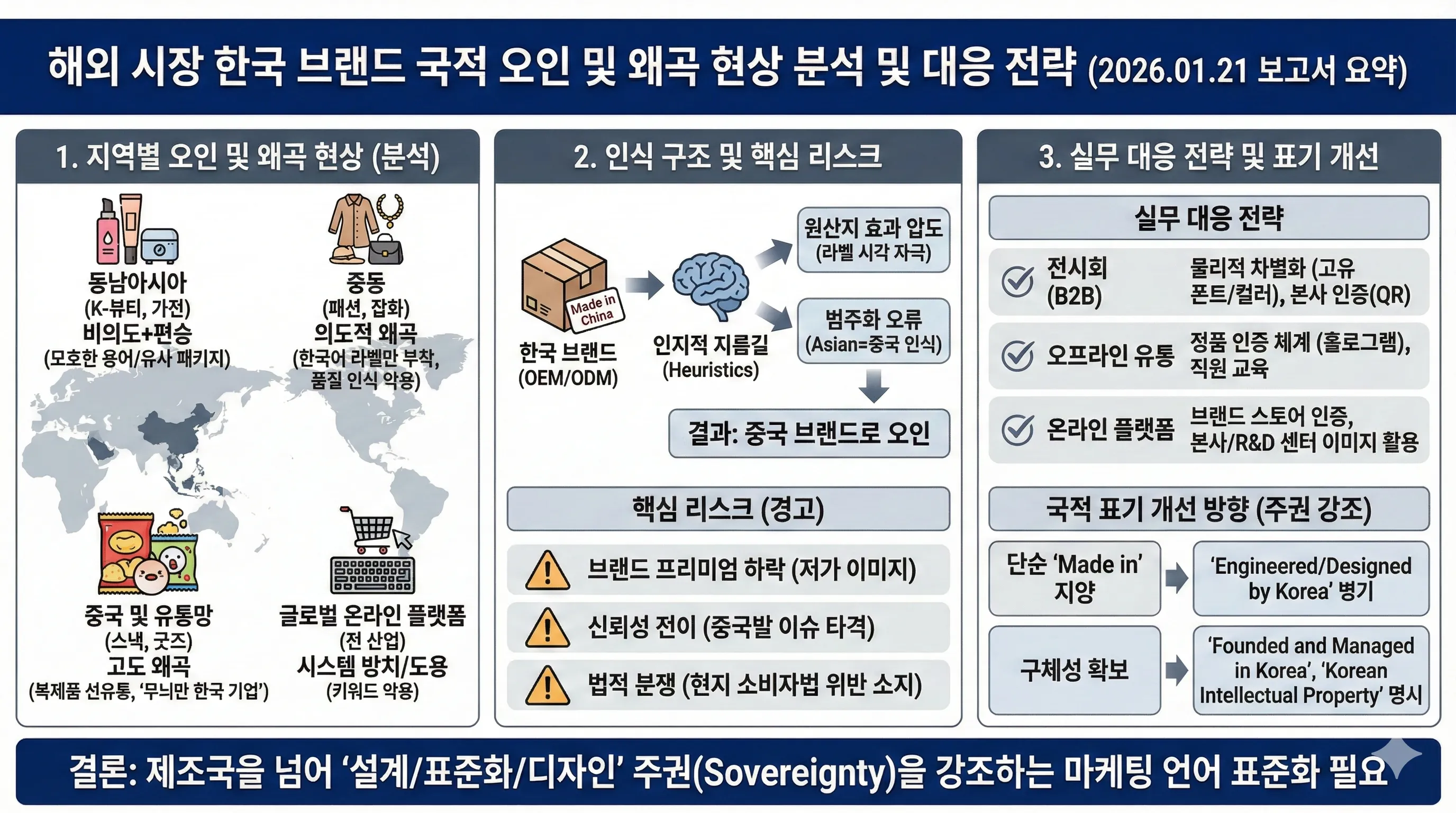
(1) 동남아시아 (베트남, 인도네시아, 태국 등)
- 주요 발생 산업군: K-뷰티(중저가 화장품), 소형 가전, 가공식품.
- 구조적 원인: 현지 소규모 수입업자들이 마케팅 편의를 위해 'Asian Top Quality'라는 모호한 용어를 사용하거나, 한국 브랜드의 디자인 요소를 차용한 중국산 저가 제품을 혼합 유통함.
- 왜곡 판단: 비의도적 오인 + 의도적 편승 혼재. 한국 제품의 인기가 높다 보니 중국산 저가품을 한국산처럼 보이게 유도하는 판매행위가 빈번함.
- 전형적 사례: 베트남 로컬 매장에서 한국 화장품 브랜드 옆에 유사한 한글 패키지의 중국 OEM 제품을 배치하여 소비자가 동일 브랜드군으로 인식하게 유도.
(2) 중동 (사우디아라비아, UAE, 이집트 등)
- 주요 발생 산업군: 패션 잡화, 디지털 액세서리, 주방용품.
- 구조적 원인: 전통적 바자르(Bazaar) 중심 유통에서 'Korean'은 브랜드명이 아닌 '스타일/품질 등급'으로 통용됨. 중국산 제품에 한국어 라벨만 부착하여 유통하는 사례가 많음.
- 왜곡 판단: 의도적 국적 왜곡. 한국산의 고품질 이미지를 도용하기 위해 브랜드의 국적을 명시적으로 속이는 경우가 많음.
- 전형적 사례: 'Made in China' 표기를 최대한 숨기고 한글로 된 브랜드명(예: '미인', '행복' 등 무맥락 한글)을 크게 부착하여 한국 브랜드로 홍보.
(3) 중국 및 중국계 유통망 (미주/유럽 내 차이나타운 포함)
- 주요 발생 산업군: 소스류, 스낵류, 캐릭터 굿즈.
- 구조적 원인: 중국 내 한국 브랜드의 복제품(Copycat)이 먼저 유통된 후, 이들이 중국계 물류망을 타고 전 세계로 확산됨. 'K-Style'이라는 명목하에 중국 자본이 소유한 브랜드가 한국 브랜드인 것처럼 활동.
- 왜곡 판단: 고도로 의도된 국적 왜곡. 한국 법인을 유령으로 설립한 뒤 중국 자본이 운영하는 '무늬만 한국 기업' 형태가 주를 이룸.
- 전형적 사례: 북미 지역 중국계 마트에서 한국 기업의 원조 제품보다 더 세련된 한글 패키지를 가진 중국 기업 소유의 '한국 스타일' 제품이 매대 상단을 점유.
(4) 글로벌 온라인 플랫폼 (Amazon, Shopee, Lazada)
- 주요 발생 산업군: 전 산업군(특히 IT 액세서리, 문구).
- 구조적 원인: 알고리즘 최적화를 위해 판매자가 키워드에 'Korean Brand', 'K-Style'을 무분별하게 사용. 플랫폼의 셀러 검증 시스템이 실제 브랜드 소유권과 국적을 일일이 대조하지 않음.
- 왜곡 판단: 시스템적 방치 및 의도적 왜곡. 검색 노출을 극대화하기 위해 판매자가 의도적으로 국적 키워드를 도용.
- 전형적 사례: 아마존 상세페이지에 제품 소재지는 중국으로 되어 있으나, 이미지와 제목에 'South Korean Tech'라는 문구를 삽입하여 소비자 혼란 야기.
(5) 해외 전시회 (B2B 전문 전시회)
- 주요 발생 산업군: 산업용 부품, 기계 요소, OEM/ODM 제조 서비스.
- 구조적 원인: 국가관(National Pavilion) 외부에서 활동하는 한국 기업들이 예산 문제로 중국 기업 밀집 구역에 부스를 차릴 경우, 바이어들이 공급망의 일부로 인식함.
- 왜곡 판단: 비의도적 오인. 물리적 위치와 클러스터링 효과로 인해 국적이 희석됨.
- 전형적 사례: 독일 가전 전시회에서 한국 중소기업 부스가 대형 중국 제조사 부스 사이에 위치하여 바이어가 해당 기업을 중국 제조사의 하청업체로 오해.
2. '중국 생산 한국 브랜드'의 인식 구조 분석
한국 기업이 원가 절감을 위해 중국에서 생산(OEM/ODM)하는 구조가 소비자에게 '중국 브랜드'로 인식되는 이유는 다음과 같은 인지적 지름길(Heuristics) 때문입니다.
- 원산지 효과(Country of Origin Effect)의 압도: 브랜드 국적보다 제품에 물리적으로 각인된 'Made in China' 라벨이 소비자에게 더 강한 시각적 자극을 줌.
- 카테고리 범주화 오류: 서구권 소비자 상당수는 'Asian Electronics'나 'Asian Beauty'를 하나의 범주로 묶어 인식하며, 가장 점유율이 높은 중국의 이미지로 전체를 수렴시키는 경향이 있음.
- 정보 비대칭성: 소비자는 기업의 지배구조나 R&D 거점을 확인하기보다 판매자의 설명과 물리적 표기에 의존함. 생산지가 중국일 경우, 판매자가 이를 근거로 "중국 브랜드와 다를 바 없다"고 설명하면 이를 반박할 정보가 부족함.
3. 한국 기업의 핵심 리스크 및 대응 전략
[핵심 리스크]
- 브랜드 프리미엄 하락: 저가 이미지의 중국 브랜드와 동일시되어 제값을 받지 못함.
- 신뢰성 전이(Risk Contamination): 중국산 유해 물질 파동 등 이슈 발생 시 한국 브랜드가 함께 타격을 입음.
- 법적 분쟁 리스크: 국적 표기 문제로 인한 현지 소비자 보호법 위반 소지.
[실무 대응 전략]
| 구분 | 대응 전략 및 실행 지침 | 개선 방향 (문구 및 디자인) |
|---|---|---|
| 전시회 (B2B) | - 물리적 차별화: 태극기 로고 대신 'KOREA' 고유 폰트와 국가 브랜드 컬러(청/홍) 적극 활용 - 본사 인증: 부스 내 본사(서울/판교 등) 실시간 연결 QR코드 배치 |
- Designed by [Brand Name] in Seoul - HQ & Engineering: Republic of Korea |
| 오프라인 유통 | - 정품 인증 체계: 홀로그램 스티커 및 원산지/브랜드 국적 분리 표기 - 현지 직원 교육: 매장 직원이 브랜드 스토리를 명확히 설명하도록 가이드북 배포 |
- Authentic Korean Heritage - Manufactured in China under strict Quality Control by [Company Name], Korea |
| 온라인 플랫폼 | - 브랜드 스토어 인증: Amazon Brand Registry 등을 통한 공식 국적 인증 - 이미지 전략: 상세페이지 상단에 한국 본사 전경 또는 R&D 센터 이미지 삽입 |
- Official Korean Global Store - Standardized by Korean Quality Assurance |
[국적 표기 개선 방향]
- 단순 'Made in' 표기의 지양: 원산지 표기법은 준수하되, 브랜드의 주권을 강조하는 표현을 병기함.
- 구체성 확보: 'Korean Style' 대신 'Founded and Managed in Korea', 'Korean Intellectual Property'와 같이 법적, 소유권적 근거를 명시하는 문구로 전환하여 의도적 왜곡 판매자가 도용하기 어렵게 만듦.
- Date: January 21, 2026
- Target Audience: Exporters, Exhibition Participants, Distribution Strategists
- Key Content: Analysis of nationality misunderstanding and distortion of Korean brands in overseas markets by region, and practical countermeasures.
1. Analysis by Region and Environment
As the popularity of Korean brands rises globally, structural issues of misuse and misunderstanding are occurring. Here are the characteristics by region:
(1) Southeast Asia (Vietnam, Indonesia, Thailand, etc.)
- Industries: K-Beauty (Low-mid price), Small Appliances, Processed Foods.
- Causes: Small local importers use vague terms like "Asian Top Quality" or mix low-cost Chinese goods with Korean design elements.
- Distortion: Mix of Unintentional & Intentional. Leveraging K-product popularity to sell Chinese low-end goods.
- Case: Placing Chinese OEM products with similar Hangul packaging next to authentic Korean cosmetics in local stores to confuse consumers.
(2) Middle East (Saudi Arabia, UAE, Egypt, etc.)
- Industries: Fashion, Digital Accessories, Kitchenware.
- Causes: In traditional Bazaars, "Korean" is used as a style/quality grade, not a brand name. Chinese products often carry only Korean labels.
- Distortion: Intentional Distortion. Explicitly deceiving consumers to steal the high-quality image of Korean goods.
- Case: Hiding "Made in China" labels and prominently displaying random Hangul words (e.g., "Beauty", "Happiness") to market as Korean brands.
(3) China & Chinese Networks (Chinatowns in US/EU)
- Industries: Sauces, Snacks, Character Goods.
- Causes: Copycats from China spread globally via Chinese logistics. Chinese-owned brands masquerading as Korean under the guise of "K-Style".
- Distortion: Highly Intentional Distortion. Establishing ghost companies in Korea but operated by Chinese capital (Fake Korean companies).
- Case: Chinese-owned "Korean Style" products with more sophisticated Hangul packaging than originals dominating shelves in North American Chinese marts.
(4) Global Online Platforms (Amazon, Shopee, Lazada)
- Industries: All sectors (esp. IT Accessories, Stationery).
- Causes: Sellers indiscriminately use keywords like "Korean Brand", "K-Style" for algorithm optimization. Platforms lack strict verification of brand ownership vs. nationality.
- Distortion: Systemic Neglect & Intentional Distortion. Sellers stealing nationality keywords for search exposure.
- Case: Amazon product pages stating "China" as the location but using "South Korean Tech" in titles and images to confuse consumers.
(5) Overseas Exhibitions (B2B)
- Industries: Industrial Parts, Machinery, OEM/ODM Services.
- Causes: Budget constraints forcing Korean firms into Chinese zones outside National Pavilions, leading buyers to perceive them as part of the Chinese supply chain.
- Distortion: Unintentional Misunderstanding. Nationality diluted by physical location and clustering effects.
- Case: Korean SME booths located between large Chinese manufacturers at a German appliance fair, leading buyers to mistake them for subcontractors.
2. Perception Structure of "China-Made Korean Brands"
Why Korean brands produced in China (OEM/ODM) are perceived as "Chinese Brands" due to cognitive heuristics:
- Dominance of Country of Origin Effect: The physical "Made in China" label stimulates consumers more visually than the brand's nationality.
- Categorization Error: Western consumers often group "Asian Electronics/Beauty" into one category, converging towards the dominant Chinese image.
- Information Asymmetry: Consumers rely on physical labels and seller descriptions rather than corporate governance or R&D locations. If sellers claim "it's the same as a Chinese brand" based on the manufacturing site, there is little information to refute it.
3. Key Risks and Response Strategies
[Key Risks]
- Premium Erosion: Equated with low-cost Chinese brands, failing to command proper pricing.
- Risk Contamination: Suffering collateral damage from issues like Chinese hazardous material scandals.
- Legal Disputes: Potential violations of local consumer protection laws due to nationality labeling issues.
[Practical Response Strategies]
| Category | Strategy & Guidelines | Improvement Direction (Wording) |
|---|---|---|
| Exhibitions (B2B) | - Physical Differentiation: Use "KOREA" fonts and colors (Red/Blue) instead of flag logos. - HQ Verification: QR codes linking to HQ in Seoul/Pangyo. |
- Designed by [Brand Name] in Seoul - HQ & Engineering: Republic of Korea |
| Offline Retail | - Authenticity System: Holograms and separate labeling for origin vs. brand nationality. - Staff Training: Guidebooks for staff to explain brand stories clearly. |
- Authentic Korean Heritage - Manufactured in China under strict Quality Control by [Company Name], Korea |
| Online Platforms | - Brand Store Verification: Official nationality verification via Amazon Brand Registry, etc. - Image Strategy: Photos of Korean HQ or R&D centers at the top of detail pages. |
- Official Korean Global Store - Standardized by Korean Quality Assurance |
[Nationality Labeling Improvements]
- Avoid Simple 'Made in': Comply with origin laws but append expressions emphasizing brand sovereignty.
- Ensure Specificity: Replace "Korean Style" with "Founded and Managed in Korea" or "Korean Intellectual Property" to state legal ownership, making it harder for distorters to copy.
현무-5 실전 배치와 동북아 안보 지형의 대격변: 전략적 함의 심층 분석 / Hyunmoo-5 Deployment: A Game Ch
Read in English (Click)#현무5 #한국형3축체계 #동북아안보 #미사일전략 #벙커버스터 #KMPR #국방혁신 #비대칭전력 #안보딜레마 #전략사령부오늘의 심층 리포트 요약세계 최대 8톤 탄두를 장착한 현무-5
www.ideas6926.cloud
[시사] 2026년 1월 글로벌 격변 정리: 이란 시위 확산·그린란드 군사 긴장·남아공 홍수 / [Current Aff
#국제정세#이란시위#그린란드병력#남아공홍수#중동긴장 #UN동향#국제관계#세계뉴스#지정학#현대사3줄 요약✔ 이란 전역에서 2025–2026 반정부 시위가 확산하며 국제 사회의 우려가 커지고 있습니
www.ideas6926.cloud


