1. 서론: 바다의 길목이 막혔다, 벼랑 끝에 선 파병의 딜레마
지도를 펼쳐 중동 지역을 보면 이란과 아라비아반도 사이에 좁디좁은 바닷길이 하나 있습니다. 전 세계 원유의 20% 이상이 지나가는 대동맥, 바로 '호르무즈 해협'입니다. 최근 미국·이스라엘과 이란의 군사적 충돌이 격화되면서 이 바닷길이 막힐 위기에 처했습니다.
골치가 아파진 미국은 동맹국인 한국을 향해 "우리 혼자 바다를 지키기 힘드니 한국 해군도 파병해서 배들을 보호해 달라"고 강하게 압박하고 있습니다. 단순히 배 몇 척 보내면 끝날 문제가 아닙니다. 파병을 안 하자니 미국의 청구서(방위비 인상 등)가 두렵고, 파병을 하자니 이란의 무서운 보복(우리나라 배 나포, 해킹 등)이 기다리고 있습니다. 국가의 경제와 안보가 걸린 이 거대한 딜레마를 이데아(IDEA)가 I(Issue) - D(Detail) - E(Evaluation) - A(Action) 프레임워크로 알기 쉽게 해부해 드립니다.
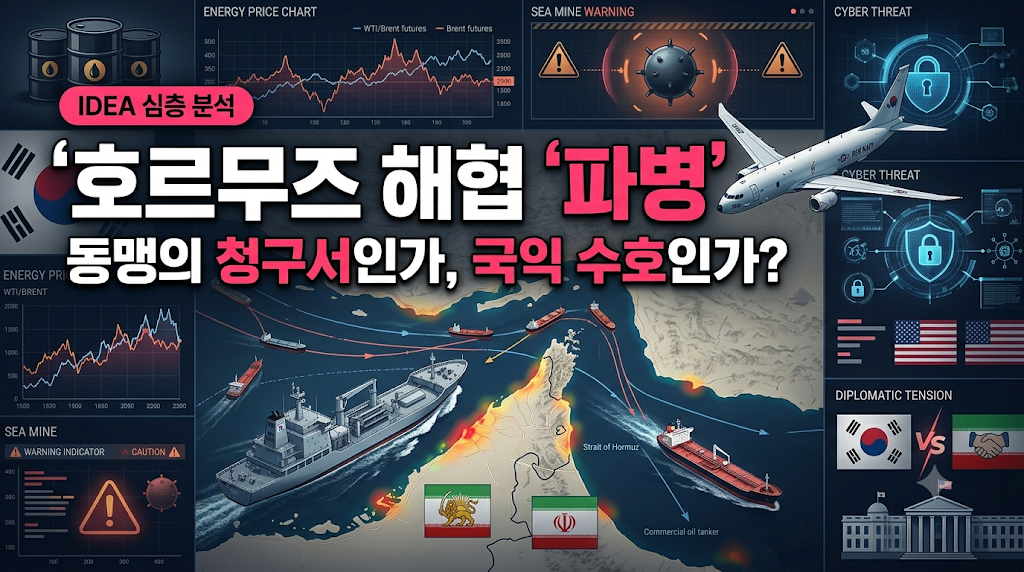
OPS
파견 검토 전력: 해상초계기(P-8A), 군수지원함(소양함), 폭발물처리(EOD) 전력 등 150명 규모
미국의 의도: 동맹국 안보 부담 분담 요구 및 대중국 견제 집중
우리의 딜레마: 미국의 방위비 압박을 방어할 외교적 카드 vs 이란의 선박 나포 등 비대칭 보복 리스크
2. [ I ] Issue : 왜 우리는 호르무즈 파병을 고민해야 하는가?
호르무즈 해협 위기는 단순히 남의 나라 싸움이 아닙니다. 기름 한 방울 나지 않는 대한민국의 경제와 한미동맹의 역학관계가 정면으로 부딪히는 사안입니다.
우리가 쓰는 원유 수입량의 70% 이상, 반도체 핵심 가스인 헬륨의 64.7%(카타르산)가 이 해협을 지납니다. 바닷길이 막히면 당장 기름값이 폭등하고 반도체 공장이 멈춥니다.
미국은 파병을 거부할 경우, 주한미군 유지비나 연합훈련 비용 등을 한국이 더 내라고 압박할(방위비 분담금 인상) 가능성이 큽니다.
과거 이란은 한국 배(MT 한국케미호)를 95일간 나포한 전력이 있습니다. 파병 시 이란이 우리 상선을 또다시 인질로 잡거나 전력망을 해킹하는 비대칭 보복을 가할 수 있습니다.
3. [ D ] Detail : 군사적 효용성과 은밀한 위협의 실체
1) P-8A 초계기와 군수지원함: 우리의 무기는 통할까?
정부가 파견을 검토 중인 최신예 'P-8A 포세이돈' 해상초계기는 시속 900km로 날며 이란의 매복 잠수함이나 기뢰(바다의 지뢰)를 멀리서 탐지할 수 있습니다. 2만 3천 톤급 거대 군수지원함인 '소양함'은 다국적 연합함대에게 바다 위에서 기름과 물자를 대주는 핵심 주유소 역할을 훌륭히 해낼 수 있습니다.
2) 보이지 않는 공포: 기뢰와 폭발물 처리(EOD)의 한계
가장 큰 문제는 이란이 좁은 해협에 몰래 뿌려두는 '기뢰'입니다. 수천 달러짜리 폭탄 하나가 수조 원짜리 군함을 마비시킬 수 있습니다. 미 해군은 무인 드론으로 안전하게 기뢰를 찾지만, 우리는 고무보트나 헬기를 타고 사람이 직접 폭발물을 해체(EOD)해야 하는 위험천만한 작전 환경에 노출될 수 있습니다.
3) 국가 배상 소송을 부르는 '선박 인질 외교'
이란의 혁명수비대는 눈엣가시인 나라의 상선을 나포하는 '인질 외교'의 달인입니다. 과거 나포되었던 선박의 선사가 "정부가 위험을 제대로 안 알려줬다"며 국가를 상대로 소송을 낸 적도 있습니다. 파병으로 이란을 자극했다가 애꿎은 우리 민간 선원들이 납치되는 끔찍한 상황을 막을 철저한 대책이 필요합니다.
4. [ E ] Evaluation : 헌법적 딜레마와 일본의 꼼수
파병을 결정하더라도, 국내 법과 국제법을 통과해야 하는 까다로운 문턱이 존재합니다.
| 파병의 법적 쟁점 | 현실적 문제 및 평가 |
|---|---|
| 국회 동의 필수 여부 (헌법 제60조) | 과거엔 '청해부대 작전 구역 확대'라는 핑계로 국회 패스를 피했지만, 이번엔 새로운 군함을 보내는 성격이 강해 야당의 극심한 반대를 뚫고 국회 비준을 받아야 하는 정치적 험로가 예상됩니다. |
| 일본 자위대의 꼼수 벤치마킹? | 일본은 미국 주도 연합군에 직접 안 들어가고 "우린 단순 정보 수집만 한다"며 국회 패스 없이 파견을 강행했습니다. 우리도 연합군에 완전히 속하지 않고 독자적으로 작전하는 '일본식 우회 모델'을 쓸지 저울질하고 있습니다. |
| 국제법상 '통과통항권' 명분 | "바다의 길목(국제 해협)은 누구나 자유롭게 지나갈 수 있다"는 국제법(UNCLOS)을 명분으로 삼아, "이란을 공격하려는 게 아니라 우리 배를 보호하러 간다"는 방어적 논리를 굳게 세워야 합니다. |
5. [ A ] Action : 국익을 쥐어짜기 위한 3대 외교 지침
파병을 지렛대로 삼는 전략적 Action Plan
- 파병을 청구서 방어용 '협상 카드'로 써라: 단순히 미국의 요구에 고개 숙이고 가는 것이 아니라, "우리가 해군을 보내는 대신 주한미군 방위비 분담금(SMA) 인상 요구를 멈추고, 북핵에 대비한 미국 전략자산을 더 확실히 보내달라"는 연계 협상을 치열하게 물고 늘어져야 합니다.
- 대이란 디커플링(선긋기) 외교망 가동: 이란 측에 핫라인을 통해 "우리는 미국과 손잡고 당신들을 공격하는 게 아니라, 철저히 국제법에 따라 우리 상선을 호위할 뿐"이라는 메시지를 집요하게 전달해 선박 나포나 해킹 같은 보복의 빌미를 주지 말아야 합니다.
- 중동 기름 의존도 체질 개선: 중동 바닷길이 한 번 막힐 때마다 경제가 멈추는 고질병을 고쳐야 합니다. 단기적으로는 사우디·UAE의 내륙 우회 송유관을 적극 활용하고, 장기적으로는 미국이나 호주 등으로 에너지 수입처를 다변화하는 진짜 '공급망 플랜'을 가동해야 합니다.
6. 결론: 한미동맹의 청구서인가, 자주국방의 시험대인가
호르무즈 해협 파병 문제는 단순히 배 몇 척을 중동에 보내고 마는 체스 게임이 아닙니다. 이는 미국이라는 거대한 동맹의 압박과, 삐끗하면 보복을 가할 이란의 칼날, 그리고 피를 말리는 국가 경제의 생존이 얽힌 잔혹한 고차원 방정식입니다.
우리가 파병을 거절하면 한미동맹에 금이 가고 막대한 안보 청구서가 날아올 것입니다. 반대로 섣불리 뛰어들면 이란의 비대칭 보복에 우리 민간인들이 인질로 잡히는 끔찍한 사태를 맞을 수 있습니다.
이 잔인한 딜레마 앞에서 감정적인 찬반 논쟁은 아무런 도움이 되지 않습니다. 철저하게 파병 부대의 안전을 지킬 군사적 대비책을 마련하고, 이를 핑계 삼아 미국의 방위비 압박을 튕겨내는 영악한 외교적 셈법만이 필요할 뿐입니다. 파병의 명분을 '국제 해상로 보호'로 좁히고 이란과의 외교적 끈을 끝까지 놓지 않는 것. 지금 대한민국 정부에게 필요한 것은 맹목적인 동맹 추종이 아니라, 호랑이(미국) 등에 타서도 사자(이란)의 꼬리를 밟지 않는 냉혹하고 정교한 외교적 줄타기입니다.
1. Introduction: The Sea Route is Blocked, The Dilemma of Deployment on the Edge of a Cliff
If you unfold a map and look at the Middle East, there is a very narrow sea passage between Iran and the Arabian Peninsula. It is the major artery where more than 20% of the world's crude oil passes: the 'Strait of Hormuz.' Recently, as military conflicts between the US/Israel and Iran have intensified, this sea route is on the verge of being blocked.
The United States, having a headache over this, is strongly pressuring its ally South Korea, saying, "It's hard for us to guard the sea alone, so please deploy the Korean Navy to protect the ships." This is not a problem that ends simply by sending a few ships. If we don't deploy, we fear the US bill (such as increasing defense cost-sharing); if we do, the terrifying retaliation of Iran (such as seizing our ships or hacking) awaits. IDEA easily dissects this massive dilemma involving national economy and security using the I (Issue) - D (Detail) - E (Evaluation) - A (Action) framework.
OPS
Forces Under Review: Maritime patrol aircraft (P-8A), Fast combat support ship (Soyang), Explosive Ordnance Disposal (EOD) forces, etc., totaling ~150 personnel.
US Intention: Demanding allies share the security burden while focusing on keeping China in check.
Our Dilemma: A diplomatic card to defend against US defense cost pressure vs Asymmetric retaliation risks like Iran seizing civilian ships.
2. [ I ] Issue: Why Must We Ponder Deployment to Hormuz?
The Strait of Hormuz crisis is not simply a fight in someone else's yard. It is an issue where the dynamics of the ROK-US alliance collide head-on with the economy of South Korea, a country that doesn't produce a single drop of oil.
Over 70% of our crude oil imports and 64.7% of Qatar's helium, an essential gas for semiconductors, pass through this strait. If the sea route is blocked, oil prices will skyrocket and semiconductor factories will halt immediately.
If we refuse to deploy, it is highly likely the US will pressure Korea to pay more for maintaining US Forces Korea (USFK) or joint military exercises (increasing the defense cost-sharing burden).
In the past, Iran seized a Korean ship (MT Hankuk Chemi) for 95 days. Upon deployment, Iran might take our merchant ships hostage again or launch asymmetric retaliation like hacking our power grids.
3. [ D ] Detail: Military Effectiveness and the Reality of Hidden Threats
1) P-8A Patrol Aircraft and Support Ships: Will Our Weapons Work?
The state-of-the-art 'P-8A Poseidon' maritime patrol aircraft the government is considering deploying can fly at 900km/h to detect Iran's ambushing submarines or sea mines from afar. The 23,000-ton massive fast combat support ship, 'Soyang', can perfectly serve as a core floating gas station supplying oil and materials to the multinational coalition fleet.
2) The Unseen Fear: Limits of Sea Mines and EOD
The biggest problem is the 'sea mines' Iran secretly lays in the narrow strait. A single bomb costing a few thousand dollars can paralyze a warship worth trillions of won. While the US Navy safely searches for mines with unmanned drones, we might be exposed to dangerous operational environments where humans must manually dismantle explosives (EOD) riding rubber boats or helicopters.
3) 'Ship Hostage Diplomacy' Inviting State Liability Lawsuits
Iran's Islamic Revolutionary Guard Corps is a master of 'hostage diplomacy,' seizing merchant ships of countries that are a thorn in their side. The shipping company of a previously seized vessel even sued the state, claiming, "The government didn't properly warn us of the danger." Thorough measures are needed to prevent the horrific situation where innocent civilian sailors are kidnapped because we provoked Iran with a deployment.
4. [ E ] Evaluation: Constitutional Dilemmas and Japan's Trickery
Even if a deployment is decided, tricky hurdles must be passed in both domestic and international law.
| Legal Issues of Deployment | Realistic Problems & Evaluation |
|---|---|
| Is National Assembly Consent Required? (Constitution Art. 60) | In the past, the government bypassed the National Assembly under the pretext of 'expanding the Cheonghae Unit's operation area', but this time it heavily features sending new warships, expecting a political rough road needing parliamentary ratification breaking through fierce opposition. |
| Benchmarking the Japanese JSDF's Trick? | Japan avoided joining the US-led coalition directly, claiming "We are only collecting information," forcing deployment without parliamentary approval. We are also weighing whether to use a 'Japanese-style bypass model' operating independently without fully joining the coalition. |
| Justification by 'Transit Passage' under International Law | Using international law (UNCLOS) stating "anyone can freely pass through bottlenecks of the sea (international straits)" as justification, we must firmly establish the defensive logic that "We are not going to attack Iran, but to protect our ships." |
5. [ A ] Action: 3 Diplomatic Guidelines to Squeeze Out National Interests
Strategic Action Plan Using Deployment as Leverage
- Use Deployment as a 'Bargaining Card' to Defend Against Bills: Rather than simply bowing to US demands, we must fiercely cling to linked negotiations: "In exchange for sending our Navy, stop demanding increases in the defense cost-sharing (SMA) and guarantee the dispatch of US strategic assets more firmly against North Korean nukes."
- Activate Decoupling Diplomacy (Drawing the Line) with Iran: We must tenaciously convey a message to Iran through hotlines saying, "We are not holding hands with the US to attack you, but merely escorting our merchant ships strictly according to international law," to avoid giving them an excuse for retaliation like ship seizures or hacking.
- Improve the Constitution of Middle East Oil Dependency: We must fix the chronic disease where the economy stops every time the Middle East sea route is blocked. In the short term, actively utilize inland bypass pipelines in Saudi/UAE; long-term, activate a real 'supply chain plan' to diversify energy import sources to the US, Australia, etc.
6. Conclusion: A Bill for the ROK-US Alliance, or a Test of Self-Reliant Defense?
The issue of deployment to the Strait of Hormuz is not simply a chess game of sending a few ships to the Middle East and being done with it. It is a cruel, high-dimensional equation intertwining the pressure of a massive ally like the US, the blade of Iran ready to retaliate at a misstep, and the nerve-wracking survival of the national economy.
If we refuse the deployment, cracks will form in the ROK-US alliance, and massive security bills will fly in. Conversely, if we jump in hastily, we could face a horrific situation where our civilians are taken hostage by Iran's asymmetric retaliation.
In the face of this cruel dilemma, emotional pro-con debates are of no help. What is needed is purely a cunning diplomatic calculus that prepares military countermeasures to thoroughly protect the deployed unit's safety, and uses it as an excuse to bounce back the US pressure on defense costs. Narrowing the justification for deployment to 'protecting international sea routes' and holding on to diplomatic ties with Iran to the end. What the South Korean government needs right now is not blind obedience to the alliance, but a cold-hearted and sophisticated diplomatic tightrope walk where it doesn't step on the lion's (Iran's) tail even while riding on the tiger's (US) back.
[이데아 심층 분석] 티빙 3,954만 계정 정보 유출, 허술한 접속키 관리가 남긴 경고 / [IDEA Deep Dive] T
[이데아 심층 분석] 티빙 3,954만 계정 정보 유출, 허술한 접속키 관리가 남긴 경고티빙 침해사고 조사에서 중복을 포함한 3,954만 계정 정보와 개발 프로젝트 361건의 유출이 확인됐다. 실제 피해
www.ideas6926.cloud
[이데아 심층 분석] 러시아 규제 시행과 파키스탄 등록 기한, 글로벌 암호화폐 규제는 어디로 향
[이데아 심층 분석] 러시아 규제 시행과 파키스탄 등록 기한, 글로벌 암호화폐 규제는 어디로 향할까2026년 9월 초 러시아에서는 새로운 암호화폐 규제체계가 시행됐고, 파키스탄에서는 기존 사
www.ideas6926.cloud


