2025년 세계 경제는 거대한 변곡점 위에 서 있습니다. 지난 40년간 중국 성장의 엔진이었던 '부동산 모델'이 멈춰 섰습니다. 지방정부는 빚더미에 올랐고, 내수는 얼어붙었습니다. 이 위기를 타개하기 위해 중국이 꺼내 든 카드는 바로 '첨단 제조업 밀어내기 수출'입니다.
오늘 리포트에서는 중국 내부의 부동산 위기가 어떻게 전기차(EV)와 배터리라는 '수출 쓰나미'로 변모하여 유라시아 무역 벨트를 뒤흔들고 있는지, 그리고 한국 경제는 이 샌드위치 위기 속에서 어떤 생존 전략을 찾아야 하는지 심층 분석합니다.
- 부동산의 종말: GDP의 25%를 차지하던 부동산 버블 붕괴로 지방정부 부채 위기와 심각한 내수 디플레이션이 발생했습니다.
- 수출로의 탈출: 내수 부진을 만회하기 위해 전기차, 배터리 등 '신3양' 산업의 과잉 생산 물량을 해외로 밀어내고 있습니다.
- 글로벌 무역 전쟁: 1조 달러에 달하는 중국 무역 흑자는 유럽과 미국의 보호무역주의를 자극하며, 한국 제조업에 심각한 위협이 되고 있습니다.
1. 부동산 슈퍼사이클의 종언과 내수 침체
토지 재정의 붕괴와 LGFV 부채
중국 경제 성장의 공식이었던 '지방정부의 땅 장사'가 끝났습니다. 주택 판매와 착공 면적이 정점 대비 60~70% 급감하면서, 지방정부의 숨겨진 지갑인 LGFV(지방정부융자기구)가 60조 위안(약 8조 3천억 달러)에 달하는 빚더미에 앉았습니다.
시진핑 정부는 10조 위안 규모의 부채 스왑을 단행했지만, 이는 급한 불을 끄는 미봉책일 뿐입니다. 부동산 개발이 멈추면서 철강, 시멘트 수요가 증발했고, 이는 글로벌 원자재 가격 하락으로 이어지고 있습니다.
역자산 효과: 지갑을 닫은 중국인들
중국 가계 자산의 70%가 부동산입니다. 집값이 떨어지니 사람들이 돈을 쓰지 않는 '역자산 효과'가 소비를 짓누르고 있습니다. 내수가 죽으니 기업들은 살기 위해 물건을 해외로 돌릴 수밖에 없는 구조가 만들어진 것입니다.
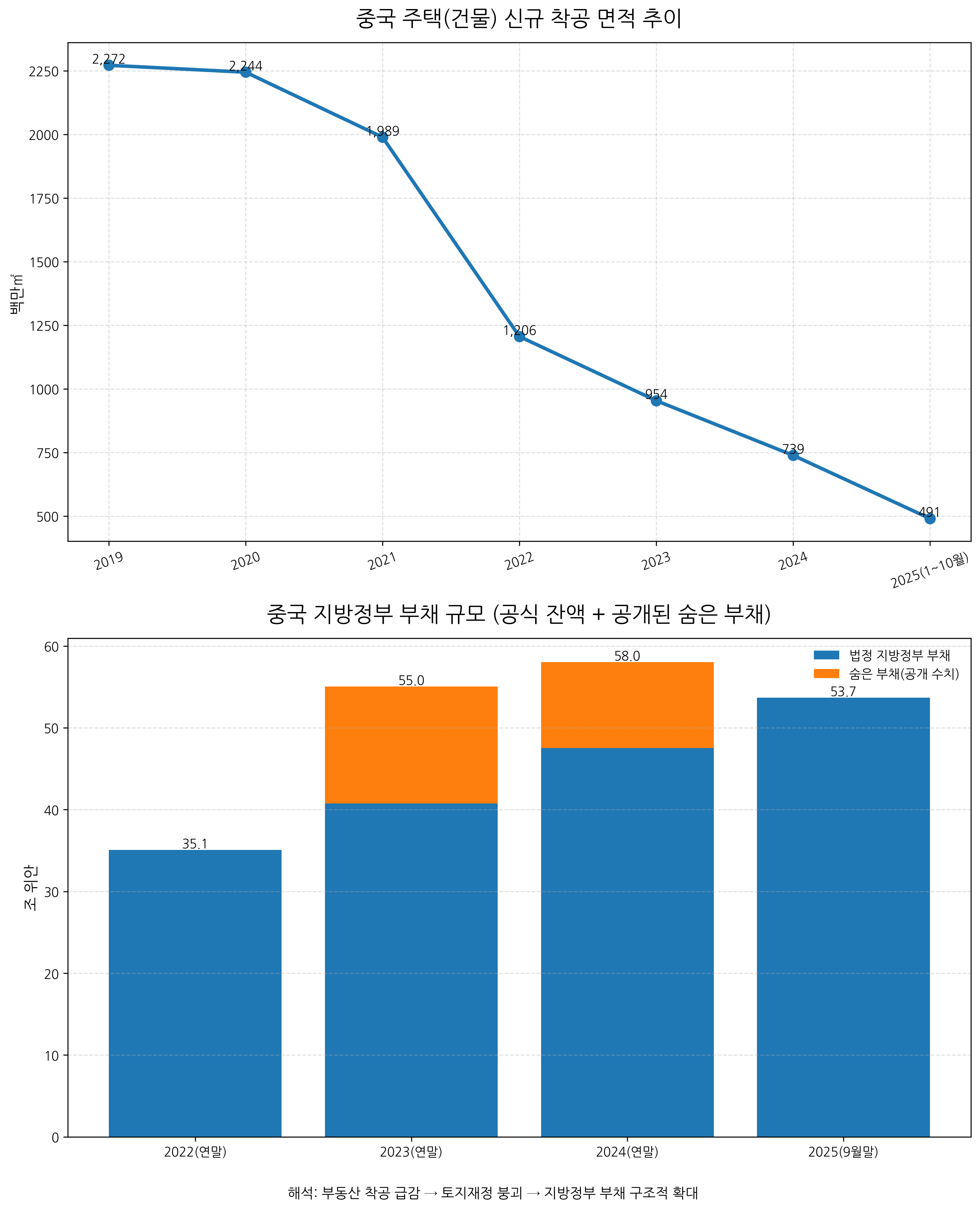
[참고 자료] 중국 주택 착공 면적 추이와 지방정부 부채 규모
2. 자동차 산업의 대전환: 과잉 생산의 수출화
내연기관은 신흥국으로, 전기차는 선진국으로
중국 내 전기차 점유율이 50%를 넘으면서 설 자리를 잃은 내연기관차는 러시아, 멕시코 등으로 헐값에 팔려나갑니다. 반면, 전기차(EV)와 배터리는 유럽을 정조준하고 있습니다.
BYD는 수직 계열화를 통해 서방 기업보다 30% 저렴한 비용으로 전기차를 생산합니다. 2025년 중국의 무역 흑자는 사상 최초로 1조 달러를 돌파할 전망이며, 이는 과거의 저가 공산품이 아닌 자동차와 첨단 기계가 주도하는 '제2의 차이나 쇼크'입니다.
3. 한국 경제와 유라시아에 미치는 충격
유럽의 방어와 아세안의 변심
유럽(EU)은 '클린 산업 딜'과 탄소국경조정제도(CBAM)를 통해 중국산 전기차 막기에 나섰습니다. 반면, 일본 차의 텃밭이었던 아세안 시장은 빠르게 중국 전기차로 넘어가고 있습니다. 태국과 인도네시아에서 일본 브랜드 점유율이 70% 밑으로 떨어졌습니다.
한국의 샌드위치 위기 현실화
한국은 가장 큰 피해국 중 하나입니다. 석유화학, 철강 등 주력 산업은 중국의 자급률 상승과 저가 공세로 3년 연속 대중 무역 적자를 기록하고 있습니다.
더 큰 문제는 반도체입니다. 미국의 제재로 중국 내 삼성/하이닉스 공장의 업그레이드가 막힌 사이, 중국은 레거시(구형) 반도체 시장을 장악하며 공급망의 허리를 쥐고 흔들 준비를 마쳤습니다. 한국은 이제 중국이 따라올 수 없는 AI 반도체 등 초격차 기술에 사활을 걸어야 합니다.
✅ 2026년 이후 전망 및 결론
- 보호무역의 일상화: 값싼 중국산 제품을 막기 위한 전 세계적인 관세 장벽이 높아질 것입니다.
- 공급망의 이원화: 첨단 기술(미국 중심)과 범용 제품(중국 중심)으로 시장이 완전히 쪼개질 것입니다.
- 한국의 생존법: 중국 의존도를 낮추고 인도, 북미로 시장을 다변화하며 기술 초격차를 유지하는 것만이 살길입니다.
The global economy in 2025 stands at a massive inflection point. The 'Real Estate Model,' which powered China's growth for the past 40 years, has ground to a halt. Local governments are buried in debt, and domestic demand is frozen. To break through this crisis, China has played a new card: 'Aggressive Export of Advanced Manufacturing.'
This report provides an in-depth analysis of how China's internal real estate crisis is transforming into an 'export tsunami' of Electric Vehicles (EVs) and batteries, shaking the Eurasian trade belt, and what survival strategies the Korean economy must find amidst this sandwich crisis.
- End of Real Estate: The bursting of the real estate bubble, which accounted for 25% of GDP, has triggered a local government debt crisis and severe domestic deflation.
- Escape via Exports: To offset weak domestic demand, China is pushing excess production of 'New Three' industries like EVs and batteries overseas.
- Global Trade War: China's $1 trillion trade surplus is provoking protectionism in Europe and the US, posing a severe threat to Korean manufacturing.
1. End of the Real Estate Supercycle & Domestic Slump
Collapse of Land Finance and LGFV Debt
The formula for China's economic growth, 'local government land sales,' is over. With housing sales and housing starts plummeting by 60-70% from their peak, LGFVs (Local Government Financing Vehicles), the hidden wallets of local governments, are sitting on a debt pile of 60 trillion yuan (approx. $8.3 trillion).
The Xi Jinping administration implemented a 10 trillion yuan debt swap, but this is merely a stopgap measure. As real estate development halts, demand for steel and cement has evaporated, leading to a decline in global commodity prices.
Negative Wealth Effect: Chinese Wallets Clamped Shut
Real estate makes up 70% of Chinese household assets. Falling home prices are creating a 'negative wealth effect,' suppressing consumption. With domestic demand dead, a structure has been created where companies are forced to divert goods overseas to survive.
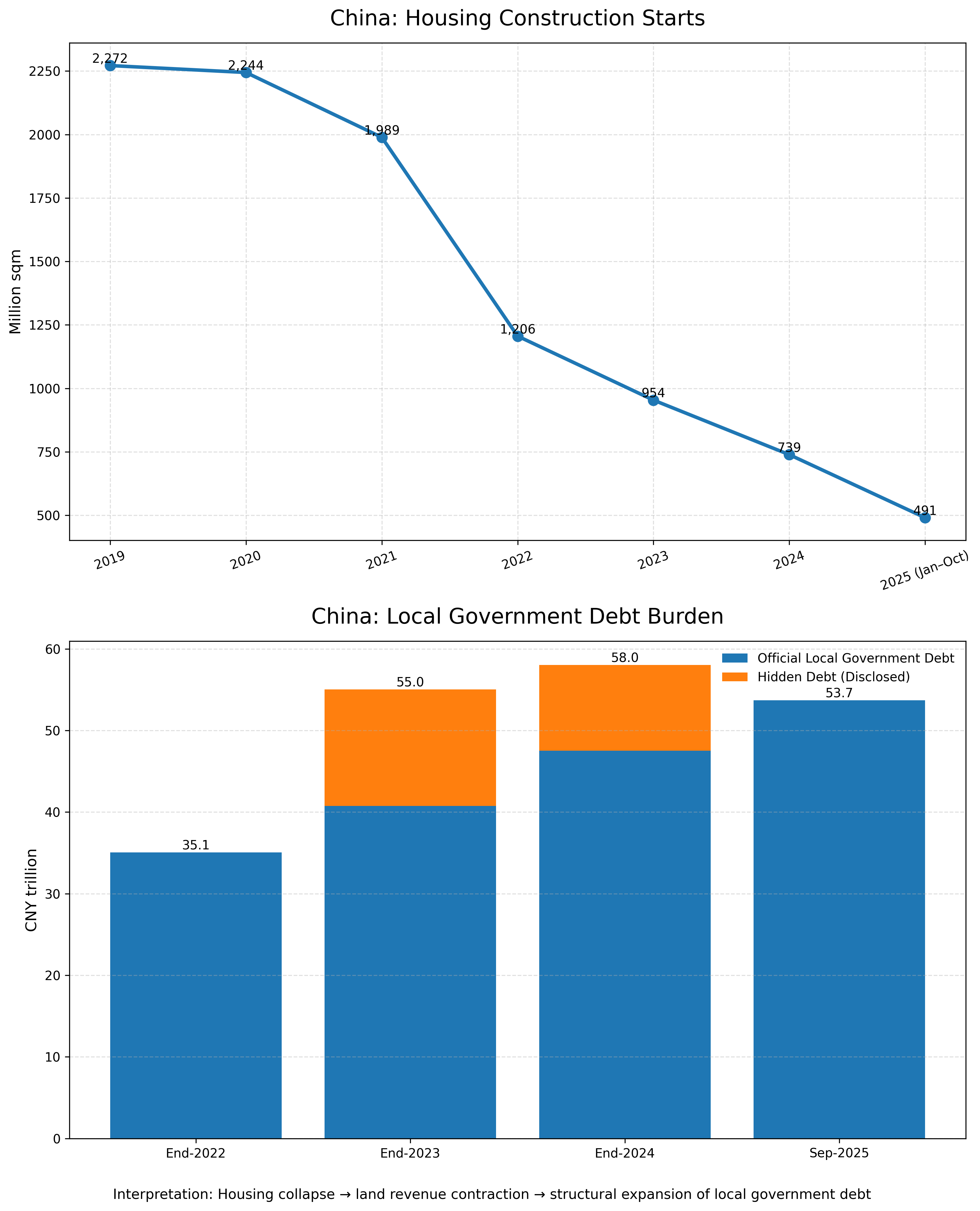
[Reference] Trends in China's housing starts and scale of local government debt
2. The Great Shift in Auto Industry: Exporting Overcapacity
ICE to Emerging Markets, EVs to Advanced Markets
As EV market share in China exceeds 50%, internal combustion engine (ICE) vehicles losing ground are being sold off cheaply to Russia and Mexico. Meanwhile, EVs and batteries are aiming squarely at Europe.
Through vertical integration, BYD produces EVs at costs 30% lower than Western companies. In 2025, China's trade surplus is expected to surpass $1 trillion for the first time, marking a 'Second China Shock' driven by automobiles and advanced machinery, not the cheap consumer goods of the past.
3. Shock to the Korean Economy and Eurasia
Europe's Defense and ASEAN's Change of Heart
Europe (EU) has begun blocking Chinese EVs through the 'Clean Industrial Deal' and CBAM. Conversely, the ASEAN market, once a stronghold for Japanese cars, is rapidly shifting to Chinese EVs. Japanese brand share has fallen below 70% in Thailand and Indonesia.
Korea's Sandwich Crisis Realized
Korea is one of the biggest victims. Key industries like petrochemicals and steel have recorded trade deficits with China for three consecutive years due to China's rising self-sufficiency and low-price offensive.
A bigger problem is semiconductors. While upgrades to Samsung/Hynix factories in China are blocked by US sanctions, China is dominating the legacy (older) chip market, preparing to shake the supply chain. Korea must now bet everything on super-gap technologies like AI semiconductors that China cannot replicate.
✅ Outlook for 2026 & Conclusion
- Normalization of Protectionism: Tariff barriers worldwide will rise to block cheap Chinese goods.
- Dual Supply Chains: The market will completely split into advanced tech (US-centric) and general products (China-centric).
- Korea's Survival Strategy: Reducing dependence on China, diversifying markets to India and North America, and maintaining technological superiority are the only ways to survive.
[KGGB] 한국형 GPS 유도폭탄 심층 분석: 2025년 첫 실전 데뷔와 기술력 (LIG Nex1) / KGGB Deep Dive: Korea's Sma
안녕하세요, 군사 기술 애호가 여러분! 오늘은 한국이 자랑스럽게 개발한 첨단 무기 시스템인 KGGB(Korean GPS Guided Bomb)에 대해 깊이 파헤쳐 보겠습니다. KGGB는 기존의 일반 폭탄을 정밀 타격 무기로
www.ideas6926.cloud
[심층 분석] 2025 태국-캄보디아 전쟁: 100년의 원한과 에너지 전쟁의 서막 (푸난 테초 운하의 나비
[심층 리포트] 2025년 태국-캄보디아 전쟁 분석 (2025.12.10) 2025년 12월, 동남아시아의 평화가 흔들리고 있습니다. 태국과 캄보디아 간의 오래된 국경 분쟁이 육상과 해상을 아우르는 전면전 양상으
www.ideas6926.cloud


